The Island of Missing Trees, by Elif Shafak

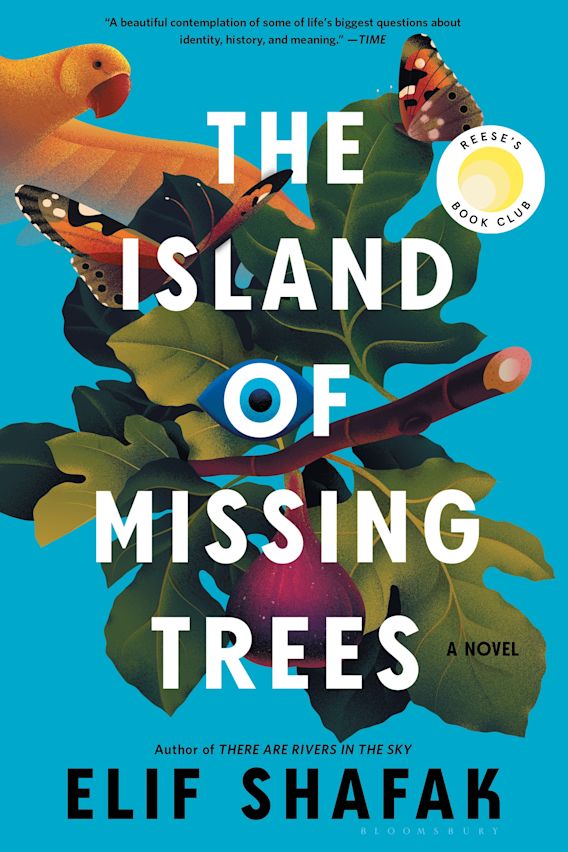
Teenaged Ada, whose name means “island” in Turkish, feels isolated living with her father Kostas in 2010s England. Her parents emigrated from Cyprus before she was born, first Kostas and later Defne, who has died before the story begins. In a powerful scene at the beginning of the book, Ada is called upon in the classroom but, frustrated at being misunderstood by her teacher and classmates, she begins to scream and cannot stop.

If she could only learn about her past, especially her parents’ lives on Cyprus and their reasons for leaving, she might at least be able to feel a connection to the past. A second timeline in the story takes us to that past: the 1970s when Cyprus ison the cusp of the violence that will erupt between the Greek and Turkish populations and cause the partition of the island, with a Turkish state in the north (recognised only by Turkey) and a Greek state in the south. Since Kostas is Greek and Defne Turkish, their romance must be kept secret.

A third and surprisingly substantial storyline is narrated by a fig tree in Kostas’s garden. It’s less of a story, though, than a tranche of information.

Most members of my book club loved the book. Indeed Shafak’s prose is often lovely, and if you don’t know anything about the history and culture of Cyprus, you can immerse yourself in luscious details about food, customs and proverbs—fruit bats, butterflies, all kinds of information—before shuddering at the terrible violence.

Others found it uneven and struggled to stay engaged. The time-shifting got in the way for a couple of us. The story sometimes stayed too long with one timeline, so that we had trouble reconnecting when it finally moved to the other. Some complained that the fig tree’s orations were long-winded and didactic, perhaps partly because much of the information overlapped with The Overstory by Richard Powers.

I found this an ambitious novel and respect Shafak for taking on so many themes and elements. We get Cypriot history, online shaming, prejudice against gay couples, the first- and second-generation immigrant experience, global warming, mental health issues, parenting, bullying, generational trauma and more.

I love the premise of two Cypriot teenagers with a forbidden love who choose to cut their daughter off from the past. However, I struggled with the execution. Overwhelmed by so much content, what suffers are plot and character development. My book club noticed that the scream—so memorable!—is never referred to again after those first few pages and wished the author had done more with it. Other bits are mentioned and then dropped. I had trouble following the plot in both the present and the past timelines. The characters, too, are barely developed. I wanted to know Ada better and Kostas and Defne.

As editor Peter Gelfan recently wrote in Jane Friedman’s blog,

Over the millennia and across just about every culture, a plot-like structure is how stories seem to work. If you have a good reason to depart from it, you better also have something else to take up the slack in reader engagement . . .

A story’s premise is the what-if seed that spawns the whole project . . . Sometimes an author gets so excited by his premise that instead of turning it into a plot, he simply takes the reader on a guided tour as the premise plays out. He might bring in a character, or a series of them, whose dialogue explains what’s going on. Other writers conduct their tours through promiscuously multiple points of view, zipping readers as if on a magic carpet from one site to the next.

I did feel as though I were on a magic carpet being zipped around. Some reviewers call the book enchanting and magical and I can see why. Plus I’m often drawn to books with experimental structures. Maybe if I reread this one with different expectations, I will end up loving it as much as the majority of my book club.

If a novel has gotten tons of praise and positive reviews, does that affect your expectations for the book?

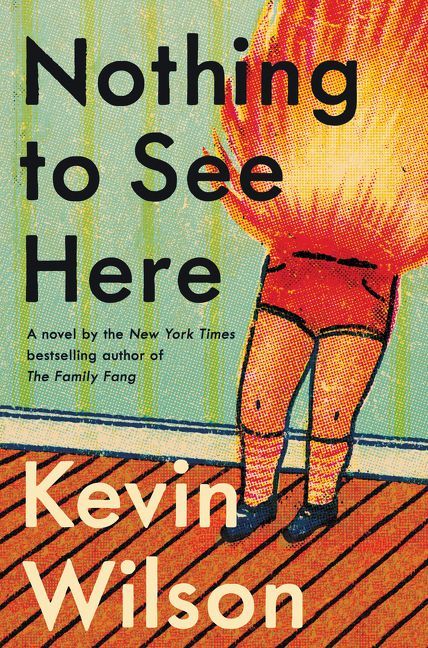
Nothing to See Here, by Kevin Wilson

The cover gives the twist away. At least that’s what I thought before deciding with a sigh that I would actually read this story one of my book clubs chose. However, Lillian’s voice pulled me right in, and I raced right through to the end.

At twenty-eight Lillian is living in her mother’s attic, smoking pot and working dead-end jobs. Long ago she’d hoped to escape from this life by earning a scholarship to an exclusive prep school where she became besties with her roommate Madison, a spoiled rich girl. When Madison gets caught in a scandal, Lillian ends up taking the fall and basically gives up on life.

Now Madison needs her again and Lillian can’t help responding to the call. “I tried to think of a time when I hadn’t done what Madison had asked me to do. That time did not exist.”

Married to a senator with presidential ambitions, Madison needs to figure out how to handle the sudden imposition of the Senator’s twins from a previous marriage who are coming to live with them. She hires Lillian—the one person she can trust to keep a secret—to care for them. They are to be hidden away in a guesthouse while Madison finds a way to keep the twins permanently out of sight.

Why? Because Bessie and Roland burst into flames when they are angry or upset.

They are not harmed, though their clothes and everything else around them burn. Lillian doubts her ability to care for any child, much less these two. Her own mother is no role model, gambling away whatever money she can lay her hands on. Plus, as Lillian is the first to tell us, failure is her middle name.

So instead of wanting more, sometimes I just made myself want even less. Sometimes I made myself believe that I wanted nothing, not even food or air. And if I wanted nothing, I’d just turn into a ghost. And that would be the end of it.

The real twist in the story is how Lillian in her own weird way confronts the bizarre challenge of caring for these stubborn, angry and fiery children while shut away in secrecy.

I appreciate stories like this one where every aspect is completely realistic except for one magical element. Magical? Impossible? Anyone who has had to deal with a young child who has BIG FEELINGS might be forgiven for thinking the author is only slightly exaggerating.

Wilson brings so much humor and real insight to the story without shading into sentimentality. Even the rare tender moment is earned by all that has come before.

Some might feel that Madison, the Senator, and Lillian’s mother are flat or predictable. In my long life, I’ve lived among the very rich and among the very poor, and all three characters struck me as true to life. I’ve known so many people like them. It’s a challenge for a writer, though, to depict people who insist on acting like the worst caricatures of themselves.

What first registered for me in this story are the social barriers for anyone who is different. It’s not just senators who try to project an image of a perfect family, hiding away their rebellious or inconvenient children and relatives. You don’t have to spontaneously combust; it’s enough to be just slightly different for people to shy away from you or hysterically call for protection. In my small town quite a few people are screaming about a crime wave, but a question quickly finds that they are talking about panhandlers, none of whom have actually been violent or threatening in any way, just different. Panhandling, of course, is not a crime.

Then I came to believe that Wilson’s story—fun as it is to read—can be seen as being about power: what sort of power each character possesses, whether they know it or not, and how they use it.

Yet in the end, it is Lillian who lingers in my mind weeks after finishing the book, what she finds in the children and in herself. Her mother also stays with me, someone who, for all her faults, always allows her daughter to come home.

Can you recommend another novel that is both fun and thought-provoking?

The Secret Staircase, by Jill Barklem

The children in my life love this story, part of the Brambly Hedge series. They are fascinated by the idea of a hidden stair and rooms that have long been locked up. Who isn’t? Surely I wasn’t the only child who went around tapping on walls and measuring the inside and outside of houses, hoping to find a secret passage or cobweb-laden room that no one remembered was there.

In this story, young Wilfred arrives at the Old Oak Palace along with Mr. Apple and the other children to prepare for that night’s big midwinter’s eve celebration. Lord Woodmouse and his daughter Primrose welcome them, and the two children go off to find costumes and to practice the poem they are to recite.

With all the bustling preparations Wilfred and Primrose have trouble finding a quiet place to practice until they enter a crowded storeroom at the end of a passage. However, they get distracted by all the things around them. Primrose explores a dresser and finds a small key in a drawer. Wilfred pulls at a green curtain that reveals a locked door hidden behind it. To their delight, Primrose’s key opens it.

Thus begins their adventure, all the more beguiling because of Barklem’s illustration of a secret stairway within the huge oak tree.

Why are we so drawn to hidden passages, mysterious rooms, and secret gardens? Though I was a practical child, I liked to imagine there was more to the world than the bare bones I could see, hear and touch. It could be a legend, a family story, or a bit of history about a place. It could even be the possibility that a dense forsythia bush hid a unicorn.

J.R.R. Tolkien wrote about adding what he called shimmer to his stories. He said that creating histories and legends around ordinary objects made them more real by adding the dimension of time—hence all his references in The Hobbit and Lord of the Rings to certain legends and songs. Sketching in those shimmering ghosts of the past can deepen the texture of the world in any story.

I’ve always been fascinated by houses anyway. My walk to and from school took me past a variety of houses large and small. I’d try to guess the layout of the bedrooms from what I could see of the windows and decide which room I would want to have. I used one of my favorites as the cover for my poetry collection Terrarium.

Gaston Bachelard in The Poetics of Space says:

. . . if the house is a bit elaborate, if It has a cellar and a garret, nooks and corridors, our memories have refuges that are all the more clearly delineated. All our lives we come back to them in our daydreams . . . In its countless alveoli space contains compressed time. That is what space is for.

Another reason to search for these hidden spaces is the thrill of entering a place where no one has been for years and years. Or perhaps ever: my brother, a lifelong caver, was part of the first team to explore Lechuguilla when it was discovered in New Mexico. He described for me that feeling of being the first person ever to step into a particular chamber.

While that’s not something I’ll probably ever experience, I like the idea of including a little bit of mystery in stories by the discovery of some hidden place. Adding shimmer to the place by giving it a history or legend would deepen its appeal. Perhaps readers would add their own shimmer as they remember being young and looking for a disguised door that might hide a secret staircase.

Did you ever search for hidden passages or secret spaces when you were young?

Parnassus on Wheels, by Christopher Morley

When I was in Madrid in the 1990s, walking the streets in the evening, I glanced down a short, dead-end alley and was astonished by what I saw. Earlier in the day I’d visited the book stalls lining the Cuesta de Moyano, a small pedestrian street by El Retiro Park, and thought myself in heaven. So many books! So many book lovers!

Now, though, in that dim alley, I saw a young man grasp the bottom of a wooden board hanging on the stone wall and lift it to reveal shelves of  books. He propped the board up to be an awning and was ready for business.

Not only was I charmed by this unexpected bookshop and wished I could change places with him—what a life that would be!—but I was also reminded of a story I’d read twenty-some years earlier. In it a man had made a horse-drawn wagon, something like a Romany vardo, with sides that opened to reveal shelves of books. He traveled about the countryside selling books to farmers and townsfolk and “evangelizing” about the delights of reading.

Published in 1917, Morley’s novella is about Helen, a former governess who cooks and keeps house for her bachelor brother Andrew on their farm. Ever since Andrew started writing books and unexpectedly became famous, she’s become disenchanted with her life, left alone on the farm while he travels about giving readings and looking for inspiration.

Then one day Roger Mifflin drives his traveling bookshop into their farmyard. A short, balding man with a red beard, he has a gift for holding forth on the wonders of books and life on the road. However, he’s now decided to retire and sell his creation, and he thinks Andrew is just the person to take his place.

So does Helen. Foreseeing many more months of being left to tend the farm alone, she takes the remarkable step of buying the Traveling Parnassus herself. Though only 39 and a self-described “fat old woman,” she’s inspired to kick over the traces and set out on a bookselling trip herself.

They decide that she’ll drive Roger to the train station which will take a few days, and along the way he’ll tutor her in the business. As she and Roger travel the New England country roads, adventures ensue.

It’s been more than fifty years since I first read this delightful, old-fashioned story. I’d forgotten the details of those adventures, but I’ve never forgotten Roger’s joyous literary orations or the Traveling Parnassus itself. I’ve never forgotten my dream of a life surrounded by books and sharing them with others.

If you’re looking for something that reminds you of the joy that life holds, The Parnassus on Wheels is a great place to start.

Have you reread a book from your youth and found it better than ever? Did it change your life?

Time of the Child, by Niall Williams

Williams returns to the fictional Irish village of Faha, where a lone doctor, Jack Troy, sees to the medical needs of those who live there. A widower, two of his daughters have married and gone, while 29-year-old Ronnie keeps house for him. Every day seems much like the last, although it being December (1962), some of the usual seasonal shenanigans are afoot. His patients even seem to have inherited the ills that plagued their parents, as attested to by the notes left by Jack’s father, the previous doctor.

Jack often pulls out his father’s sayings, like smooth stones he keeps in his pockets. “The sick are ourselves . .. When you stop understanding that, take your name off the wall and throw your bag in the river.” Yet Jack holds himself aloof from others, maybe because of his position and his sorrows or perhaps just the weight of all the secrets his patients confide in him.

I loved Williams’s earlier book This Is Happiness. The man can write about the big emotions without sentimentality. He treats all his obstreperous characters with gentle humor and tenderness and respect. There are some outsized characters here for sure, but he never invites us to laugh at them, just to appreciate them for themselves. I love this description of Ronnie:

Like the triangle that has one leg longer than the other, Ronnie had an asymmetrical relation with Faha. She was and was not part of the community, known by everyone, but kept at that distance that had too many causes, but was condensed into the phrase, the doctor’s eldest. And, because she was the one who opened the door to patients in the morning, the one who wrote their names in the book, helped those who needed help getting to chairs in the waiting room, help rising from them, and getting down the creaking hall into the riverward room of the surgery, she shared the perspective of those statues prayed to across the penny candles: she knew the parish through its illnesses. She was also the only person in the parish you could tell your complaint and not hear that she had that too or was suffering from worse.

As you can see, his writing is extraordinary: tangled sentences that somehow always make sense and capture the peculiar voice—syntax and sayings—of the residents of Faha. And that last sentence!

Although there are brief references to it, starting with the title, the promised child doesn’t appear until almost the halfway mark. Some may complain about that, but I say: Who cares about standard story structure when there is so much entertaining wordplay and so many wild events to enjoy, such as rebellious cattle being driven to a market that itself mixes chaos with kindness? I also didn’t mind the slow pace because every page is so rich with music and humor and heart.

This book is a treasure. I was almost afraid to read it, fearing it couldn’t possibly be as good as Happiness. It’s better: a genuinely moving story about what we are and can be to each other.

What novel have you read about what ties a community together or tears it apart?

The Quiet Librarian, by Allen Eskens

Hana Babić is at work in the stacks of her library in Minnesota when she is approached by Detective David Claypool. He tells her that her best friend Amina is dead, possibly murdered, in a fall from her balcony.

I expected Hana to be shocked and saddened by the news, and she is. What I didn’t expect was for her to immediately become tense and guarded.

Claypool came to Hana because he is investigating Amina’s death, and her will names Hana as the guardian for her young grandson Dylan. Hana responds by stating that there is no way Amina committed suicide. Her firm convictions and thoughts reveal her to be something more than the modest, self-effacing woman her colleagues call “the sweater lady” because of her cardigans.

It turns out that Hana originally lived in Bosnia as Nura Divjak. At the start of the war, 17-year-old Nura vows to find and kill the Serbs who raped her mother and murdered her family. Eventually she joins a militia as a warrior and spy. She’s so feared by the Serbs that a legend grows up around her; they call her the Night Mora. When they put a bounty on her head, the militia help her emigrate to the U.S. with a new identity.

Now she wonders if that 30-year-old bounty is what led to Amina’s death. Amina would never have revealed Hana’s identity and whereabouts; she’d proven her ability to withstand torture back in Bosnia. Hana feels responsible and must protect Dylan as well as find her friend’s murderer.

As the tension grows, the story moves back and forth between the two time frames: Bosnia in 1995, where the details of Hana’s past emerge, and the present day in Minnesota, where she has to decide how much to reveal to Claypool and whether to help him or work independently.

I often wanted to look away, overwhelmed by the tragedies I experienced along with Hana, but I couldn’t. Such a complex and fascinating character! I just wanted to learn all I could about her and her life. The other thing that kept me reading had to do with the way the author withheld and revealed information. I would love to see his map for the book, if he had one.

Eskers also does such a good job of arranging the two storylines so that, despite their covering different places and times and events, the book feels unified. The jump between the two never felt jarring to me. However, it did seem unrealistic that a detective would reveal so much information to a stranger and potential suspect.

I came away with the song War, by Norman Whitfield and Barrett Strong, in my head. What makes people one day turn on their neighbors and believe that they are justified in raping and killing them and stealing their property? If you avenge your family’s death by killing their murderers and then their survivors come after you, where does the cycle of revenge end?

“War . . . What is it good for?”

Have you read an absorbing historical fiction book with a dual timeline?

Bruno, Chief of Police, by Martin Walker

In Saint-Denis, a small French village in the Dordogne, Bruno Courrèges is indeed the chief of police. He’s also the only member of the Police Municipale. This fictional village is so quiet that Bruno keeps his gun locked in a safe in his office while he works with the mayor to keep the peace. When not handling the rare parade or dealing with minor matters—the 2,900 denizens love to report each other and mislead the EU’s bureaucrats—he plays rugby and teaches tennis to the town’s children.

The village seems so idyllic, with its slow pace and everyone gathering for coffee in their café of choice, its weekly market and nicknames for everyone, that at first I thought the story must be set in the distant past. However, we learn that Bruno has been chief for ten years, after taking refuge in Saint-Denis following his service in Bosnia with the French Army as part of the UN peacekeeping force. A little addition makes the timing of the story to be shortly before the book was published in 2008.

Bruno seems to be in his thirties and full of surprises. He’s restored a shepherd’s cottage and lives there peacefully with his basset hound Gigi and a wood full of truffles. An excellent cook, he makes use of local ingredients and recipes. The descriptions of meals are simply luscious, worth rereading and salivating over. But when a peace march is disrupted by militants from the anti-immigrant National Front, Bruno’s hand-to-hand fighting skills come to the fore.

Trouble comes unexpectedly when an elderly North African man is found murdered, with a swastika carved into his chest. Bruno knows the family—he knows everyone—and learns that the old man had fought for France in the Algerian war and won the Croix de Guerre. The medal has now been stolen, presumably by the murderers.

That, along with the swastika, lead Bruno and the mayor to think at first that the culprits are Front National types. Anti-Arab sentiment is strong in the village, though most inhabitants consider their neighbors French citizens and support them when militants try to stir things up.

Whether it’s a picnic at sunset or a fight scene in the Mairi, the writing is evocative and absorbing. I especially liked the deliberate pacing of the book. Some might find it too slow, but I thought it suited Bruno’s personality and his calm, thoughtful way of dealing with problems. The solutions he finds are sometimes surprising and always entertaining. The mystery itself is interesting, with some unexpected turns and a satisfying ending.

But it’s the village that will make me pursue the rest of the series. Just as I read Louise Penny’s books mostly to return to Three Pines, I’ll be reading the rest of Walker’s series to return to the Dordogne and inspect the caves in the limestone, to feast on truffle omelets and have a petit blanc at Fauquet’s café.

Despite the murder and the long memories of WWII and the French-Algerian War, Bruno and his village are a delightful place to spend an afternoon. Even Momu, son of the victim, expresses the philosophy that “there were some problems beyond human solution, but none beyond human kindness.”

Have you read a novel recently that made you want to drop everything and go to the place where it is set?

Metropolitan Stories, Christine Coulson

This month’s pick seemed perfect for one of my book clubs. Advertised as a behind-the-scenes look at The Metropolitan Museum of Art in New York by someone who’d worked there for twenty-five years, it seemed designed to appeal to frequent visitors and fans like us. Indeed, we all enjoyed revisiting a favorite place. Most of our group praised it, some enthusiastically, some less so, but still finding it light-hearted fun.

My own reactions were mixed. I found some of the stories amusing, some poignant, and a couple  astonishing. However, I felt perturbed while reading the book, as though I were waiting for it to settle down and actually get started. Part of that feeling came from the declaration on the cover that the book is a novel when it is actually a collection of short stories with almost nothing to connect them except that they all take place at the Met. It is true that occasionally a character or item turns up in another story.

The styles of the stories are inconsistent, ranging from magical realism to satire to naturalism. The surreal aspect to some of the stories—artworks personified, instances of time travel—is well done. Still, the piecemeal nature of the stories left me longing for some kind of thematic through-line other than the museum itself. I wondered if the stories could have been arranged differently to provide better transitions between them. Again, though, almost everyone else in my book club enjoyed it immensely as is.

The other part of my feeling perturbed is a result of my expectations for the book. Not only did it not seem like a novel, there was little of the promised behind-the-scenes aspect. Yes, we visited the basement and the office of the director. We shared a neurotic curator’s worries about an upcoming exhibition and attended a fund-raising dinner. It was rather superficial, though. Once you take away the ghosts and talking artworks, it seemed no different from any other office workplace and many of the characters the sort of people you’d find in any business.

Maybe I shouldn’t have expected much of a theme or emotional depth from what’s clearly meant to be a light read. Yet a couple of the stories do achieve both with brilliant results, so I found myself wishing the author had done more. Even in the superficial stories, there are hints of themes that could be developed.

The Met itself raises some expectations. Despite their delight in the book, some members of my book club were disappointed that with all of the wonderful art at the Met, little was made of the emotional impact of the art itself. We expected more wonder perhaps. A rare exception is this description of one piece of sculpture..

This particular Adam was a favorite of scholars, but not of the visitors who crowded around other, more famous sculptures at the Met. His pure white form was the first life-sized nude of the Renaissance, idealized and simplified, with uninterrupted planes of muscle and a soft, dreamy grace. Supported by his right leg, his left foot lifted lightly off the ground, Adam was an art historian’s work of art: garden sculpture to most, but revolutionary to those who understood his historical force.

Of course, it’s the author’s book and her choice, and readers’ expectations are their problem, not the author’s. However, in this case, expectations could have been managed by not calling it a novel and not emphasizing behind-the-scenes revelations. Another way to manage expectations would be to order the stories to better lead the reader into the world of the museum. For example, I and one other member of my book club were offended by one of the stories, and since it was right up front, it colored my reading of the rest of the book. I might have had a different reaction to the book if that story had been later.

Perhaps some of these decisions came from the publishers. This author clearly had terrific writing skills; the couple of astonishing stories in this collection prove that. I’m saddened to find that she passed away earlier this year, a terrible loss to her friends and family as well as to the literary and art worlds. I wonder if this book might have been different if she’d had more time to work on it. I plan to read her other book and her shorter pieces which are available on her website.

What novel have you read that’s set in a museum?

The Next Ship Home, by Heather Webb

Two sisters from Sicily arrive at Ellis Island in 1902 after a nightmare ocean journey. Fleeing their abusive father, they hope to build a new life together in the U.S. However, Francesca worries that her beloved sister Maria will not pass the health exam; she has become ill in the crowded and unsanitary third-class compartment where they were confined. They might both be sent back to Sicily on the next ship.

Meanwhile Alma, a second-generation German-American, lives in a tenement in the Lower East Side’s Little Germany where her stepfather owns and runs a bierhaus in the basement. He thinks Alma is worthless and mocks her interest in learning languages spoken by their Irish and Italian neighbors. Deciding her unpaid labor in the bierhaus and home is not enough, he forces her to take a job at Ellis Island processing new arrivals telling her she must give her pay to him to help support the household.

Although Alma starts her new job filled with the prejudice against immigrants she’s learned at home, her compassion is stirred by the fear and suffering she encounters, and she gradually learns that these are just people like herself. Becoming especially close to Francesca and Maria, Alma works hard at her language skills so she can help by translating for those who don’t speak English. She also tries to find ways around the roadblocks put in place by the bureaucracy and some corrupt officials.

At first Alma doesn’t believe the whispered stories of extortion and abuse at Ellis Island—carefully researched by the author and based on real events—but Francesca has first-hand knowledge of them. The courage of two women and the growing friendship between them are inspiring.

Unlike some historical fiction that glosses over the practical details of everyday life, the author gives us a full picture of these women’s lives. I love that Webb has chosen to portray this neglected but important part of history: the corruption at Ellis Island, the mutual support of the downtrodden, and the dreams that women fight for despite the forces arrayed against them.

The story also follows Francesca after she leaves Ellis Island, providing unusual insight into this critical phase, including the hoops that new immigrants—especially women—must jump through and the traps they must avoid. I’m learning so much these days about the immigration process as I follow the news, so I appreciate the author’s depiction of the inner lives of both Francesca and Alma.

As we confront and protest against the atrocities visited upon legal immigrants in this country by a rogue regime, I found both comfort and inspiration in this story. Corruption and the abuse of immigrants have a long history in the U.S. and Webb’s portrait of the Ellis Island bureaucracy shows the range of workers, from those who actively abuse arriving immigrants to those who look the other way to those who try to help the new arrivals as best they can. At the same time, Webb shows what seemingly powerless people can accomplish by working together.

Can you recommend a fiction or nonfiction book about the history of Ellis Island?

A Good Neighborhood, by Therese Anne Fowler

In Oak Knoll, a diverse and modest North Carolina neighborhood full of trees and ranch houses,  professor of forestry and ecology Valerie Alston-Holt is concerned about the people who’ve just moved in next door. Flush with new money, the Whitmans have ignored the character of the neighborhood and instead cleared all the trees from their plot and built a McMansion complete with in-ground pool.

Although Valerie is worried about the health of her beloved and historic oak tree, its root system disrupted by all the digging, she tries to find a way to get along with her new neighbors, inviting Ms. Whitman—Julia—to a book club meeting. Then Valerie’s bright and talented biracial son Xavier meets Julia’s teenaged daughter Juniper.

In order to shield her daughters Juniper and young Lily from the hardscrabble life she led until marrying her boss, the up-and-coming millionaire Brad Whitman, Julia had the family join an evangelical church. Juniper agreed to take the church’a purity vow in which she agreed that her virginity belongs to God and, until she marries, to his representative on earth: her stepfather Brad. Having just watched the Neflix documentary Trust Me, this vow gave me the creeps. Already Julia’s purity vow has opened her up to bullying at her new school.

Meanwhile, Xavier, a classical guitar prodigy, is off to college in the fall on a music scholarship. He has close friends to hang out and play music with. He’s had two brief relationships with classmates, but his heart wasn’t really in either. When he meets Juniper, though, he discovers the power and glory of love. And miracle of miracles: she, too, falls for him.

Fowler makes this familiar story both urgent and utterly engaging with a relatable setting, masterful pacing, and vivid characters. I like that she works against stereotypes with some characters, but wonder if she doesn’t go too far, making them either too good to be true or too evil.

What really makes the book stand out, though, is the use of the neighborhood itself to narrate the novel. They say right on the first page: “[W]e never wanted to take sides.” They come back as a chorus throughout the story, reminding me of Euripides’ plays and other Greek tragedies. Just as the main characters are changed in the course of the story, so too is the collective group.

Using the first person plural “we” as the point of view in a novel is unusual and difficult to do well. I loved Then We Came to the End, by Joshua Ferris, where he maintained that point of view until near the end of the book. Here the chorus appearing between more traditional third-person scenes adds to a sense of looming tragedy. Even more importantly, it includes the reader as part of the “we,” making us complicit in their attitudes and opinions.

What a brilliant way to work issues of class, race and women’s lives into an old story! Because of our involvement, we readers are put on the spot: What we really think it means to be a good neighbor? How can we share our community with those who may be different from us?

Fowler’s story is more important than ever during this time when resurgent racism is polluting our  society. We may not want to take sides, but standing aside while tragedy unfolds carries its own consequences.

Have you read a novel with an unusual point of view?