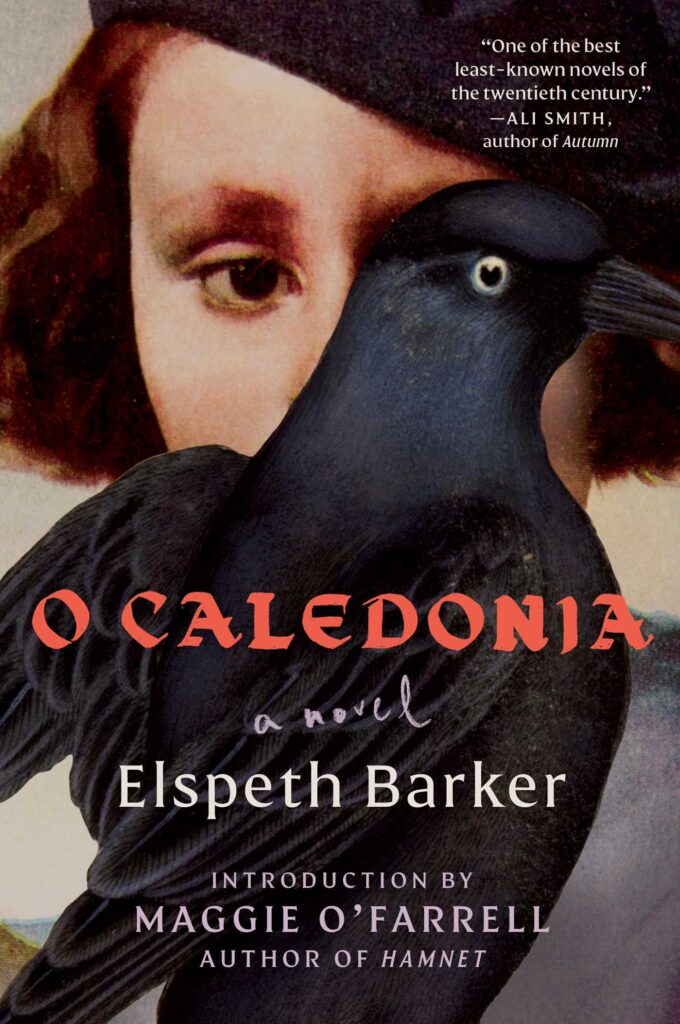
O Caledonia, by Elspeth Barker

You think you know where you are when this novel begins. “Halfway up the great stone staircase which rises from the dim and vaulting hall of Auchnasaugh there is a tall stained-glass window.” At night, the moon shines through the dying cockatoo in the window and

casts his blood drops in a chain of rubies onto the flagstones of the hall. Here it was that Janet was found, oddly attired in her mother’s black lace evening dress, twisted and slumped in bloody, murderous death.

But this is no ordinary murder mystery. Who killed sixteen-year-old Janet hardly matters. Instead, we are taken back to Janet’s birth in the 1940s, the first of five children and the least-loved.

Her life makes for a dark and sometimes funny tale of isolation and misadventure. Unlike her siblings, Janet never quite grasps the social rules. She makes disastrous mistakes, and other times acts upon what seem like logical ideas, such as burying the new baby in earth and leaves.

It was a rigorous life, but for Janet it was softened by the landscape, by reading, and by animals whom she found it possible to love without qualification. People seemed to her flawed and cruel.

The only sympathetic person is her strange, older Cousin Lila, who lives at Auchnasaugh, sipping whisky and smoking all day. Like Janet, she prefers animals to people. The whole family is pretty eccentric, but Lila outdoes them all.

Auchnasaugh, the field of sighing, took its name from the winds which lamented around it almost all the year, sometimes moaning softly, filtered through swathes of pine groves, more often malign, shrieking over the battlements and booming down the chimneys, so that the furnace which fed the ancient central heating system roared up and the pipes shuddered and the Aga top glowed infernal red.

I couldn’t help feeling for Janet as a victim of the stereotypes and restrictions around being a woman in postwar Calvinist Scotland. Whether it’s the expectation that girls will be prim and proper—and obedient—or the insistence that the only life for a woman is marriage and children, Janet simply doesn’t measure up.

No wonder she finds herself an outsider, not only at home but also at school and church. Janet is so much an outsider to her family that they bury her in a different graveyard, so they won’t be plagued with her in the afterlife. Only her pet jackdaw mourns for her.

The title comes from the epigraph, a quote from Sir Walter Scott. Caledonia is the Roman name for the part of Scotland where Janet lives, the part that remained outside Roman jurisdiction. Stern, wild, poetic: It fits Janet’s story. So too does the surprising and shocking cover.

When I finished the book, I turned back to the beginning and read it again. Mostly I wanted to savor the unusual yet precise prose.

Janet began to hate the sea. There was so much of it, flowing, counter-flowing, entering other seas, slyly furthering its interests beyond the mind’s reckoning; no wonder it could pass itself off as sky; it was infinite, a voracious marine confederacy.

I want to keep quoting huge chunks of this book. In her introduction, Maggie O’Farrell says that when she used to teach creative writing, she would read aloud the opening chapters, emphasising Barker’s word choice, imagery, and sentence structure. First published in 1991, O Caledonia was republished in 2022 with O’Farrell’s introduction.

Dark yet funny, realistic yet fantastical: This haunting book is a perfect October read.

Can you suggest another perfect October read?

Fortune Favors the Dead, by Stephen Spotswood

Fortune Favors the Dead

This witty, fast-paced mystery starts in New York City in 1945, with Willowjean “Will” Parker and her boss, famous detective Lillian Pentecost, investigating the murder of society matron Abigail Collins. Will has been Pentecost’s assistant and protégé for three years, the two having met when Will saved the older woman’s life with her knife-throwing skills.

Knife-throwing? Yes, at the time Will had been working as a roustabout in a traveling circus for five years, gaining some unusual skills. She’s the one telling this story, and her sassy, smart voice makes this a thoroughly enjoyable ride.

Pentecost, too, is unusual, and not just because she is a female detective at a time when women who stepped up during WWII are being forced into domestic roles while jobs are given to the returning men. She has multiple sclerosis, a progressively degenerative disease which at this point affects her stamina and gait but not her brilliant mind.

I loved both these characters before even getting to the story. Casting someone with a chronic disease as a major character is a rare and brilliant stroke. Plus, Will undermines all the stereotypes for women, not to mention circus workers, of the time. The duo quickly put me in mind of Rex Stout’s Nero Wolfe and Archie Goodwin, reimagined as women, but I love that Will is still a young woman, still finding her way in the world, unlike Archie.

On to the story! Abigail Collins is found in the locked study of her home during a big Halloween party at her mansion. She’s been beaten to death with a crystal ball, used in the séance held there, while seated in the chair where her husband killed himself a year before. Rumor holds that the ghost of her husband appeared during the séance, so many believe he is the murderer.

There are plenty of other, more corporeal, suspects. The psychic Ariel Belestrade has been on Ms. Pentecost’s radar for some time. Skeptical anthropology professor Olivia Waterhouse has also been investigating Belestrade for fraudulent practices and written her up in her most recent book. The psychic’s seductive power is brilliantly portrayed in some of the book’s most chilling scenes.

Even more complications ensue when Rebecca Collins, daughter of the murdered woman and a continuing frustration to her straight-laced brother, starts putting moves on Will, and Will finds herself responding to them.

Spotswood does a great job of bringing the period to life with details small and large, whether about circus life, nightclubs, or the mean streets of NYC. As a side note, the cover art boldly announces both its classic noir roots and Will’s unusual character. An intriguing cover will always make me look twice at a book.

For a fun read, you can’t go wrong with this cosy mystery with a bite to it. Will’s voice and personality alone are worth the price of admission. I’m looking forward to reading the other books in the Pentecost and Parker series.

Have you read a novel recently where you’ve been utterly charmed by the characters?

Sunburn, by Laura Lippman

Sunburn+HC

Pauline leaves her family at the beach and returns to their rented apartment to pack her bag. Inspired by Anne Tyler’s Ladder of Years, she has decided to simply walk away from her life.

Though Tyler’s book isn’t named, I knew immediately which one was meant. Who could forget Delia on Bethany Beach, walking away from her family, carrying only a straw tote decorated with a large flower? For all of us overburdened mothers with our unrealised dreams—often undefined even to ourselves—it was as though Tyler had revealed our most secret fantasy. Can you really do that? we wondered.

Lippman takes that fantasy and spirals deeper and deeper into it. What would make a woman leave her husband and three-year-old daughter?

Pauline doesn’t get very far. She hitches a ride to Washington D.C. with an elderly man whose wandering hands force her to abandon him in Belleville, a small Delaware town, only an hour away from where she started.

She decides to stay. Introducing herself as Polly, she persuades the owner of a bar/cafe to hire her as a second part-time waitress/bartender. What she doesn’t know is that the man sitting at the bar with her that first night is a private investigator hired to find her.

Adam wasn’t hired by her husband, who is only that night realising she is gone, but by a shady lawyer whose connection to her in unclear.

Much is unclear, to Pauline/Polly and Adam, and to us. Lippman seduces us, revealing bits of information while spinning out new webs of suspicion. We try to decide which of the stories these characters tell are true and which are lies, even as the characters themselves do the same.

It’s like a game of three-dimensional chess. There’s what Adam knows and doesn’t know, what Pauline knows he knows, and what she doesn’t know he knows. Same with Pauline: what she knows and doesn’t know, what Adam knows and doesn’t know she knows. And then there’s the reader. For all our insight into both characters, there’s plenty we know we don’t know, not to mention what we don’t know we don’t know.

It all unfolds naturally, the twists and turns easy to follow. The puzzle is embedded in an engrossing story: a love story, a change-your-life story, a mysterious-death story. Adam, Pauline, and the other characters make their moves based on their limited understanding of the others’ knowledge and motivations, just as we all do.

I especially liked Lippman’s reimagining of the classic noir femme fatale. She pries open the stereotype and takes us on an unexpectedly deep dive into Pauline, her history, her motives, her dreams and weaknesses.

I was also captivated by Lippman’s setting this noir tale in the tiny fictional town of Belleville in rural Delaware in the 1990s. True, there are forays into Baltimore and Wilmington, but the confines of a small town add intriguing nuances to the atmosphere. There is suspense for sure, but the book isn’t a thrill ride. It’s a measured unfolding over the course of one summer of a multi-layered story.

What did you do on your summer vacation?