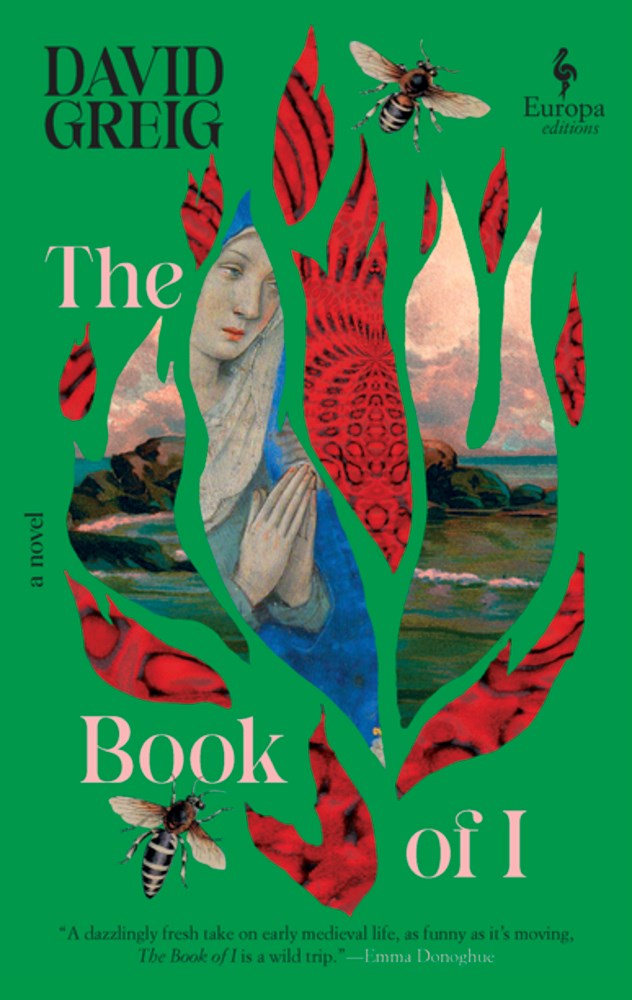
The Book of I, by David Greig

In 825 CE a Viking ship approaches a tiny island off the Scottish coast. Named “I” (modern-day Iona), the island is holy, home to an abbey founded by St. Columba in the sixth century. A few peasants are the only other inhabitants. The Vikings, including one Grimur, proceed to raid the abbey for its relics and treasures, killing everyone they can find in the process.

It’s a grim opening, and one that made me put off reading this story for a while, but I’m glad I took the book up again because what follows the raid is quite remarkable.

Three people survive. Young Brother Martin, to his lasting shame, hides in the latrine while the other monks offer themselves joyously to martyrdom. After killing her abusive husband the blacksmith, Grimur spares Una when she gives him her astonishing mead. In his resulting stupor, Grimur is assumed to be dead by his fellows and is left behind on the island.

With their varying strengths and weaknesses, not to mention their conflicting values and beliefs, they must find a way to live and work together. The pace slows as they move through their days. “Saint Fillan, the monastery cat stretches in the sun. Things happen and then they pass.”

They labor in their various ways: Grimur to learn about agriculture, art, Christianity and family; Una to keep them alive with her bees and mead and gardens; and Martin to restore the abbey and complete the illuminated manuscript—The Book of I—that the monks were working on before the raid.

Copying was not a simple act of reproduction. It was also a type of prayer, the way to a deeper understanding of scripture. Writing out lines was a meditation on meanings and hidden meanings. Illustrations appeared on the page in a dream state of grace.

I’m fascinated by stories of people creating a society from scratch, whether it’s the television series Deadwood or Octavia Butler’s brilliant Parable of the Sower, so I welcomed the languid pace and contemplative moments. Discarding traditional plot structure with its reliance on conflict, Greig presents the story almost as a succession of the monastery cat’s quiet days, brief chapters that beautifully evoke life on the island.

Now it was high summer. Night made hardly a smear on the long blue days. The island had long forgotten the ache of winter’s grip. Bees hovered over the flowers in the garden even into the late evening. Small birds shouted to each other in the oak grove.

The author is better known as a playwright which shows in his confident handling of this unconventional story.  He even manages to weave some quiet humor into what one would expect to be a bleak tale. “He was so gentle with the beast. So careful with the udder. How could these be the same hands that had killed the smith? Maybe he just really likes tits?”

Greig’s book—more a novella—is part of a series called The Darkland Tales, retellings of stories from Scotland’s history, myth and legend. His is drawn from the tale of the martyrdom of Saint Blathmac by Viking raiders in 825. If the rest of the series is as good as this story, I’m eager to read them all.

Have you read any of The Darkland Tales?

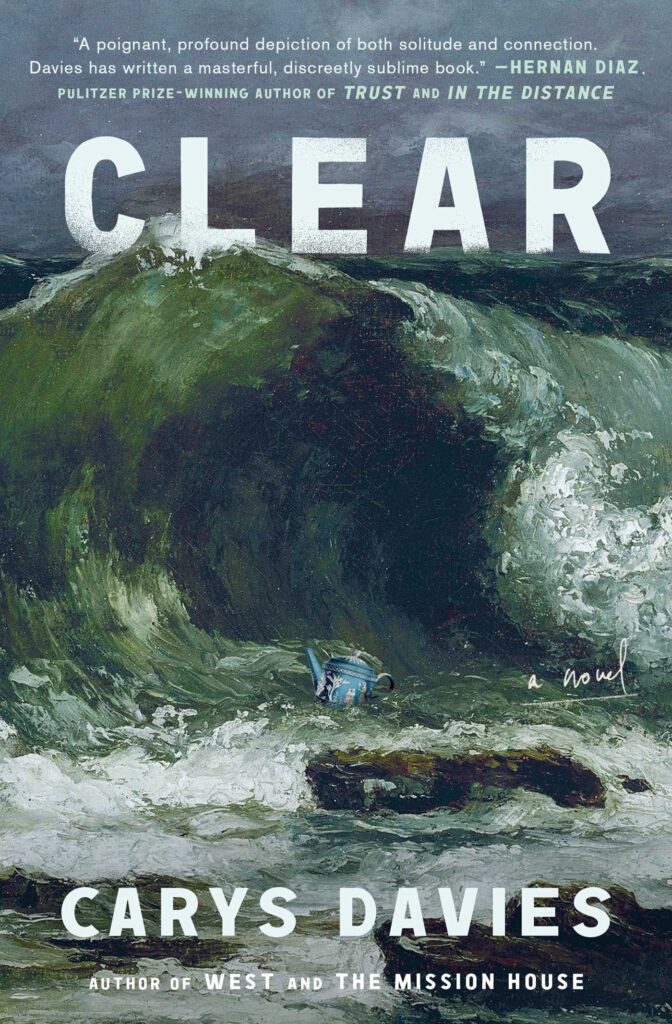
Clear, by Carys Davies

In 1840s Scotland, John Ferguson makes the difficult decision to become one of the evangelical ministers leaving the Church of Scotland to help form the Free Church of Scotland. It means giving up his job and income, but at least his church will be free of patronage and interference from the British Government. Also, it’s not the life he’d promised his wife Mary, but she accepts his choice.

The other major political upheaval besides the Disruption of the Church of Scotland is the ongoing Highland Clearances in Scotland which saw wealthy rural landowners evicting tenant farmers to clear the land for cattle or sheep. Most of the people in my book club were not familiar with the Clearances, which caused immense poverty and fury among the rural poor. A couple of us knew about them through our reading or family stories, but none of us had heard of the Disruption.

Desperate for funds, John jumps at the offer of a temporary, well-paying job as a factor. His assignment is to travel to a remote Scottish island and evict the lone remaining inhabitant—Ivar—so the island may be turned over to sheep. However, soon after arriving on the island he’s badly injured in a fall from a cliff.

Ivar finds the unconscious man and takes him into his home to nurse him. For a long period, John does not remember why he is there and busies himself learning Norn, the ancient language used by Ivar, so the two can communicate.

This lovely story is told in through three perspectives: Ivar, John and Mary. The author’s descriptions of the lonely island and Ivar’s life there are stunning both for their beauty and their authenticity. I especially enjoyed the language lessons, using actual Norn words that are poetic in their precision, such as the word “for the moment before something happens; for the state of being on the brink of something.”

It’s also a story of connection, of how a life of isolation and solitude can be transformed by the arrival of another human being. The author’s spare, elegant prose turns the book into, as one member of my book club said, a real gem.

Curiously, everyone in the book club understood the ending differently. No spoilers here, though many reviewers have criticised the ending as abrupt and unearned. For us, even though we read it aloud several times, we still understood it to mean different things.

That’s okay with me. I don’t mind endings where the story seems to go on after you close the book. In fact, the different endings we came up with said more about each of us that they did about the book. One person suggested we write to the author and ask her to write a sequel, though that mostly reflected our desire to spend more time with the characters.

I do mind when the ending is unearned. I believe the story could have prepared the ground for it a little better, but I actually liked it as it is.

If you enjoyed Small Things Like These, you might enjoy this story. I certainly did, and that was one thing that my book club did agree on: we all were immensely glad to have read it.

What books set on a Scottish island have you enjoyed?

The Hunting Party, by Lisa Foley

Foley

For their annual New Year’s reunion, nine friends travel to a remote lodge in the Scottish Highlands. It becomes even more remote when cut off by a massive blizzard on New Year’s Day, just as Heather and Doug—the two staff who live at the lodge—discover the body of the missing guest.

The bruises on the neck indicate murder, which means the murderer must be one of the people at the lodge, though there is a serial killer on the loose and the possibility of local poachers. The lodge sits on a loch far from the nearest town, with only three staff: Heather the manager, Doug the gamekeeper, and a third staff person who lives in the now-inaccessible town. For this weekend, the exclusive lodge has only two other visitors: an Icelandic couple who keep their distance from the rowdy group of friends.

In their thirties, the nine of them are starting to pull apart, mostly because of the changes that come with aging. The tensions between them become obvious on the train from London. Katie and Miranda have been friends since childhood, Miranda the queen bee who enlivens any gathering and Katie the plain friend. Seven others congregated around them at Oxford: Julian, now married to Miranda; two couples—Giles and Samira with their new baby, Nick and Bo—and Mark who always had a crush on Miranda. The ninth is Emma, Mark’s girlfriend of three years. She’s the one who organised this plush weekend.

The settings—the loch, the trails up the mountain, the glass lodge, individual cabins, the relentless snow—are beautifully and vividly described. Foley keeps up the suspense, not only about who the murderer is but who has been murdered. The suspense is also fed by the gradually emerging backgrounds of the characters. They have secrets, as do we all but some of theirs are pretty ugly. Old resentments, betrayal, and shifting alliances cloud the air.

The narrator changes with each chapter, giving us different insights into all the characters. There are flashbacks filling in the characters’ backgrounds and illuminating the difference between the accepted story about an incident and an actual memory from someone who was there.

I generally dislike multiple protagonists. I’m easily confused and they can blur together if the voices are not distinctive. Plus moving around keeps me from bonding with any one character, though that may not be a bad thing in a locked-room story like this, where anyone could be an unreliable narrator. I can also get confused when, as here, chapters bounce back and force between several time periods, in this case the several days around New Year’s.

I wasn’t confused here, though. Each chapter immediately clarifies who is speaking and what day it is. Also, I listened to the audio version which has a different actor for each point-of-view character, so it was more like listening to a play. Their voices did the necessary differentiation; I don’t know how well it would have worked if I’d read the book.

It’s been promoted as a classic locked-room mystery, which it is. I found the puzzle interesting; the characters less so. If you saw gamekeeper and thought D.H. Lawrence, you wouldn’t be far wrong. If you saw queen bee with plain friend and thought of stereotypes, you’d be on target, not just for those two but for everyone.

Beyond that, I simply could not work up sympathy for any of them, especially the nine friends trying to clutch at their youth, their golden days at Oxford. Drinking too much, taking pills, playing childish or teenage games, making risky impulsive decisions: maybe I’m just not the right audience for such characters. On top of that, some of the more extreme antics—no spoilers—seemed implausible to me. The person would surely have died or fallen into a coma.

Still, I enjoyed the twists and turns of the story. Some I saw coming; others took me by surprise. And I loved the descriptions of the loch and surrounding forests.

Do you like a good locked-room mystery? What’s one you can recommend?