The Benefits of Being an Octopus, by Ann Braden

If only Zooey were an octopus, her life would be so much easier. It’s bad enough having to handle seventh grade where she is routinely bullied by the rich kids. She also has to take care of her three young siblings—one a baby—feeding them, getting two of them off to Head Start and picking them up from the bus afterwards. Then she must watch them all until their mom gets off work at the pizza parlor, and even then fill in for her tired mother.

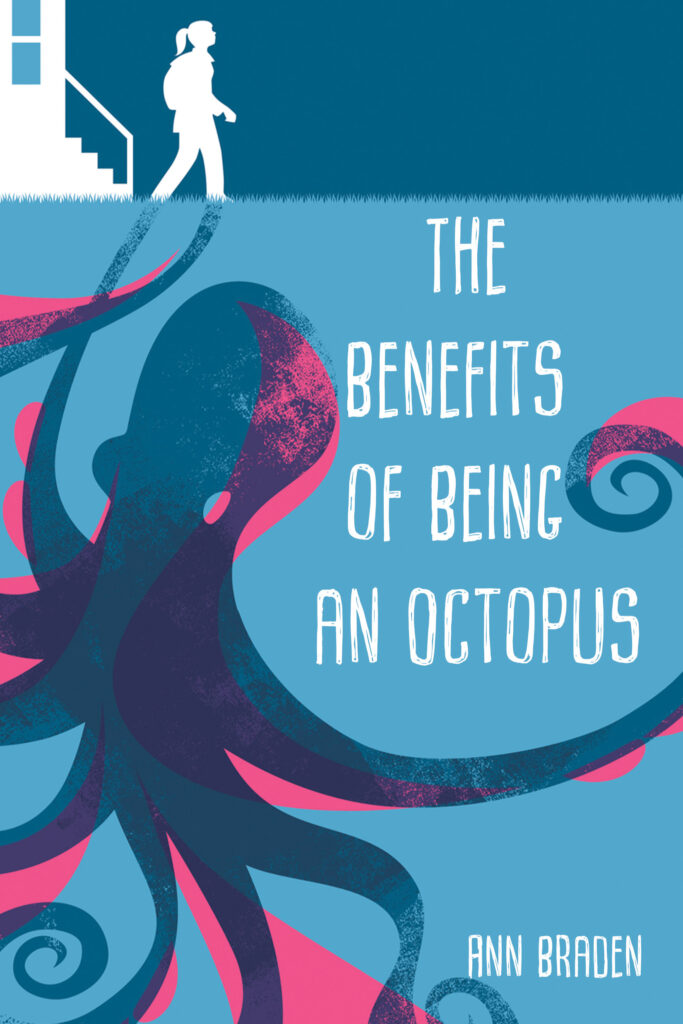
If she were an octopus, though, she’d have eight arms to handle all these things at once. She’d be able to change her color and appearance to blend into any environment and become invisible. She’d be safe.

At least her mother’s new boyfriend Lenny lets them all live in his nice trailer, but he’s a neat freak who is constantly criticising their mother and demanding silence from the children. Zoey’s managed to make one friend from school, Fuchsia, mostly because no one wanted to be friends with either of them.

Why? Because they are poor.

Zoey takes the same bus as Silas who also lives in the trailer park. His strategy for avoiding the bullies is complete silence from the moment he leaves the trailer he and his father share until the moment he returns.

One teacher seems to recognise what Zoey, who can rarely get around to completing any schoolwork, is going through. Ms. Rochambeau encourages her to join the Debate Club that meets after school. Just what she needs: one more responsibility!

There are many children like Zoey in this country, trying hard to hold their families together in the face of poverty, having to bear adult responsibilities and fears on top of the usual adolescent problems.

It’s hard for someone who hasn’t been there to understand how impossible the lives of the working poor can be. Not only does Zoey not have trendy clothes, but there often isn’t enough money for the laundromat. There’s never enough time to do her homework because she has to fix dinner and keep the children silent so as not to set off Lenny or his perpetually angry father who often comes over to watch television.

In this Young Adult (YA) novel, Ann Braden captures the voice and attitudes of a seventh grader like Zoey. Plus the author has endowed her teenaged protagonist with a determination and persistence that Zoey herself probably wouldn’t recognise as courage.

Most of all, Braden has created an accurate portrait of the kind of lives many children and teens—and their parents—lead. She understands the despair and hopelessness of those who simply cannot make enough to get by, much less prosper. I wrote about this hopelessness in my memoir Innocent: Confessions of a Welfare Mother.

It’s common in the U.S. to blame poor people themselves for their plight—declaring that “They’re just lazy” or “They made bad choices”—instead of blaming the societal structures that keep them there, like low wages and lack of affordable housing, healthcare, childcare, etc.

This blaming-the-victim attitude is a leftover from the Puritans who settled in the northern colonies between 1630 and 1643. The Puritans believed poverty was a sin, and that poisonous lie continues to infect U.S. culture almost 400 years later.

The truth is that even with two jobs, many families today don’t make enough to meet their basic needs. I know a couple, both elementary school teachers with no children, who recently looked up their state’s Basic Needs Budget and discovered that even their combined incomes fell short.

The it’s-their-own-fault attitude is also an artifact of the misogyny rampant in the U.S. culture. There are those who believe a woman without a man to support her is expendable. As one fellow welfare mother said to me, “They would  kill us if they could.” Well, they’re working on that now, cutting valuable programs that help the poor survive.

There’s plenty of suspense in Zoey’s story. How bad will life in Lenny’s trailer get? Can Zoey protect her family? Will she discover that she has more power than she knows? Perhaps this is a timely message for all of us right now: Let’s reasses our own power.

I highly recommend this story. Ann Braden recently delivered a powerful presentation at the Brattleboro Literary Festival. The video hasn’t been posted to the Brattleboro Literary Festival YouTube channel yet, but I’ll come back and add the link when it’s available.

Have you read a YA story recently that you can recommend?
The Original, by Nell Stevens

“There was a painting my family set on fire. It burned to ashes, and then it came back.” This  irresistible opening blossoms into a prologue that for once works like the way a prologue should. It lures us on from sentence to sentence, introducing Grace, who at ten has been brought to live with her cold aunt and uncle in their bleak Oxfordshire mansion after her parents were shut up in a lunatic asylum.

Then the story proper starts in 1899 with a 25-year-old Grace and her aunt in Rome—the uncle has died—where her long-lost cousin Charles, presumed drowned at sea, has turned up.

But is it Charles? This man is enormous, unlike the slender Charles of 13 years earlier. He seems reluctant to claim them, although it is his letter that has brought them. Even his mother isn’t sure.

Although she eventually becomes convinced—or decides—that Charles is her son, other family members think he’s an imposter and push for a showdown in court. Like the Tichborne Claimant whose case fascinated Victorian Britain, Charles has no way to prove his identity beyond the details he so accurately remembers. Yet his behavior continues to be puzzling; he acts as though he doesn’t care whether he’s accepted or not.

It felt like someone amongst us was the mad one, but none of us knew who, and maybe it was all of us, each mad in a specific and complicated way. . . It felt as though we were all missing something.

Such a plot is always enthrallng, but it is really Grace’s story that pulls me in: her mad parents and only slightly less mad aunt and uncle, her dubious position in the household, and her secret gift.

Charles had been the only one to be kind to young Grace, teaching her to paint when he finds her copying his own work. However, her talent turns out to be for producing copies of paintings rather than creating her own originals.

Grace has a condition called face blindness where she cannot remember faces. She can only recognise people by smell or sound. Yet she can study a painting and remember every detail of it. As she gets older, she hopes that talent will be her ticket to independence. There is always a market for copies of famous paintings.

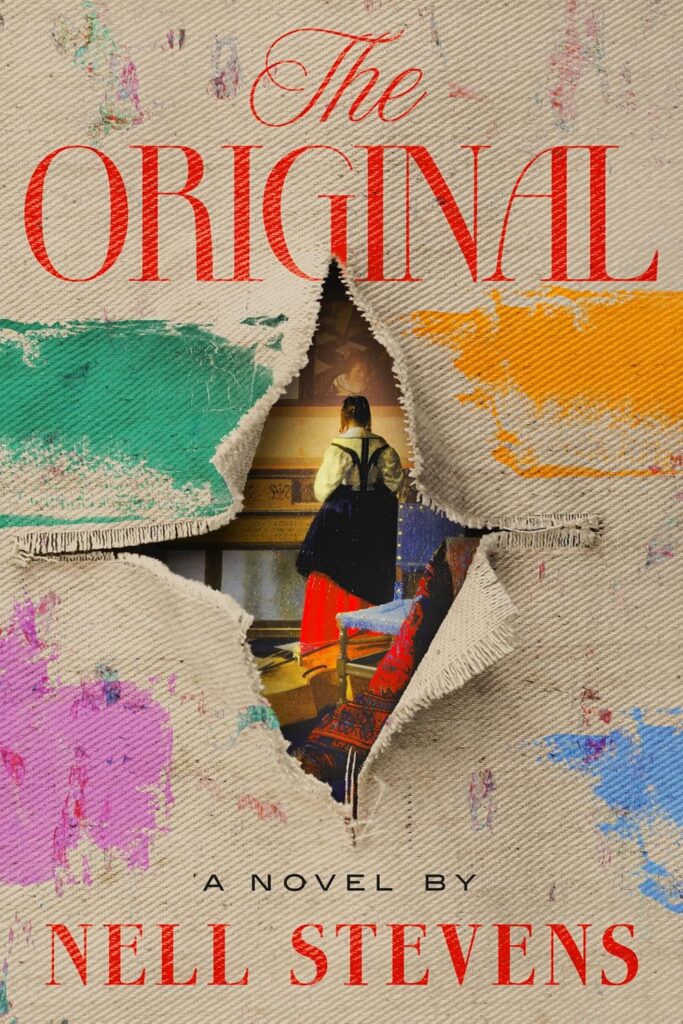
The discussions of pigment and glazes and details intrigued me. When she is asked to copy the famous Arnolfini Portrait,

I found myself beginning to write a kind of verbal map: toe of left clog, Naples yellow and white, five ascending dots of raw umber increasing in size from a quarter to a half an ant . . . Arnolfini’s robe: caput mortuum and black and, again, cerulean in repeating ripples, a succession of dark horizons tipped sideways.

What really lifted the book for me are the occasional aphoristic chapters, meditations on a color, like rose madder—“There are ways to navigate the world by colour alone . . .”—or a concept. “Some Truths About Copies” begins:

Everything in language is a copy of a real thing.

Every memory is a copy of the remembered events.

Everything done for the second time is a copy of when it was done for the first time, and an attempt to bring back something lost.

After all, are even we ourselves the same person we were at 17?

This story is rich in themes about authenticity, family, madness, belonging, class, and love. Stevens asks us to consider the intersection of these themes.

When we fall in love with a person, we start to copy them . . . When we fall in love with a person, we fall in love with the copy of them, inexpertly done, that we carry around with us whenever they aren’t there.

A suspenseful plot, vivid writing, a sympathetic main character, and much to think about: who could ask for anything more?

Have you read a novel recently that left you thinking about it long after you’d finished reading?

Stories from Capon Bridge

Photo by Richard Anderson, used by permission.

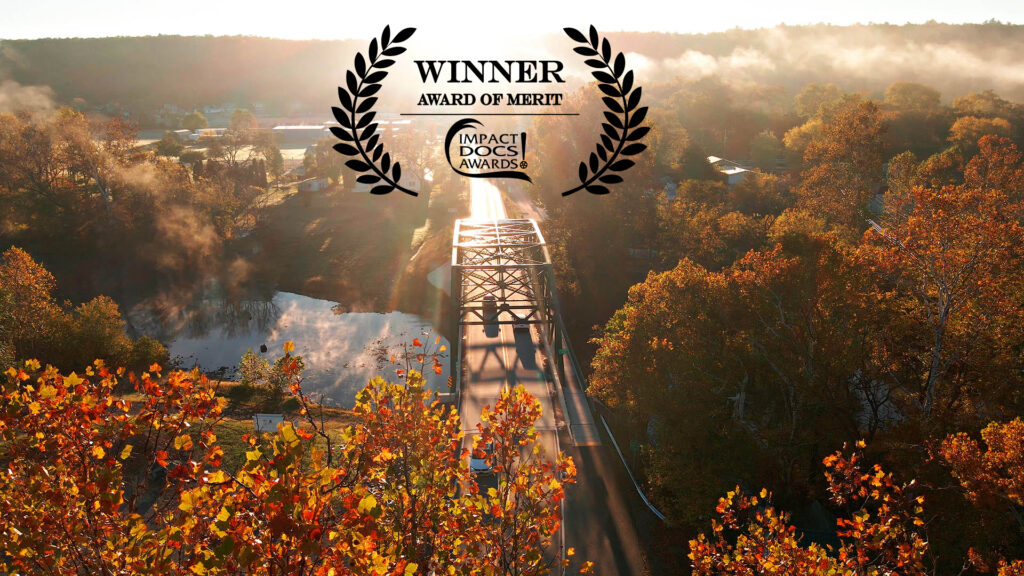
With so much working to divide us, this documentary film by Richard Anderson provides a much-needed balm. In it residents of the small West Virginia town of Capon Bridge tell us in their own words why their sense of community outweighs their differences.

Across all four seasons, Anderson interviews people ranging from farmers to local business owners to craftspeople, including both newer and long-time residents, seeking their opinions and insights into why their community is so close. One reason is the number of town-wide events, like community meals and holiday celebrations, where people work and talk together in person. While it’s easy to demonise or dehumanise a class of people, once you get to know them as individuals it’s a different matter.

“Let’s stop learning about each other through the media, talk face-to-face and get a better idea of who each other is.” Rev. W. Scott Ingleton, North River Mills United Methodist Church

I’m reminded of the street I live on where we are of different ages, educational background, economic status, etc. We probably hold different political views as well, but we don’t talk about that so much as share town-related information. We talk about children and cats and gardens and trees. We come together when an elderly neighbor needs help shoveling their walk or there’s some other problem.

“You can stand and say a lot of things hollering at your neighbor across the fence but when it’s their barn’s on fire you’re going to cross the fence. It think it’s the same thing on a national level . . . Don’t build a taller fence; build a longer table.” Becky Morgan, Quicken Farm

If we can indeed take that kind of care for each other, could we begin to bring even those spewing hate into the fold? Perhaps Capon Bridge’s success can only work in a small town. If nothing else, it can be a model for us as we move forward. This film reminds me that at heart I’m still the person I was in the 1960s: advocating peace and love, speaking out about wrongs and calling for us to come together for the common good.

The residents of Capon Bridge don’t shy away from the problems that come with change and progress, but talk about compromise and remembering that these are the people you run into every day in town. They discuss the need to support the decision-making process in their town government, whether or not you agree completely with the result.

“A lot of change can come about in small communities. It starts there actually because community is made up of people that have to get along in order to make sure that the water runs and that the roads are drivable and the sidewalks are walkable . . . Everyone contributes something.” Julie Farrar, Wild Earth Studio

What a gift this film is! I love the mix of interviews and shots of the town and surrounding areas. I love the community festivals. I love the music that is selected and performed by Dakota Karper, who is also interviewed in the film as the owner of The Cat and Fiddle music school in Capon Bridge.

Historical photos of the town add to the texture of life there. The progression of the interviews—the order in which they are presented—is smooth and effective; they build on each other to make a composite portrait of the community. Plus the bridge as the central metaphor for the town and its people is powerful. This film truly reveals how small communities can show us the way forward.

You can now see Stories from Capon Bridge: Portrait of a Small Community on YouTube (ad-free) here.

What brings you hope in these dark times?

Disclosure of Material Connection: I received access to this film free from the producer. I was not required to write a positive review. The opinions I have expressed are my own.
 

O Caledonia, by Elspeth Barker

You think you know where you are when this novel begins. “Halfway up the great stone staircase which rises from the dim and vaulting hall of Auchnasaugh there is a tall stained-glass window.” At night, the moon shines through the dying cockatoo in the window and

casts his blood drops in a chain of rubies onto the flagstones of the hall. Here it was that Janet was found, oddly attired in her mother’s black lace evening dress, twisted and slumped in bloody, murderous death.

But this is no ordinary murder mystery. Who killed sixteen-year-old Janet hardly matters. Instead, we are taken back to Janet’s birth in the 1940s, the first of five children and the least-loved.

Her life makes for a dark and sometimes funny tale of isolation and misadventure. Unlike her siblings, Janet never quite grasps the social rules. She makes disastrous mistakes, and other times acts upon what seem like logical ideas, such as burying the new baby in earth and leaves.

It was a rigorous life, but for Janet it was softened by the landscape, by reading, and by animals whom she found it possible to love without qualification. People seemed to her flawed and cruel.

The only sympathetic person is her strange, older Cousin Lila, who lives at Auchnasaugh, sipping whisky and smoking all day. Like Janet, she prefers animals to people. The whole family is pretty eccentric, but Lila outdoes them all.

Auchnasaugh, the field of sighing, took its name from the winds which lamented around it almost all the year, sometimes moaning softly, filtered through swathes of pine groves, more often malign, shrieking over the battlements and booming down the chimneys, so that the furnace which fed the ancient central heating system roared up and the pipes shuddered and the Aga top glowed infernal red.

I couldn’t help feeling for Janet as a victim of the stereotypes and restrictions around being a woman in postwar Calvinist Scotland. Whether it’s the expectation that girls will be prim and proper—and obedient—or the insistence that the only life for a woman is marriage and children, Janet simply doesn’t measure up.

No wonder she finds herself an outsider, not only at home but also at school and church. Janet is so much an outsider to her family that they bury her in a different graveyard, so they won’t be plagued with her in the afterlife. Only her pet jackdaw mourns for her.

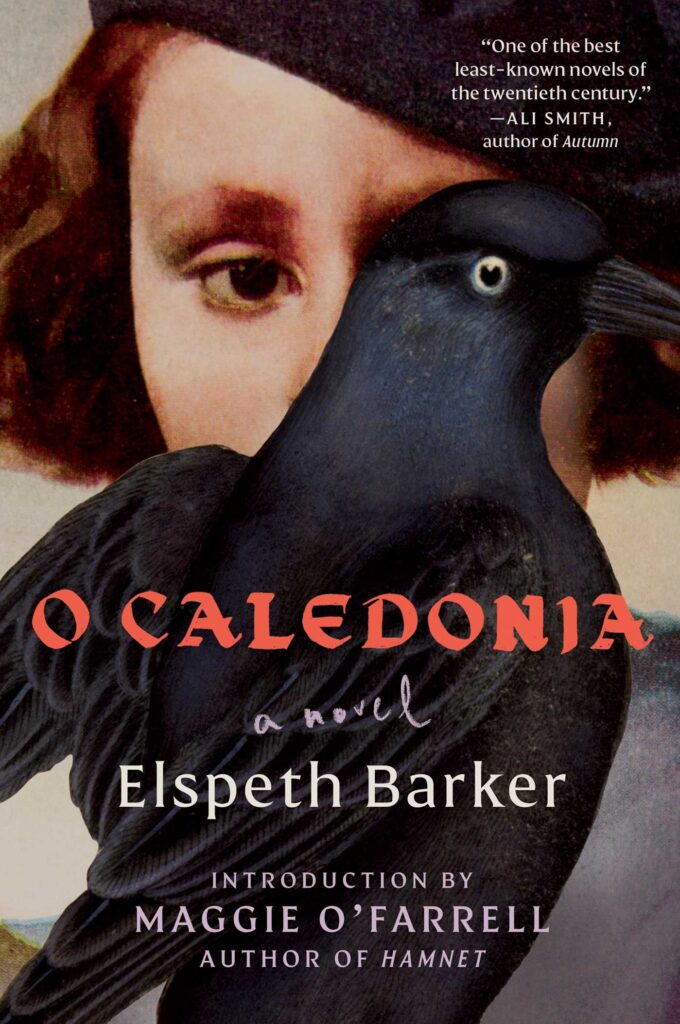
The title comes from the epigraph, a quote from Sir Walter Scott. Caledonia is the Roman name for the part of Scotland where Janet lives, the part that remained outside Roman jurisdiction. Stern, wild, poetic: It fits Janet’s story. So too does the surprising and shocking cover.

When I finished the book, I turned back to the beginning and read it again. Mostly I wanted to savor the unusual yet precise prose.

Janet began to hate the sea. There was so much of it, flowing, counter-flowing, entering other seas, slyly furthering its interests beyond the mind’s reckoning; no wonder it could pass itself off as sky; it was infinite, a voracious marine confederacy.

I want to keep quoting huge chunks of this book. In her introduction, Maggie O’Farrell says that when she used to teach creative writing, she would read aloud the opening chapters, emphasising Barker’s word choice, imagery, and sentence structure. First published in 1991, O Caledonia was republished in 2022 with O’Farrell’s introduction.

Dark yet funny, realistic yet fantastical: This haunting book is a perfect October read.

Can you suggest another perfect October read?