You think you know where you are when this novel begins. “Halfway up the great stone staircase which rises from the dim and vaulting hall of Auchnasaugh there is a tall stained-glass window.” At night, the moon shines through the dying cockatoo in the window and
casts his blood drops in a chain of rubies onto the flagstones of the hall. Here it was that Janet was found, oddly attired in her mother’s black lace evening dress, twisted and slumped in bloody, murderous death.
But this is no ordinary murder mystery. Who killed sixteen-year-old Janet hardly matters. Instead, we are taken back to Janet’s birth in the 1940s, the first of five children and the least-loved.
Her life makes for a dark and sometimes funny tale of isolation and misadventure. Unlike her siblings, Janet never quite grasps the social rules. She makes disastrous mistakes, and other times acts upon what seem like logical ideas, such as burying the new baby in earth and leaves.
It was a rigorous life, but for Janet it was softened by the landscape, by reading, and by animals whom she found it possible to love without qualification. People seemed to her flawed and cruel.
The only sympathetic person is her strange, older Cousin Lila, who lives at Auchnasaugh, sipping whisky and smoking all day. Like Janet, she prefers animals to people. The whole family is pretty eccentric, but Lila outdoes them all.
Auchnasaugh, the field of sighing, took its name from the winds which lamented around it almost all the year, sometimes moaning softly, filtered through swathes of pine groves, more often malign, shrieking over the battlements and booming down the chimneys, so that the furnace which fed the ancient central heating system roared up and the pipes shuddered and the Aga top glowed infernal red.
I couldn’t help feeling for Janet as a victim of the stereotypes and restrictions around being a woman in postwar Calvinist Scotland. Whether it’s the expectation that girls will be prim and proper—and obedient—or the insistence that the only life for a woman is marriage and children, Janet simply doesn’t measure up.
No wonder she finds herself an outsider, not only at home but also at school and church. Janet is so much an outsider to her family that they bury her in a different graveyard, so they won’t be plagued with her in the afterlife. Only her pet jackdaw mourns for her.
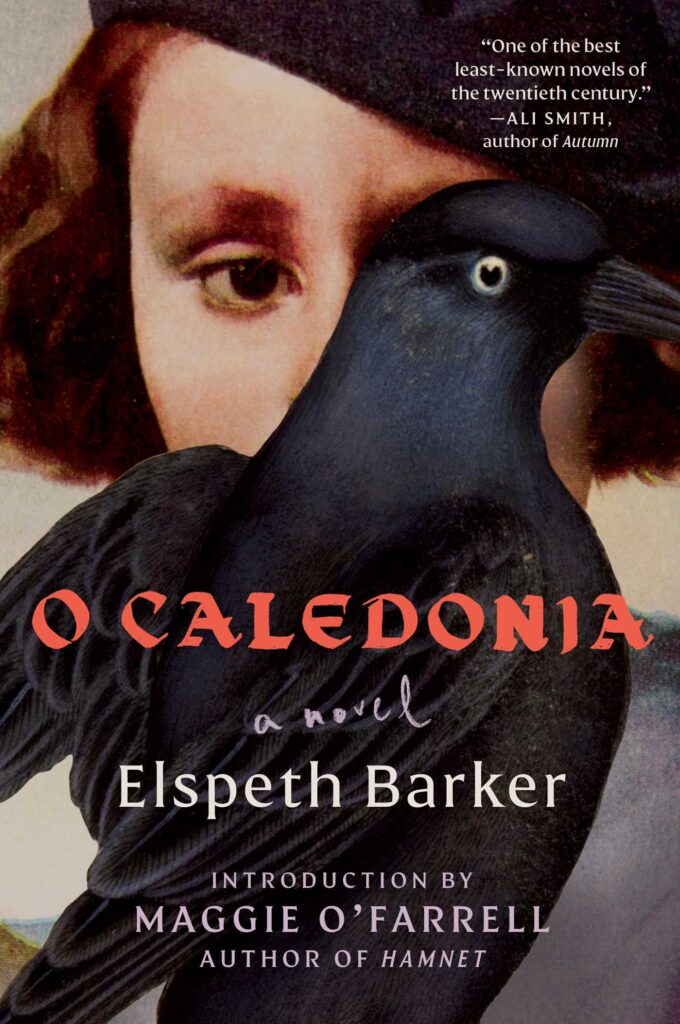
The title comes from the epigraph, a quote from Sir Walter Scott. Caledonia is the Roman name for the part of Scotland where Janet lives, the part that remained outside Roman jurisdiction. Stern, wild, poetic: It fits Janet’s story. So too does the surprising and shocking cover.
When I finished the book, I turned back to the beginning and read it again. Mostly I wanted to savor the unusual yet precise prose.
Janet began to hate the sea. There was so much of it, flowing, counter-flowing, entering other seas, slyly furthering its interests beyond the mind’s reckoning; no wonder it could pass itself off as sky; it was infinite, a voracious marine confederacy.
I want to keep quoting huge chunks of this book. In her introduction, Maggie O’Farrell says that when she used to teach creative writing, she would read aloud the opening chapters, emphasising Barker’s word choice, imagery, and sentence structure. First published in 1991, O Caledonia was republished in 2022 with O’Farrell’s introduction.
Dark yet funny, realistic yet fantastical: This haunting book is a perfect October read.
Can you suggest another perfect October read?