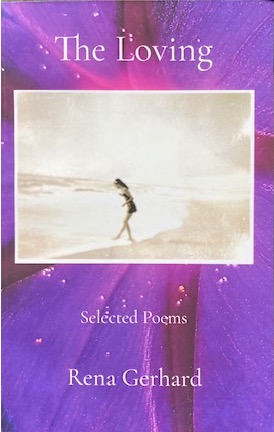
The Loving, by Rena Gerhard

Rena Gerhard began writing poetry as a child in the 1940s. Later, many of her poems were published in Musings, the poetry column in her local newspaper, The Reading Eagle. She continued to write until her death in 2014. Now her son and fellow poet Fred Gerhard has issued a selection of her work from all these phases of her life.

With such a breadth of time, the reader can see how her style developed as she matured while also recognising how she retained the elegant simplicity and emotional impact of her earlier work. Some consistent themes emerge.

Many of the poems are suffused with her love of nature and its rhythms, such as in “Night Walk” in which she describes a maple tree as “sleeping standing up / Having dreamed her children / to the wind.”

Alive to the magic of childhood, she speaks of the moon in “Midnight Forest.”

That whispering sigh above your head,

Know you what it means?

A rustling leaf—long brown and dead

Or th’ song of Fairy Queens.

Other poems are drawn from daily life, such as “Supper Will Be Late.” Or “Mystery” whose two lines capture a moment we can identify with: “Don’t you just hate when you clean out a drawer / And not all things fit that fit before!” The humor here can be found in many of the poems. One of my favorites is “Dancers” which begins:

Dinosaurs dance sedately.

Because of their weight and their delicate toes,

Their walnut-sized brains and their clattering clothes,

Dinosaurs dance sedately.

Subsequent stanzas continue the fun. As a dancer myself, I perk up every time she refers to dancing in a poem. When you take to the floor and begin moving to the music, you have to feel the rhythm in your body. Rena’s dance experience is evident in the confident rhythms she chooses for her poems.

Her imagery, too, is surprising and fresh, such as when she describes a light snow as “heirloom lace” spread over a “tablecloth world.” She continues the motif with “Finest stitch of sparrow hops / link bush to branch to porch to perch”  and “Squirrel-leap and rabbit dart / basting stitch the path of paws.”

You can see her love of words in poems like “Absurd” where she says, “What a wonderful word! / A laugh that bursts / Like water balloons.”

Although I never met Rena, I feel I have a sense of her based on her humor and love of nature as well as her sure handling of concision and emotion in these poems. In “Poem to  Old Writings” she looks back over her life and is grateful to be reminded of who she used to be and whom she has become. I’m grateful to her son for sharing these poems.

Have you ever looked at a poet’s collected work and considered what has changed over time and what has stayed the same?
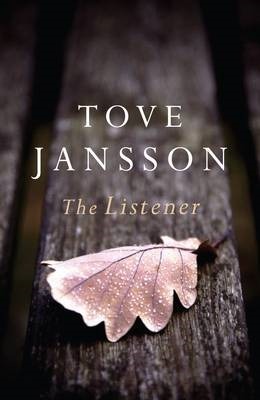
The Listener, by Tove Jansson

These eighteen short stories, most of them very brief, were first published in 1971 in Swedish; this 2014 translation by Thomas Teal is the first in English. Having loved The Summer Book, I wanted to slip again into Jansson’s spare, evocative prose. Here, too, I relished the way she explores emotional experiences and existential questions through everyday situations.

The stories may seem a bit baffling at first. They read so easily and yet you reach the end and know that you’ve missed something. There are no lessons, no endings tied up in a neat bow. As with all the most rewarding books, the reader must interpret the story for themselves.

In the title story, Aunt Gerda is not only a good listener but also a good letter writer. She replies “with care and serious interest” to all of her friends’ concerns, without putting herself forward or giving advice. Then at the age of fifty-five, she begins to betray the secrets she has been storing all these years. Jansson writes so well about the experience of aging, and also about isolation, which shadows many of the stories.

When people such as Aunt Gerda spend their time alone, it’s not always good for them. And that alienation can become apparent even in company. In “The Birthday Party” the two Häger sisters become flustered trying to throw a birthday party for their niece, and once the children begin arriving Vera and Anya have no idea what to do with them. It is the interaction between the two sisters that is fascinating, not the party itself.

 “Black-White” is subtitled “Homage to Edward Gorey.” In it, an unnamed illustrator finds that there is too much light in the home designed by his wife and decamps to an old house owned by his wife’s aunt—Mrs. Jansson—to finish a big project. He approaches the house amid the melting snow. “In the darkening winter evening, this landscape was utterly abandoned, a territory that had no meaning for anyone but him.”

These are quiet stories. My favorite is “Lucio’s Friends.” It begins:

Actually, there’s nothing the matter with him except that he’s so terribly nice. Maybe that’s natural for a big endomorph like Lucio, but it doesn’t seem to me that endless, almost heart-breaking niceness of that kind can be natural for a person who has had so many disappointments. I heard about those indirectly, not from him; he never talks about himself. I really don’t believe I’ve ever heard him make any voluntary statement about anyone he knows or has ever known or been introduced to. It creates an empty space around him.

 Of course we all love Lucio. But it’s an affection that borders on despair and can even cross over into irritation.

Well, I’m a sucker for any story about friendship. As Jansson says, “Friendship is such a serious thing that it’s hard to talk about.” I also love stories like these where the seemingly plain prose leaves space for the reader to continue the story and make of it what they will. Let the winter come; let the snow fall. Here is a book to read and reread.

What book have you read that made you want to turn back to page one and read the whole thing again?

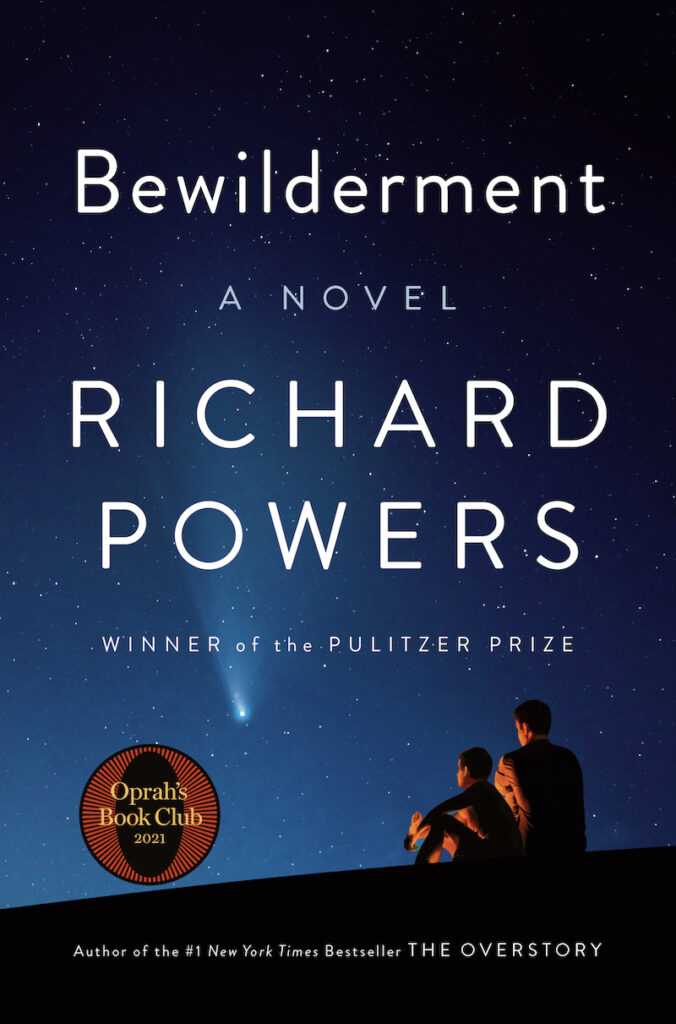
Bewilderment, by Richard Powers

Astrobiologist Theo Byrn searches for life in the universe. Even as a child he imagined different planets, sketching out their topography, geology and biology. Now he models potential varieties of planets, based on the latest research, and what sorts of life might be expected to develop there. His models will be used when—if—those life forms are discovered or make contact with us.

But it is as a father that we most get to know Theo. His 9-year-old son Robin is brilliant in his own way, but has trouble with social expectations and is bullied in school. When he’s interested in something, he learns everything about it, but when he isn’t, he stops paying attention.

Theo doesn’t want Robin medicated. He can’t bear the idea of blunting this extraordinary child’s mind to make him fit better into school. To do so would also betray the boy’s mother Alyssa who’d insisted that Robin be allowed to develop his capabilities. An animal rights activist, she had been killed two years earlier when she swerved to avoid hitting an opossum. Robin shares his mother’s passion for trying to save creatures from extinction.

Robin’s passion is one of the joys of the book; the various ways it manifests are astonishing and thought-provoking. Another joy comes from the planets that Theo describes for his son as bedtime stories and sometimes directly for the reader. Such imagination!

What does it mean to raise an exceptional child? Does it mean ignoring all the science? All the social rules? All the well-meaning teachers? Would I feel as though I’d failed my child? Parental guilt is bottomless. And anyway how many ways are there to be exceptional? The kind of intelligence classrooms recognize? Or creativity that looks beyond what is to what could be? Or a sensitivity that is tuned beyond what most of us understand?

I have struggled this with this myself. As a parent you don’t want to crush what is special about your child, yet at the same time you don’t want them to be excluded from the community around them. Where is the balance?

Perhaps your male child has a sweetness that is not acceptable in our world. Perhaps your girl child has a vulnerability that scares you out of your wits. What are the consequences for trying to be true to your child and let them develop as they are wired to do? How much danger are you putting them in?

Don’t we need them? These amazing young people who are in touch with ideas and proposals that we never even imagined? These young people who will be our doctors and lawyers and friends?

Theo says, “I wanted to tell the man that life itself is a spectrum disorder, where each of us vibrated at some unique frequency in the continuous rainbow.” But Theo also says, “No doctor can diagnose my son better than I can.” Such contradictions are human, aren’t they? I spend a lot of time with a nine-year-old these days, so Robin, while also contradictory, seems well-drawn to me. He veers between astonishingly mature comments and sentimental platitudes that he’s just discovered. He can throw destructive tantrums or spend hours creating a detailed work of art.

One of my library’s patrons wrote on the comment form for this book that there was so much bad news already that they didn’t need more, no matter how much they liked his previous book The Overstory. True, this 2021 novel takes the then-current political situation farther and presciently shows the kind of destruction of the country’s science infrastructure and capabilities that actually occurred four years later. Meanwhile, the climate crisis worsens every month while corrupt politicians bloviate about bathrooms.

Of course I share Robin’s heartbroken despair at the species that are going extinct and the natural places that are being destroyed. While I am delighted by the many and detailed worlds that Theo comes up with, they will not save us. Only we can do that.

Have you read another book by Richard Powers? What did you think of it?

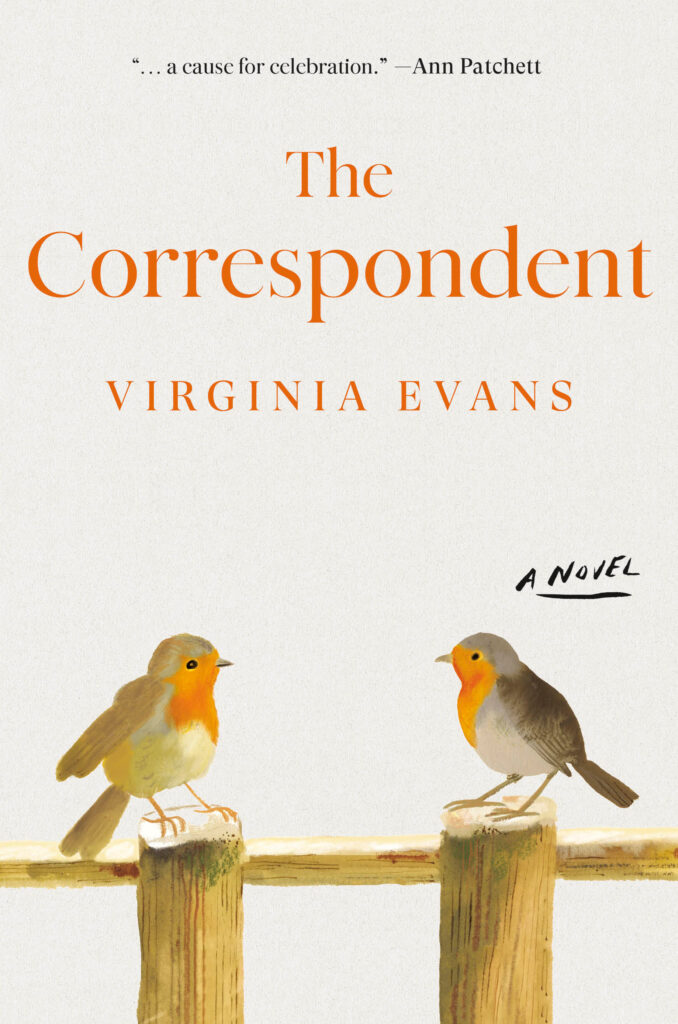
The Correspondent, by Virginia Evans

Sitting alone in her Baltimore home, 73-year-old Sybil Van Antwerp communicates with the world primarily through letters, the kind you put in envelopes and mail. This novel consists exclusively of her letters to and from friends, family, public figures she admires, and others she has, as my Baltimore mother used to say, a bone to pick with.

I was initially skeptical, as was at least one other person in my book club, that a collection of letters could amount to a novel worthy of the effusive praise this one has earned. Every book club I know is reading it. I’ve read other epistolary novels, and they’re okay but not as good as a traditional novel in my opinion. This one is.

First of all, Sybil fascinates me. She’s a complicated woman. Acerbic and prickly she may be, but as a retired lawyer she values words and enjoys living alone. The letters constitute a protective covering, allowing her to communicate with others while maintaining strict control over her privacy. At the same time, she is writing letters to an unnamed recipient that are never sent, and these reveal what she is really thinking.

Second, unlikely as it may sound, her quiet life whips up enough tension and suspense to make the reader not want to look away for a second. Not only are Sybil’s health and eyesight beginning to fail, not only does she long to heal the rifts in her relationship with her two children, but suddenly the world is more with her than she expected. A surprising friendship with a neighbor, Theodore Lübeck, upsets her solitude, as does a brash Texan with romance on his mind.

Events accelerate. She is asked to be responsible for a child and to heal her relationship with her ex-husband. A stalker sends her threatening letters. Regrets about her past coldness to others pile up. Members of my book club couldn’t stop reading. We loved all the humor and human interest. Also, being based in Baltimore, we appreciated the local settings and all the literary references. Sybil is a reader like us!

We also praised the author’s writerly skills. The order of the letters is nicely balanced between recipients to show different sides of Sybil’s character, and arranged in such a way that they keep us waiting and wondering about the outcome of a particular exchange for just the right amount of time, i.e., we remained interested without being annoyed. Also, I thought the unsent letters a masterful solution to the need to show her inner thoughts.

A few members complained that some of the story lines had unrealistic, “Pollyanna-ish” endings. I don’t disagree. At the same time, I think the author did a good job of portraying a woman contemplating the end of her life and trying to come to terms with her regrets, guilt, and failures over the course of her life.

Some of us went out and bought stationery and plan to write some real letters. We talked about how much value we have found in reading collections of letters and how biographers rely on them. We wondered what will happen in the future, since almost no one writes letters anymore. Our emails and texts seem both permanent and ephemeral. In the future, will anyone publish collections of emails, or will that sense of everyday life be lost?

When was the last time you wrote a letter to someone, not an email or text, but a physical letter?