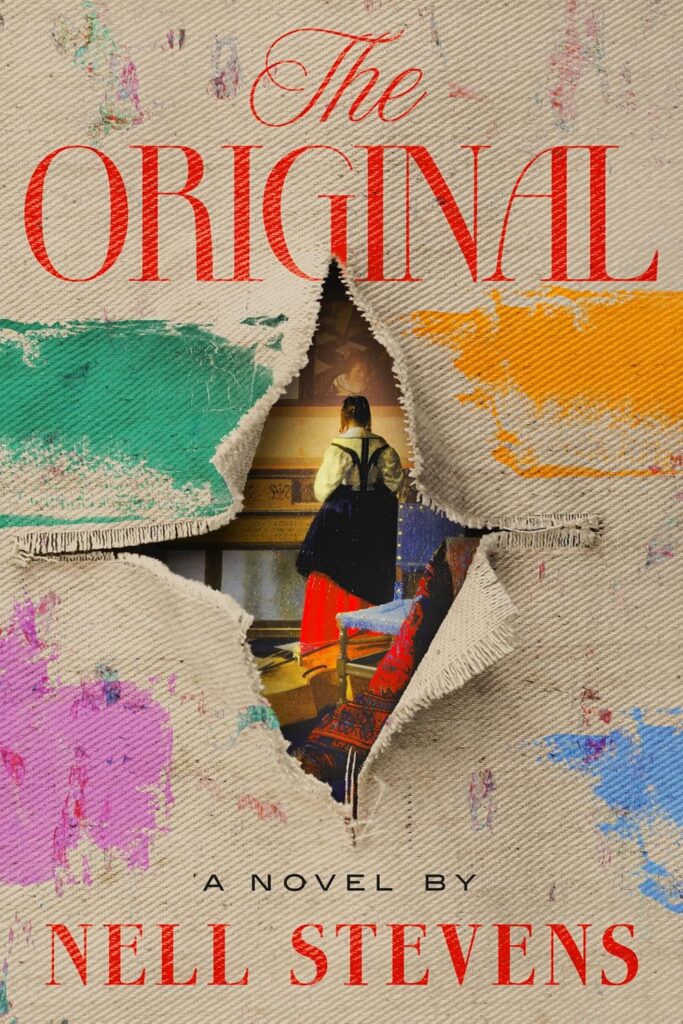
“There was a painting my family set on fire. It burned to ashes, and then it came back.” This irresistible opening blossoms into a prologue that for once works like the way a prologue should. It lures us on from sentence to sentence, introducing Grace, who at ten has been brought to live with her cold aunt and uncle in their bleak Oxfordshire mansion after her parents were shut up in a lunatic asylum.
Then the story proper starts in 1899 with a 25-year-old Grace and her aunt in Rome—the uncle has died—where her long-lost cousin Charles, presumed drowned at sea, has turned up.
But is it Charles? This man is enormous, unlike the slender Charles of 13 years earlier. He seems reluctant to claim them, although it is his letter that has brought them. Even his mother isn’t sure.
Although she eventually becomes convinced—or decides—that Charles is her son, other family members think he’s an imposter and push for a showdown in court. Like the Tichborne Claimant whose case fascinated Victorian Britain, Charles has no way to prove his identity beyond the details he so accurately remembers. Yet his behavior continues to be puzzling; he acts as though he doesn’t care whether he’s accepted or not.
It felt like someone amongst us was the mad one, but none of us knew who, and maybe it was all of us, each mad in a specific and complicated way. . . It felt as though we were all missing something.
Such a plot is always enthrallng, but it is really Grace’s story that pulls me in: her mad parents and only slightly less mad aunt and uncle, her dubious position in the household, and her secret gift.
Charles had been the only one to be kind to young Grace, teaching her to paint when he finds her copying his own work. However, her talent turns out to be for producing copies of paintings rather than creating her own originals.
Grace has a condition called face blindness where she cannot remember faces. She can only recognise people by smell or sound. Yet she can study a painting and remember every detail of it. As she gets older, she hopes that talent will be her ticket to independence. There is always a market for copies of famous paintings.
The discussions of pigment and glazes and details intrigued me. When she is asked to copy the famous Arnolfini Portrait,
I found myself beginning to write a kind of verbal map: toe of left clog, Naples yellow and white, five ascending dots of raw umber increasing in size from a quarter to a half an ant . . . Arnolfini’s robe: caput mortuum and black and, again, cerulean in repeating ripples, a succession of dark horizons tipped sideways.
What really lifted the book for me are the occasional aphoristic chapters, meditations on a color, like rose madder—“There are ways to navigate the world by colour alone . . .”—or a concept. “Some Truths About Copies” begins:
Everything in language is a copy of a real thing.
Every memory is a copy of the remembered events.
Everything done for the second time is a copy of when it was done for the first time, and an attempt to bring back something lost.
After all, are even we ourselves the same person we were at 17?
This story is rich in themes about authenticity, family, madness, belonging, class, and love. Stevens asks us to consider the intersection of these themes.
When we fall in love with a person, we start to copy them . . . When we fall in love with a person, we fall in love with the copy of them, inexpertly done, that we carry around with us whenever they aren’t there.
A suspenseful plot, vivid writing, a sympathetic main character, and much to think about: who could ask for anything more?
Have you read a novel recently that left you thinking about it long after you’d finished reading?