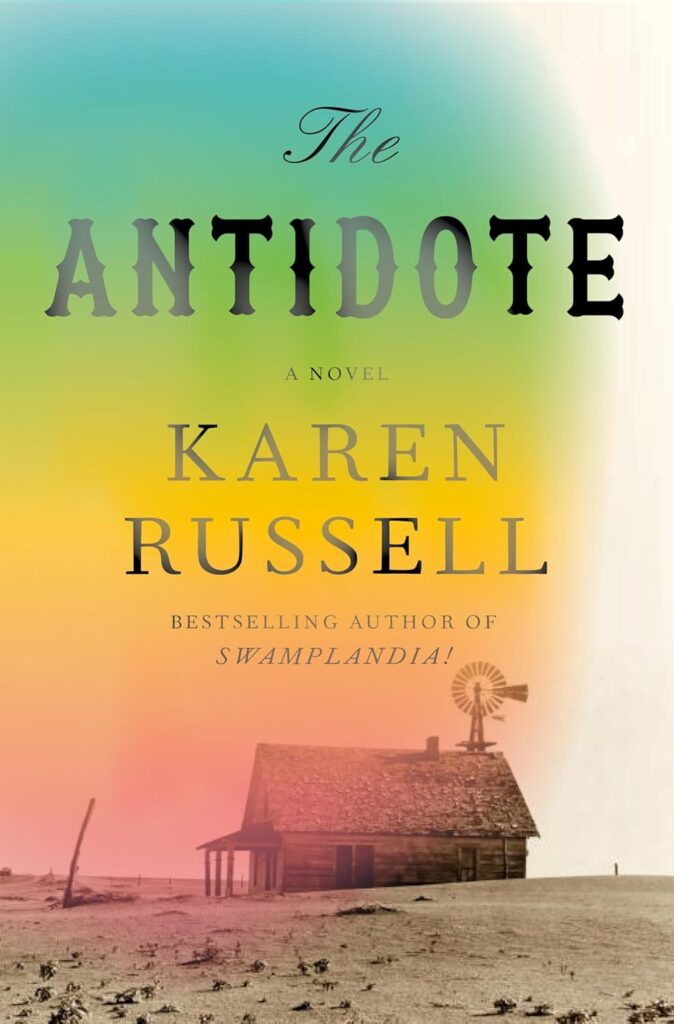
After a gruesome prologue that almost prevented me from continuing, the story proper opens on April 14, 1935—Black Sunday—when an historic dust storm consumes the fictional town of Uz, Nebraska, including the cell where Antonina Rossi, known as the Prairie Witch, is being held.
Gillian Welch calls April 14 Ruination Day, being not only the anniversary of Black Sunday, but also of the day the Titanic struck the fatal iceberg, and of the assassination of Abraham Lincoln. Uz, which is also the name of the land where Job lived, has already been suffering from the Great Depression, poor harvests, and the dust storms, of which this is the worst and leads to the region becoming known as the Dust Bowl.
The Prairie Witch, who has taken The Antidote as her professional name, has the peculiar ability to take away and store people’s memories. As with a bank, they can retrieve their memories if they want, but few do because they enjoy their pleasant lives untinged by regrets and painful memories of misdeeds and violence. However, just as it has scoured the fields of their topsoil, the storm has emptied her vault of its stored memories. And now bankrupt families are choosing to leave town and want to redeem their deposits.
The other narrators are Harp Oletsky, a Polish bachelor farmer whose fields have somehow been spared from the dust and drought; Asphodel Oletsky, his basketball-star niece still grieving her mother’s unsolved murder; a scarecrow with a human voice; and Cleo Allfrey, a Black photographer sent by FDR’s Resettlement Administration to document conditions. Oh, and a cat.
Each of their stories is absorbing. Freed from her cell, Antonina must fight off the corrupt sheriff who forces her to remove memories from witnesses in order to manipulate trials. Cleo’s new camera, purchased at a pawn shop, produces pictures that show the hidden past or unimagined future of that spot. Dell tries to hold her team together for the last game of the regional championship after their coach and his family leave town. And Harp struggles with his good fortune that sets him apart from his neighbors.
The other farmers are furious when a representative from another of FDR’s agencies shows the film “The Plow That Broke the Plains” and tells them that they are responsible for the dust storms and the crop failures because in plowing up the grasslands to plant wheat, they destroyed the fragile ecology of the plains. The farmers complain that they were only doing what the government told them to do: turn “wasteland” into fields of wheat.
Already an ambitious novel with all these voices, there’s yet another layer to the story that begins to come through. Like the individuals burying memories of personal sins and failures, our narrators begin to reckon with our national amnesia about living on stolen land and their own (and their ancestor’s) complicity in that crime.
Russell’s writing is strong and engaging. Some scenes are among the most exciting or poignant I’ve ever read. I love the moral arc of the book and its themes exploring memory, history, and forgetting. Yet the story creaks a little under the great weight it is made to carry. Some important story threads are left not only unresolved but unaddressed. Even the main plotlines are numerous enough to challenge the reader as we bounce between narrators.
Just as Russell merges actual history and fiction into a seamless story, she integrates realism with speculative aspects such as Cleo’s camera, Harp’s protective bubble, and the Prairie Witch’s gift. What I failed to find quite believable, however, are three of the narrators. I could accept the scarecrow and cat as part of the magical realism, and Antonina is well-drawn.
However, Dell, Harp and Cleo, working-class people of the 1930s, seem instead more like representatives of today’s culture wars who each move in a protective bubble of their own. I don’t want to give away too much, but they are each wildly out of step with the culture of a small, rural town in 1930s Nebraska. Yet none of that is explored, nor are they treated any differently by others, beyond a brief allusion such as Cleo being charged extra for her room.
The ending, too, is disappointing. Still, I applaud the ambition and the stunning accomplishment of much of the book. I listened to this as an audiobook, and the actors did a wonderful job. The print book contains photographs, which I am glad I did not see.
What novel have you read that blends realism and speculative fiction to portray our world?