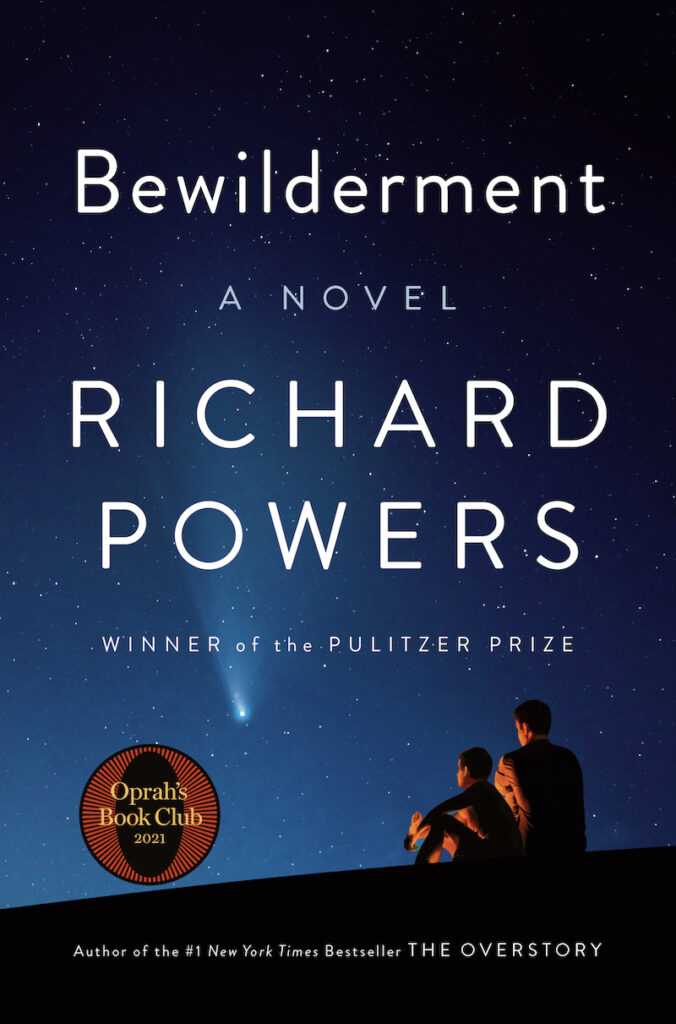
Bewilderment, by Richard Powers

Astrobiologist Theo Byrn searches for life in the universe. Even as a child he imagined different planets, sketching out their topography, geology and biology. Now he models potential varieties of planets, based on the latest research, and what sorts of life might be expected to develop there. His models will be used when—if—those life forms are discovered or make contact with us.

But it is as a father that we most get to know Theo. His 9-year-old son Robin is brilliant in his own way, but has trouble with social expectations and is bullied in school. When he’s interested in something, he learns everything about it, but when he isn’t, he stops paying attention.

Theo doesn’t want Robin medicated. He can’t bear the idea of blunting this extraordinary child’s mind to make him fit better into school. To do so would also betray the boy’s mother Alyssa who’d insisted that Robin be allowed to develop his capabilities. An animal rights activist, she had been killed two years earlier when she swerved to avoid hitting an opossum. Robin shares his mother’s passion for trying to save creatures from extinction.

Robin’s passion is one of the joys of the book; the various ways it manifests are astonishing and thought-provoking. Another joy comes from the planets that Theo describes for his son as bedtime stories and sometimes directly for the reader. Such imagination!

What does it mean to raise an exceptional child? Does it mean ignoring all the science? All the social rules? All the well-meaning teachers? Would I feel as though I’d failed my child? Parental guilt is bottomless. And anyway how many ways are there to be exceptional? The kind of intelligence classrooms recognize? Or creativity that looks beyond what is to what could be? Or a sensitivity that is tuned beyond what most of us understand?

I have struggled this with this myself. As a parent you don’t want to crush what is special about your child, yet at the same time you don’t want them to be excluded from the community around them. Where is the balance?

Perhaps your male child has a sweetness that is not acceptable in our world. Perhaps your girl child has a vulnerability that scares you out of your wits. What are the consequences for trying to be true to your child and let them develop as they are wired to do? How much danger are you putting them in?

Don’t we need them? These amazing young people who are in touch with ideas and proposals that we never even imagined? These young people who will be our doctors and lawyers and friends?

Theo says, “I wanted to tell the man that life itself is a spectrum disorder, where each of us vibrated at some unique frequency in the continuous rainbow.” But Theo also says, “No doctor can diagnose my son better than I can.” Such contradictions are human, aren’t they? I spend a lot of time with a nine-year-old these days, so Robin, while also contradictory, seems well-drawn to me. He veers between astonishingly mature comments and sentimental platitudes that he’s just discovered. He can throw destructive tantrums or spend hours creating a detailed work of art.

One of my library’s patrons wrote on the comment form for this book that there was so much bad news already that they didn’t need more, no matter how much they liked his previous book The Overstory. True, this 2021 novel takes the then-current political situation farther and presciently shows the kind of destruction of the country’s science infrastructure and capabilities that actually occurred four years later. Meanwhile, the climate crisis worsens every month while corrupt politicians bloviate about bathrooms.

Of course I share Robin’s heartbroken despair at the species that are going extinct and the natural places that are being destroyed. While I am delighted by the many and detailed worlds that Theo comes up with, they will not save us. Only we can do that.

Have you read another book by Richard Powers? What did you think of it?

A Children’s Bible, by Lydia Millet

childrens bible

By coincidence, I read this book immediately after Rumaan Alam’s novel, so two novels in a row that imagine how the looming climate catastrophe might play out.

Here our narrator is teenaged Eve. A group of families, including hers, have taken a vacation home beside a lake. The twelve children of various ages are turned loose on their own while their parents indulge themselves. The children are so disgusted by their parents’ hedonistic antics that they refuse to acknowledge which set of adults belongs to them; it becomes a contest to see who can keep from being outed.

Eve is especially protective of her little brother Jack, who is curious and innocent, fragile in some ways and tough in others. One of the adults gives him a children’s bible which he comes to believe explains everything about the world, for example deciding that “God” really means “nature.”

A massive hurricane strikes, downing trees, flooding the area and the house, knocking out electricity and internet. In a reversal of Lord of the Flies, it is the children who decamp to the treehouse where they care for each other, while the adults, ignoring the fact that their children are missing, party even harder.

I certainly know some upper-class parents whose neglect of their children is epic, yet even they would flinch at sending their children to live in the woods during a hurricane while they themselves indulge in orgies of adulterous sex, alcohol and drugs. Adding to the sense that we’re in a fairy tale rather than the real world is the fact whenever the children get in trouble, we get magical, deus ex machina rescues.

With the flood, our narrator’s name, and Jack’s book as rather obvious clues, not to mention the cover, it’s pretty easy to line up the characters with their biblical counterparts. However, I think most readers would prefer, as I do, the satisfaction of puzzling out a story rather than having it made so easy.

Unlike the adults, the children are realistic and age-appropriate. Eve and Jack’s characters are nuanced and believable, while the others are less so; I actually had trouble keeping the other children straight, much less the unnamed parents. Of course, we are getting the adults through Eve’s eyes, and she’s at an age when parents cannot do anything right.

Millet’s decision to use a child’s point of view to accuse the older generation of indulging themselves instead of actually doing something to avert the climate catastrophe is brilliant. It really is the children who will bear the brunt of the disaster coming towards us. Still, it’s hard to take that threat seriously when the characters we care about are always being magically lifted to safety. When characters are forced to overcome obstacles, not only do they grow but we readers also experience their triumph. That experience is missing here.

Also missing is a larger sense of the world and society. These are privileged people. True, we run into some one-percenters who are even more aloof and protected from any danger than these families, yet we don’t see people of color, middle-class workers, the poor or elderly—the people who, just as in this pandemic, will suffer the most in a climate apocalypse. Thus, the real extent of the terror and loss is missing, an enormous iceberg hidden below the waves.

As in the Alam novel, the tone of Millet’s book veers between dramatic and satirical, the latter inviting you to view the story as a fairy tale or a parable—nothing that could happen in real life. That’s a shame. This book could have been a good wake-up call about the coming climate catastrophe and the need to make the world safe for our children.

Have you read this book? What did you think?

Learning to Die, by Robert Bringhurst and Jan Zwicky

learning

While the title of this slim volume sounds tailor-made for this pandemic with its hundreds of millions of deaths, the subtitle clarifies its theme: Wisdom in the Age of Climate Crisis. Its two essays and Afterword give us perspective on the environmental catastrophe through which we are living.

These are not attempts to quote scientific studies to persuade us of the seriousness of our Anthropocene Era, though statistics are given and backed by numerous endnoted sources. Instead, the two essays address our inner selves and how we relate to the world, while the Afterword refutes a recent book which proclaims that there is no problem because more progress will save us.

In “The Mind of the Wild” Bringhurst reminds us that life survived and regenerated after each previous global extinction event, though it wasn’t the same life as before. I can’t help but think again about our current time, when it appears our post-COVID 19 world will not ever be quite what it was before.

Bringhurst goes on to say that after the coming catastrophe, it will be the wild—defined as “everything that grows and breeds and functions without supervision or imposed control”—that “will rescue life on earth, if anything does, because nothing else can.” Humans may not survive; any that do will find their culture eviscerated.

He refers to an 1858 speech by the physicist Michael Faraday, who in a lecture on electricity said, “I am no poet, but if you think for yourselves, as I proceed, the facts will form a poem in your mind. ” He goes on:

Letting the facts form a poem in your mind is an exercise in a certain kind of thinking: letting something happen instead of forcing it to happen, and simultaneously letting yourself be enlarged. Letting the facts form a poem in your mind is a way to practise thinking like an ecosystem, thinking like a planet, thinking like a world. But in order to let the facts form a poem in your mind, you have to have some facts to start with.

And of course you must have a mind in good working order. Increasingly we have been learning that one of the best ways to get our minds in order is to go out into the natural world, the wild. Bringhurst says that there we “enter a larger, possibly stricter, moral sphere” and encourages us to bring that “heightened sense of morality” home with us.

There is much more to this moving and persuasive essay. It is reinforced and expanded by “A Ship from Delos” by Zwicky. The title comes from Plato’s account of the death of Socrates, which was delayed by the custom of not allowing any executions during the annual voyage to Delos to honor Apollo. The sight of the ship returning tells Socrates that his life will end the next day.

Zwicky says that “Humans collectively are now in Socrates’ position: the ship with the black sails has been sighted.” Building on Bringhurst’s appeal to our moral selves, she proposes the virtues that Socrates embodied, starting with awareness (attended by the humility to recognise what we don’t know).

Here it is the recognition of our own mortality, which she describes beautifully as “to look at the world openly and to see it, and one’s own actions, and the actions of others, for what they are: gestures that vanish in the air like music.” She goes through the other virtues, showing how cultivating them will serve us well as we enter our extinction event, both by perhaps postponing it a little and by giving us tools to handle it.

For the Socratic virtue usually translated as piety, she substitutes contemplative practice, saying:

At the heart of contemplative practice of any sort is attention. As [Simone] Weil observes, prayer is nothing other than absolutely unmixed attention . . . The more we attend to the world, the less we find ourselves wishing to control it.

I recommend this small book to anyone who wishes to go deeper into an understanding of who we are and who we are becoming as our culture rocks and is remade during this time of great change.

What writers help you to adjust and find your best life during difficult times?