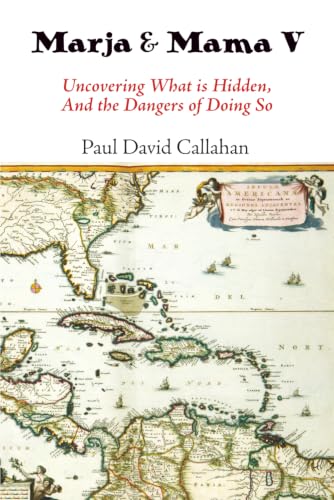
Marja and Mama V, by Paul David Callahan

In 18th century Finland, fifteen-year-old Marja travels south with her beloved horse Timo and the young cow. She has buried her parents, taken together by fever, on their small farm and now goes to her aunt and uncle. She offers to build them a barn, and they are surprised by her expertise with wood, learned from her father, a builder. When she and her aunt go to collect hay at the shore, they encounter men working to repair their ship, a herring buss from Holland. Marja helps them with the work and eventually joins the crew of the Zeenimf.

Such a brief summary doesn’t do justice to the details Callahan uses to bring these scenes to life, from the white reindeer lichen broth Marja makes for her sick father to the “rushing chatter” of the river running over rocks when she goes to check the trot line for salmon. Where Callahan really excels, though, is in his descriptions of life at sea. Drawing on his own experience as a fisherman, he captures the thrill and terror of storms at sea as well as the work of an ordinary day.

To set the nets, four men are lowered into the double-ended tender to carry out and drop the driftnet’s end-buoy, a large barrel with a stick and colorful cloth at the top. Then, slowly as the Zeenimf drifts downwind, the black nets are paid out over the steep side of the big boat like a silky animal returning home to the deep.

Marja herself is a marvelous character: physically strong, quick to learn, with an intuitive understanding of both animals and people. Surprising turns take her and her new husband Vim to another ship and a dangerous voyage to Sint Eustatius, Statia for short, an island in the Caribbean, and later to trade outposts in North America.

The details about the Dutch colonies in the Caribbean were new to me, and Callahan provides just enough explanation to support the story without stalling it. Statia was known as “the warehouse of the Caribbean.” Owned by The Netherlands, its orthogonal position to the great rival countries—England, France, Spain—meant that these countries could trade with each other on Statia even when they were at war with each other. The island merchants were major suppliers to the revolutionaries in the American colonies and a transit depot for the slave trade.

Statia’s duty-free trade port attracted greedy, corrupt and dangerous men. The deeply moral Marja is shocked by such venality, but she and Vim find trusted friends with whom to build a life. Among them is Mama V, an accomplished midwife who still mourns the brother left behind in Africa when she was captured by slave traders.

There are a few little errors, leading me to suspect the book was rushed into print. I’m just grateful that Callahan was able to finish and launch it before his untimely death. I look forward to reading his memoir of his own life at sea, Door in Dark Water. As a writer, I’ve learned from him that we can look to our strengths, as he does in his vivid and realistic sections on sailing and fishing. We can fill in any gaps with research.

A rousing tale of adventure, narrow escapes, and difficult choices, this story gripped me and wouldn’t let me go until I finished it. My main takeaway, though, is the love: love of family, of purpose, the love and care for friends and co-workers, and the love of seafaring. For example, when Vim returns home from encounters in town, he finds Marja and their baby asleep.

The pair breathe in the soughing rhythms of the deepest sleep . . . In the corner of the bedroom, Mama V sits dozing in a rocker amidst bundles of freshly picked sea lavender tied like sheaves of wheat . . . [Vim] sinks into a deep chair in the ante room and lets the warmth of the scented room take him away to a dream. He is standing on a spar, aloft amid clouds of white canvas, and feeling the joy of a great press of wind on the sails, and its power driving the schooner beneath him.

What novel have you read that took you to strange and wonderful places?

Disclosure of Material Connection: I received a copy of this book free from the author’s family. I was not required to write a positive review. The opinions I have expressed are my own.
 

Collected Poems of Thomas Hardy

Hardy started writing poems in his teens and continued right up until his death. Yet he knew that to support himself and his wife as a writer  he’d have to write novels as well. The son of a builder, he never went to university, unlike other writers of the time. Instead, he was apprenticed to an architect where he was successful but found the work tedious, so he taught himself how to write a novel through extensive reading and trial and error. Fortunately, his friend and mentor, Horace Moule, who had been to Cambridge, then introduced him to publishers in London.

Although I first read Hardy’s novels as a teenager and have reread them frequently over the years, I’d never gotten around to reading more than a handful of his poems until this dreadful year. Maybe I want to escape to the fields and forests of his 19th century Wessex. Perhaps what draws me is something in Hardy himself. From the Poetry Foundation: “In the words of biographer Claire Tomalin, the poems illuminate ‘the contradictions always present in Hardy, between the vulnerable, doomstruck man and the serene inhabitant of the natural world.’ ”

In poem after poem, Hardy’s language is simply astonishing. He weaves together the rural Dorset speech of his youth with that of the professional and educated classes in which he began moving to create a distinctive diction of his own: forthright but rich. In one of his most famous poems, he nods to Matthew Arnold’s “Dover Beach” not just in the title but in the theme. Written in December of 1900, “The Darkling Thrush” is about the end of things: the day, the year, the century, and the age of faith. It begins:

I leant upon a coppice gate,
When Frost was spectre-gray,
And Winter’s dregs made desolate
The weakening eye of day.
The tangled bine-stems scored the sky
Like strings of broken lyres,
And all mankind that haunted nigh
Had sought their household fires

Sometimes he enlivens even gloomy poems by playing with words. Notice the pun on “ash” in the first stanza of “Neutral Tones” and the anagram of “over” and “rove” in the second.

We stood by a pond that winter day,
And the sun was white, as though chidden of God,
And a few leaves lay on the starving sod;
—They had fallen from an ash, and were gray.

Your eyes on me were as eyes that rove
Over tedious riddles of years ago;
And some words played between us to and fro
On which lost the more by our love.

I’m reading Claire Tomalin’s biography of Hardy as well as the Collected Poems. While certain incidents and people in his life can be associated with some of poems and a few characters in his novels, that background is not essential. Hardy leaves just enough ambiguity for the reader to bring in their own experiences and emotions. In “When I set out for Lyonnesse” we don’t need to know what “bechanced” him there to remember a moment that changed everything for us. Here’s the final stanza.

When I came back from Lyonnesse
With magic in my eyes,
All marked with mute surmise
My radiance rare and fathomless,
When I came back from Lyonnesse
With magic in my eyes!

One bit of biographical information is helpful. When Hardy’s first wife Emma died in November 1912, they had been estranged for years. But after she died he began to remember their early love and realise what he had lost. As Tomalin says, “This is the moment when Thomas Hardy became a great poet.” The power of these elegies is stunning, full of emotions barely held in check by the various verse forms he uses. Here’s the first stanza of “The Voice”.

Woman much missed, how you call to me, call to me,
Saying that now you are not as you were
When you had changed from the one who was all to me,
But as at first, when our day was fair.

Although of a lower class, his father and other family members were musicians and Hardy himself played the fiddle for dances starting from a young age. His musical experience shows in the rhythms he brings to his poetry, even as his architectural background influences the careful poetic forms he constructs.

Almost the first thing that stands out in these collected poems are the many different forms he uses. In “Beeny Cliff”, another poem for Emma, he uses tercets, three lines with the same end rhyme in each stanza, creating an unsettling feeling that leaves us vibrating between two forms we’re more accustomed to (a couplet and a quatrain) just as he shivers between past and present, ghost and girl.

“At Castle Boterel” he remembers being at that same spot in the past with a woman who now appears to him as a phantom. The form Hardy comes up with by playing with line lengths adds drama and—again—emotion to this poem. The final stanza perhaps references Poe.

I look and see it there, shrinking, shrinking,
 I look back at it amid the rain
For the very last time; for my sand is sinking,
 And I shall traverse old love’s domain
     Never again.

Gloomy and grieving as some of these poems are, we have, as Tomalin says, the solace Hardy finds in nature. There’s hope at the end of “The Darkling Thrush.”

So little cause for carolings
Of such ecstatic sound
Was written on terrestrial things
Afar or nigh around,
That I could think there trembled through
His happy good-night air
Some blessed Hope, whereof he knew,
And I was unaware.

Do you have a favorite Thomas Hardy poem?

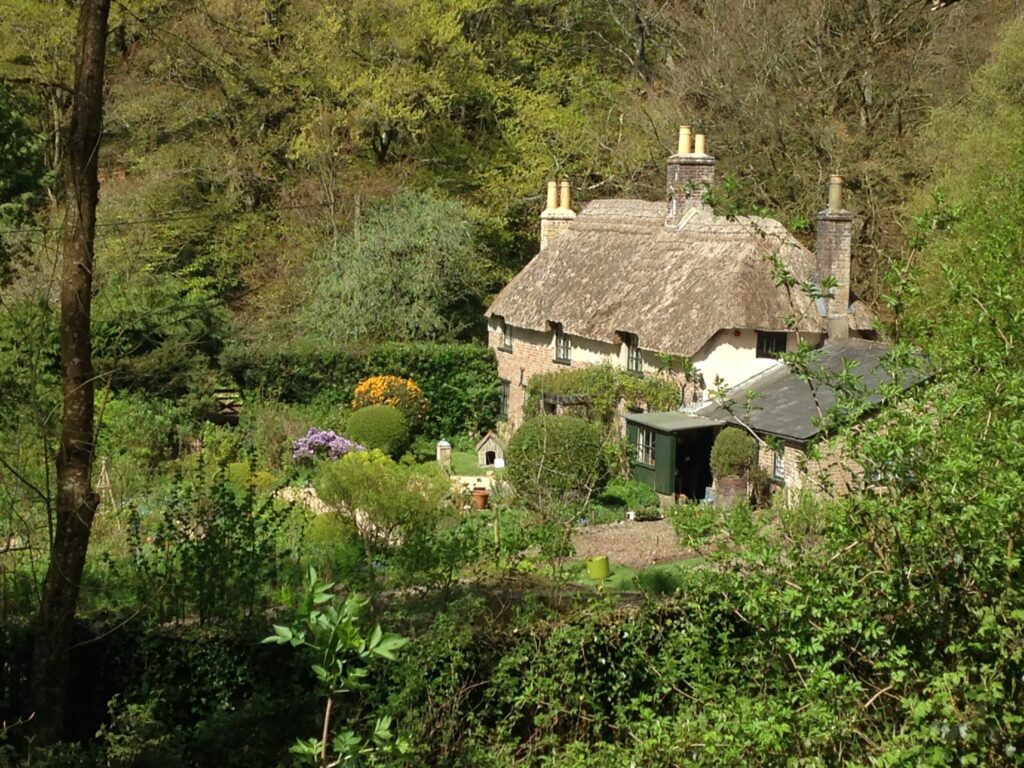
Photo by B. Morrison

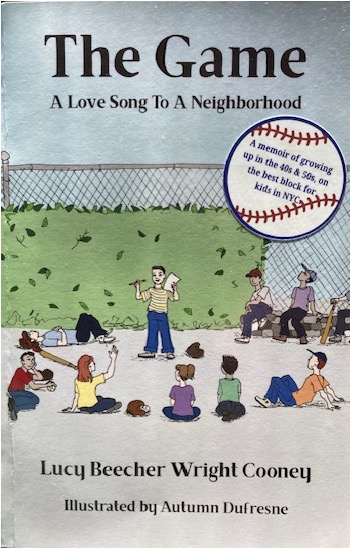
The Game, by Lucy Beecher Wright Cooney

Subtitled “A Love Song to a Neighborhood,” this first novel is a fictionalised account of an extraordinary game of baseball that did in fact take place in Cooney’s neighborhood when she was twelve years old.

In 1954 much of the U.S. was baseball-mad. My hometown certainly was. In my family listening to the game on the radio was a summertime staple. New York had three major league teams to cheer for: the Brooklyn Dodgers, the NY Giants, and the NY Yankees.

Cooney lived in Sunnyside Gardens, Queens, a mostly blue-collar neighborhood. Her block was laid out in a rectangle of apartment buildings and single-family homes surrounding a big green area with swings, tennis courts, and space for a baseball diamond.

After school and in the summer, Lucy and her friends gathered outside in that green space every day to play baseball. In those days (and in my slightly later childhood) even very young children were sent outside after breakfast and expected to entertain themselves, only turning up for meals.

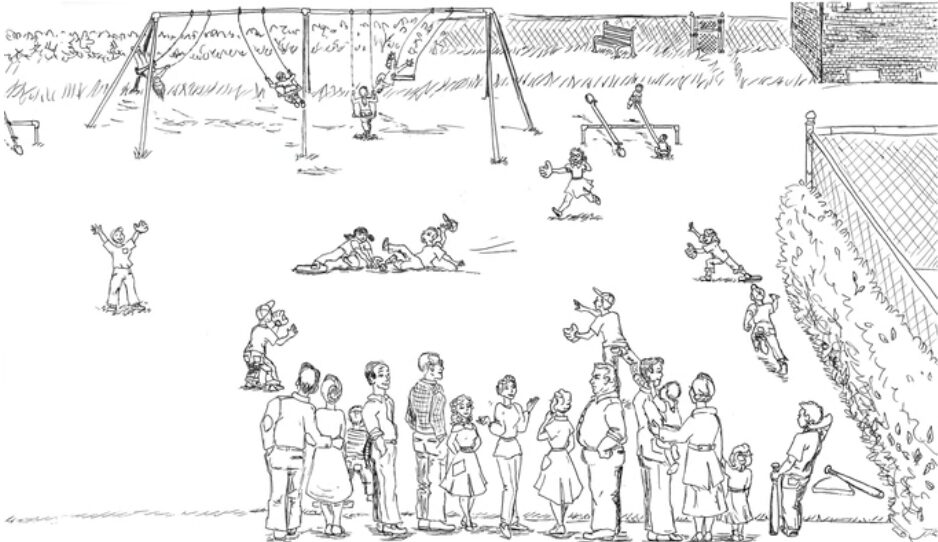
When the fathers on Cooney’s block realised that they might not be able to field a team for the annual July Fourth father-son game, one of the mothers suggested letting some of the mothers play. The dads laughed and dismissed the idea, so the moms challenged them to a dads-vs-moms game.

Illustration by Autumn Dufresne © Lucy Beecher Wright Cooney, used by permission

Since this was before women’s sports were a thing, few of the women could even throw or catch a ball. Then the children—girls and boys—decide to train the moms in secret so they’d be ready to take on the dads.

The suspense builds as the younger children act as lookouts to warn if any fathers were coming along. The older children wrestle with the idea of telling lies to their fathers in order to keep the secret. Along the way, Cooney brings each of the various children and adults into focus, using deft touches to make them memorable.

This irresistible tale could be characterised as a Middle Grade (MG) novel but is equally fun for adults. It’s also a time capsule so that everyone can glimpse what it was like to be a child in a 1950s New York working-class neighborhood.

I’m saddened that most of today’s children don’t get to experience the kind of freedom we had. Cooney herself says the story “doubles as a passionate plea to let kids alone to solve their own problems, thus allowing them to grow into independent, self-reliant people.”

It certainly worked for her. Cooney has been teaching, as well as driving a schoolbus, for decades. Senator Bernie Sanders featured her on his Bernie Buzz where he thanked her for her service to children and to the community. She was also featured on Stuck in Vermont in a segment titled Everyone Loves Lucy.

If you want a fun novel based on a true story that shows a community coming together, check out The Game. Ditto if you love baseball. Illustrations by Autumn Dufresne throughout the book add charm and help to bring to the story to life.

Unfortunately, this delightful self-published book is not available online. If you’re interested in a copy, let me know, and I’ll forward your request to the author.

I’m always on the lookout for books that celebrate community. Can you recommend one?

Disclosure of Material Connection: I received a copy of this book free from the author. I was not required to write a positive review. The opinions I have expressed are my own.