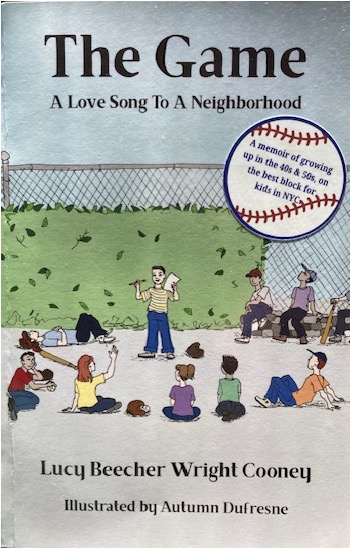
The Game, by Lucy Beecher Wright Cooney

Subtitled “A Love Song to a Neighborhood,” this first novel is a fictionalised account of an extraordinary game of baseball that did in fact take place in Cooney’s neighborhood when she was twelve years old.

In 1954 much of the U.S. was baseball-mad. My hometown certainly was. In my family listening to the game on the radio was a summertime staple. New York had three major league teams to cheer for: the Brooklyn Dodgers, the NY Giants, and the NY Yankees.

Cooney lived in Sunnyside Gardens, Queens, a mostly blue-collar neighborhood. Her block was laid out in a rectangle of apartment buildings and single-family homes surrounding a big green area with swings, tennis courts, and space for a baseball diamond.

After school and in the summer, Lucy and her friends gathered outside in that green space every day to play baseball. In those days (and in my slightly later childhood) even very young children were sent outside after breakfast and expected to entertain themselves, only turning up for meals.

When the fathers on Cooney’s block realised that they might not be able to field a team for the annual July Fourth father-son game, one of the mothers suggested letting some of the mothers play. The dads laughed and dismissed the idea, so the moms challenged them to a dads-vs-moms game.
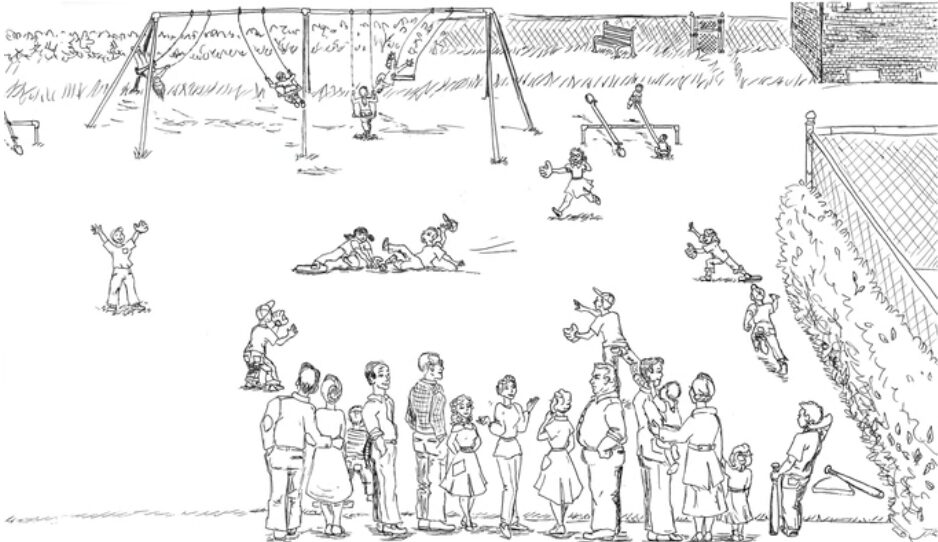
Illustration by Autumn Dufresne © Lucy Beecher Wright Cooney, used by permission

Since this was before women’s sports were a thing, few of the women could even throw or catch a ball. Then the children—girls and boys—decide to train the moms in secret so they’d be ready to take on the dads.

The suspense builds as the younger children act as lookouts to warn if any fathers were coming along. The older children wrestle with the idea of telling lies to their fathers in order to keep the secret. Along the way, Cooney brings each of the various children and adults into focus, using deft touches to make them memorable.

This irresistible tale could be characterised as a Middle Grade (MG) novel but is equally fun for adults. It’s also a time capsule so that everyone can glimpse what it was like to be a child in a 1950s New York working-class neighborhood.

I’m saddened that most of today’s children don’t get to experience the kind of freedom we had. Cooney herself says the story “doubles as a passionate plea to let kids alone to solve their own problems, thus allowing them to grow into independent, self-reliant people.”

It certainly worked for her. Cooney has been teaching, as well as driving a schoolbus, for decades. Senator Bernie Sanders featured her on his Bernie Buzz where he thanked her for her service to children and to the community. She was also featured on Stuck in Vermont in a segment titled Everyone Loves Lucy.

If you want a fun novel based on a true story that shows a community coming together, check out The Game. Ditto if you love baseball. Illustrations by Autumn Dufresne throughout the book add charm and help to bring to the story to life.

Unfortunately, this delightful self-published book is not available online. If you’re interested in a copy, let me know, and I’ll forward your request to the author.

I’m always on the lookout for books that celebrate community. Can you recommend one?

Disclosure of Material Connection: I received a copy of this book free from the author. I was not required to write a positive review. The opinions I have expressed are my own.

On the Rooftop, by Margaret Wilkerson Sexton

In the 1950s, San Francisco’s Fillmore District had a large Black population, contributing to its reputation as the largest jazz scene on the West coast. Vivian sees music as the ticket to give her three daughters a better life. Ever since hearing Ruth, her oldest, astound the church with her choir solo, Vivian has been training her to become a professional singer, adding Esther and Chloe, the youngest, as they began to show interest and talent.

By the beginning of this, Sexton’s third novel, the three are performing regularly at neighborhood clubs as the Salvations. Vivian drills them relentlessly on their routines up on the roof of their apartment building, inventing warmup exercises, song arrangements and dance steps.

Having endured racial violence in Louisiana, the death of her beloved husband, and the drudgery of her own nursing job, Vivian wants more for her daughters. Now, just as the dream seems within reach, with an offer for major representation, the three young women begin to second-guess the path they’ve been following.

The joys and conflicts between three sisters are familiar from fairy tales and folklore. Some of us (me) also have personal experience of these dynamics. Sexton shifts between Vivian’s point of view and that of each of the sisters, giving us their distinct personalities and desires, as well as their complicated relationships with their mother and each other.

Further difficulties arrive with White developers, maneuvering to drive out Black residents and business owners with underhanded tactics and cash offers. Clearing out Black people in the name of “urban renewal” happened in cities across the U.S. during the mid-twentieth century. Here, not only renters like Vivian are threatened, but also the owners of the clubs, the church that is so much a part of the family’s life, and the businesses where they work.

This is not an action-packed thriller, but rather a story of family and community, how love and tensions can co-exist within them, how one generation’s dreams may or may not be relevant to the next. Even big blow-ups are treated with realism rather than melodrama. This isn’t a typical rags-to-riches drama of an artist’s life, but something more real, more important.

I mostly identified with Vivian and her concern for her children. However, I can imagine younger readers being put off by the amount of control she exercised over her daughters, trying to direct their lives down the path of her choosing. Having grown up in the 1950s and 1960s, I can attest to how common it was back then for parents to expect to make such decisions for their children.

Also, as we just saw during the Olympics, to achieve at such high levels requires dedication and hard work from an early age. This family reminded me of Venus and Serena Williams and made me consider what sacrifices they had to make. It also made me wonder about the emotional negotiations that must have taken place between their dreams and their father’s.

I enjoyed this slow burn of a story, with its focus on relationships. Vivian, the three daughters, Vivian’s best friend Mary, even the Preacher are all vivid characters with their own dreams and desires, their own flaws. I found it a gift to be part of this family and their world for a little while.

Have you read a novel by Margaret Wilkerson Sexton? What did you think of it?