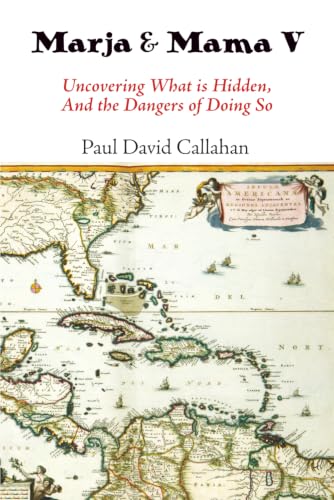
In 18th century Finland, fifteen-year-old Marja travels south with her beloved horse Timo and the young cow. She has buried her parents, taken together by fever, on their small farm and now goes to her aunt and uncle. She offers to build them a barn, and they are surprised by her expertise with wood, learned from her father, a builder. When she and her aunt go to collect hay at the shore, they encounter men working to repair their ship, a herring buss from Holland. Marja helps them with the work and eventually joins the crew of the Zeenimf.
Such a brief summary doesn’t do justice to the details Callahan uses to bring these scenes to life, from the white reindeer lichen broth Marja makes for her sick father to the “rushing chatter” of the river running over rocks when she goes to check the trot line for salmon. Where Callahan really excels, though, is in his descriptions of life at sea. Drawing on his own experience as a fisherman, he captures the thrill and terror of storms at sea as well as the work of an ordinary day.
To set the nets, four men are lowered into the double-ended tender to carry out and drop the driftnet’s end-buoy, a large barrel with a stick and colorful cloth at the top. Then, slowly as the Zeenimf drifts downwind, the black nets are paid out over the steep side of the big boat like a silky animal returning home to the deep.
Marja herself is a marvelous character: physically strong, quick to learn, with an intuitive understanding of both animals and people. Surprising turns take her and her new husband Vim to another ship and a dangerous voyage to Sint Eustatius, Statia for short, an island in the Caribbean, and later to trade outposts in North America.
The details about the Dutch colonies in the Caribbean were new to me, and Callahan provides just enough explanation to support the story without stalling it. Statia was known as “the warehouse of the Caribbean.” Owned by The Netherlands, its orthogonal position to the great rival countries—England, France, Spain—meant that these countries could trade with each other on Statia even when they were at war with each other. The island merchants were major suppliers to the revolutionaries in the American colonies and a transit depot for the slave trade.
Statia’s duty-free trade port attracted greedy, corrupt and dangerous men. The deeply moral Marja is shocked by such venality, but she and Vim find trusted friends with whom to build a life. Among them is Mama V, an accomplished midwife who still mourns the brother left behind in Africa when she was captured by slave traders.
There are a few little errors, leading me to suspect the book was rushed into print. I’m just grateful that Callahan was able to finish and launch it before his untimely death. I look forward to reading his memoir of his own life at sea, Door in Dark Water. As a writer, I’ve learned from him that we can look to our strengths, as he does in his vivid and realistic sections on sailing and fishing. We can fill in any gaps with research.
A rousing tale of adventure, narrow escapes, and difficult choices, this story gripped me and wouldn’t let me go until I finished it. My main takeaway, though, is the love: love of family, of purpose, the love and care for friends and co-workers, and the love of seafaring. For example, when Vim returns home from encounters in town, he finds Marja and their baby asleep.
The pair breathe in the soughing rhythms of the deepest sleep . . . In the corner of the bedroom, Mama V sits dozing in a rocker amidst bundles of freshly picked sea lavender tied like sheaves of wheat . . . [Vim] sinks into a deep chair in the ante room and lets the warmth of the scented room take him away to a dream. He is standing on a spar, aloft amid clouds of white canvas, and feeling the joy of a great press of wind on the sails, and its power driving the schooner beneath him.
What novel have you read that took you to strange and wonderful places?
Disclosure of Material Connection: I received a copy of this book free from the author’s family. I was not required to write a positive review. The opinions I have expressed are my own.
