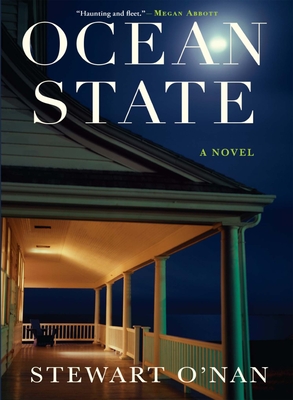
Sometimes an author writes about a place or time or circumstance that so accurately reflects a slice of your experience that reading their work feels like coming home. Their people are your people, so familiar, so themselves. Stewart O’Nan’s novels are like that for me.
At its heart, this story set in Ashaway, Rhode Island, in 2009 is about four women. Three of them are a constellation, a solid triangle: overweight and overlooked Marie, her older sister Angel—the beautiful one, the popular one—and their divorced mother Carol. Angel’s classmate Birdy is the fourth woman, with her own sister and mother. Birdy’s family is of Portuguese heritage, as so many people in that area are. Through these four women’s voices, the author takes us deep into their lives.
My library attaches a little comment form inside the back cover of novels so patrons can rate the book. On it, one person wrote that the characters were interesting but there was no plot. There is indeed a plot, though an unusual one: A reverse-chronology story starts with the ending and then proceeds to take us there. It’s hard to do in a way that doesn’t feel manipulative, but O’Nan succeeds, beginning the story with Marie’s earnest and honest voice.
When I was in eighth grade my sister helped kill another girl. She was in love, my mother said, like it was an excuse. She didn’t know what she was doing. I had never been in love then, not really, so I didn’t know what my mother meant, but I do now.
Both Angel and Birdy are fully and irrevocably in love with their classmate Myles. Angel and Myles have been together for three years, a legendary couple at their school, even though his well-to-do parents don’t approve of her. But he’s started seeing Birdy secretly as well, another triangle. We don’t learn much about Myles—he seems to be one of Gatsby’s careless people—but it’s not his story. Here’s Birdy leaving to meet him.
“I’m leaving,” she calls.
With a scraping her mother gets up from her chair and comes to see her off, tottering on her bad knees, the good water glasses inside the hutch tinkling as she crosses the dining room. Her mother is the wisest person she knows, attuned to the whole family’s moods. She knew Josefina was pregnant with Luz before Josephina did. Now Birdy’s sure she can tell, and hugs her too tightly, makes a show of taking her stupid visor from its peg. Everything she does is a lie.
They are all stuck in their places in this remote corner of the tiniest state in the country, in a mill-town where the mills have closed. The houses are wonderfully described, from the expensive beachfront mansion belonging to Myles’s parents where he takes his women for privacy, to the tumble-down house where Carol and her daughters live, across the road from the abandoned mill where her parents once worked. Marie says:
We weren’t happy that fall, in that rotting, underwater house, with everything we’d already lost, and everything still to come, but lying safe and warm under my grandmother’s afghan, eating popcorn and stealing glances at my funny, beautiful sister as the light played over her face, I wished we could stay there forever.
The bigger story is of people with—really—such modest dreams, whose lives are constricted by an economy and a society that offer little hope of achieving them. Carol wants a better life for her daughters, better than her job as an aide at a home for the elderly or Angel’s after-school work at CVS. Carol’s only plan to achieve that is to find a man, but her daughters call each new boyfriend a loser. Their father, too, is stuck. He comes around now and then to fix things and takes his daughters every other weekend to stay in his apartment over a Chinese restaurant.
I love O’Nan’s tenderness towards his characters, and I’m amazed by how accurately he summons the voices of these four women. Each page is sprinkled with little surprises: jolts of familiarity and unexpected insight. They combine with the compelling story to lure me on and on, even though I’ve been warned from the beginning that it will end in tragedy.
What novel have you read that feels like coming home?