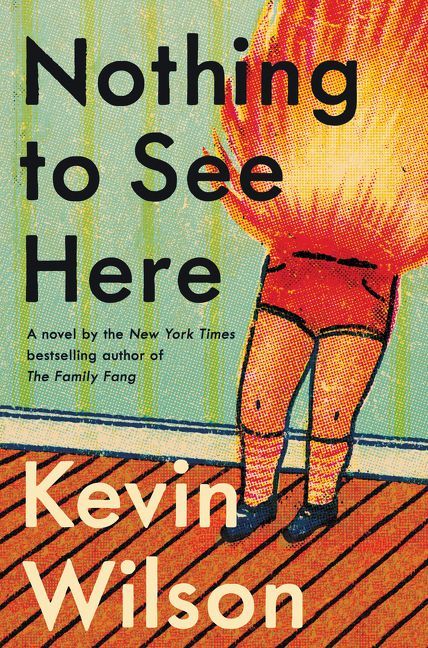
The cover gives the twist away. At least that’s what I thought before deciding with a sigh that I would actually read this story one of my book clubs chose. However, Lillian’s voice pulled me right in, and I raced right through to the end.
At twenty-eight Lillian is living in her mother’s attic, smoking pot and working dead-end jobs. Long ago she’d hoped to escape from this life by earning a scholarship to an exclusive prep school where she became besties with her roommate Madison, a spoiled rich girl. When Madison gets caught in a scandal, Lillian ends up taking the fall and basically gives up on life.
Now Madison needs her again and Lillian can’t help responding to the call. “I tried to think of a time when I hadn’t done what Madison had asked me to do. That time did not exist.”
Married to a senator with presidential ambitions, Madison needs to figure out how to handle the sudden imposition of the Senator’s twins from a previous marriage who are coming to live with them. She hires Lillian—the one person she can trust to keep a secret—to care for them. They are to be hidden away in a guesthouse while Madison finds a way to keep the twins permanently out of sight.
Why? Because Bessie and Roland burst into flames when they are angry or upset.
They are not harmed, though their clothes and everything else around them burn. Lillian doubts her ability to care for any child, much less these two. Her own mother is no role model, gambling away whatever money she can lay her hands on. Plus, as Lillian is the first to tell us, failure is her middle name.
So instead of wanting more, sometimes I just made myself want even less. Sometimes I made myself believe that I wanted nothing, not even food or air. And if I wanted nothing, I’d just turn into a ghost. And that would be the end of it.
The real twist in the story is how Lillian in her own weird way confronts the bizarre challenge of caring for these stubborn, angry and fiery children while shut away in secrecy.
I appreciate stories like this one where every aspect is completely realistic except for one magical element. Magical? Impossible? Anyone who has had to deal with a young child who has BIG FEELINGS might be forgiven for thinking the author is only slightly exaggerating.
Wilson brings so much humor and real insight to the story without shading into sentimentality. Even the rare tender moment is earned by all that has come before.
Some might feel that Madison, the Senator, and Lillian’s mother are flat or predictable. In my long life, I’ve lived among the very rich and among the very poor, and all three characters struck me as true to life. I’ve known so many people like them. It’s a challenge for a writer, though, to depict people who insist on acting like the worst caricatures of themselves.
What first registered for me in this story are the social barriers for anyone who is different. It’s not just senators who try to project an image of a perfect family, hiding away their rebellious or inconvenient children and relatives. You don’t have to spontaneously combust; it’s enough to be just slightly different for people to shy away from you or hysterically call for protection. In my small town quite a few people are screaming about a crime wave, but a question quickly finds that they are talking about panhandlers, none of whom have actually been violent or threatening in any way, just different. Panhandling, of course, is not a crime.
Then I came to believe that Wilson’s story—fun as it is to read—can be seen as being about power: what sort of power each character possesses, whether they know it or not, and how they use it.
Yet in the end, it is Lillian who lingers in my mind weeks after finishing the book, what she finds in the children and in herself. Her mother also stays with me, someone who, for all her faults, always allows her daughter to come home.
Can you recommend another novel that is both fun and thought-provoking?