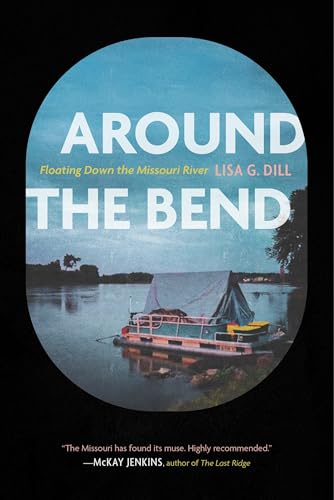
Around the Bend, by Lisa G. Dill

The title is slang for being crazy, and that’s how most people described Lisa Dill’s decision to go, as the subtitle says, Floating Down the Missouri River.

We don’t hear much about the Missouri, despite it being the longest river in the U.S. and one of the most dangerous. There’s the folksong Oh, Shenandoah (another river) with its refrain: “Away, we’re bound away, / Across the wide Missouri.” I’ve read stories set on the Platte, which is a tributary of the Missouri, and of course many stories set on the river it runs into: the Mississippi. Writers like Mark Twain and William Faulkner filled my imagination, enhancing childhood experiences of the Mighty Mississippi such as the night I spent on the Delta Queen, a sternwheel steamboat.

So I welcomed the chance to learn more about the Missouri. It runs from southern Montana through the Dakotas, between Iowa and Nebraska, along Kansas and into Missouri before emptying into the Mississippi. Along the way it gathers strength, not just from the Platte, but also from the Yellowstone River, the Big Sioux River, and many others.

Although she is a college professor in Delaware, Dill has family in Iowa. When she found that four of her mother’s cousins had decided to take their 40-year-old pontoon boat down the river from Sioux City, Iowa, to St. Louis, Missouri, where they would sell it, she jumped at the chance to join them.

True, the somewhat rickety boat was more suited to the lake where they’d always used it than to the powerful Missouri. But two weeks on their old FloteBote would give her a chance to get to know both the cousins and the river.

The book, recommended by the person who gave me Brave the Wild River about two women who paddled down the Colorado River in the Grand Canyon, surprised me by how it held my attention. Dill uses all of our senses to help us share the experience while also exploring some aspect of the Missouri River’s history, ecology, climate, geography, and role in the economy.

There are a few setbacks, like the engine not starting on the first day, and some alarming near misses, but for the most part the pace reflects the rolling of the river. My interest never wavered, and I read the book straight through. The tales Dill tells of recent floods and long-ago explorations, of attempts to tame the river and those who live near it, all provide plenty of drama.

Another reason it’s such a pleasure to read is simply how well Dill writes. Her sentences are clear and varied. They lead one into another in an easy, conversational way that must have been difficult to achieve so consistently. She’s simply an interesting person to hang out with for a while. Also, conversations with the cousins and with people they meet when they tie up for the evening pepper the story, providing a little variety.

Most important of all is the way she structures chapters to be a good balance of her personal experience and information that helps us better understand what we’re experiencing. Even complex information goes down easily; it’s hard not to be interested in such details. In a blog post, Dill writes:

I worked as hard as I could to create transitions, to figure out ways to move gracefully from the complexity of underwater engineering, flood data, and endangered species I hadn’t seen to the experience of sailing what one relative called “elderly flotsam” down the longest river on the continent. I sifted through mountains of research, looking for not just the important historical facts and scientific data, but for ways to connect it to the story of the trip, the story of my family, the story of the 40-year-old pontoon boat that somehow survived 750 miles on the Missouri River intact.

These transitions and connections are what make the story so engaging. I learned a lot about the Missouri, from the number of wrecked steamboats still never recovered to the ongoing attempts to rein in the river’s wanderings. These days I live where a large river joins an even larger river. The Abenaki called the area Wantastegok which means “at the place of the lost river.” We’ve suffered floods and droughts in recent years, so much of the story here resonated with me.

Also, as Dill points out, rivers hold a fascination for cultures all over the world, Often sacred and sometimes symbolic of eternal truths, rivers are as romantic and powerful a part of the landscape of our lives as oceans and mountains.

And then there’s the joy of embarking on a mad adventure like taking an old FloteBote down the river to where it ends.

What do you know about the Missouri River? What mad adventures would you like to undertake?

Commonwealth, by Ann Patchett

28214365

This 2016 bestseller has received lots of good reviews. It begins with an unexpected and uninvited guest arriving at the christening party for Franny, second daughter of Fix and Beverly Keating. Bert Cousins brings a bottle of gin as a present, something unexpected and unusual at a christening. As the party goes on, everyone gets drunk; most people behave badly; a priest gives up his vocation; and Bert, who has a pregnant wife and three children at home, falls in love with Beverly.

I was ready to stop halfway through this first chapter. I’m not a fan of stories of people behaving badly. I don’t find them funny, which is why I rarely watch any sitcoms. Yet many people have loved this book, according to Goodreads and various book reviews, and my book club had chosen it, so I plowed on.

In ten or so stand-alone vignettes like the first chapter, the story zigzags through the lives of the Keating and Cousins families. Two drawbacks of the book are the sheer number of main characters and the huge jumps in time and space from one chapter to the next. It was sometimes hard for me to figure out the chronology and also to keep track of which child belonged to which pair of parents.

The children’s lives are upended by the reckless decisions their parents make. The parents continue to neglect them, not just their emotional life but even their physical safety. At one point, the parents finally show up at the children’s motel room at 2 pm, saying that they “slept in”. What kind of parent does that?

Unsurprisingly, the children are little monsters. Left to their own devices and hating their parents, they entertain themselves by embarking on dangerous expeditions, drugging the youngest child with Benadryl, and carrying around Dad’s loaded gun.

I liked the vignettes where the children were older much better. Well, mostly. At least one, like some of the childhood vignettes, reminded me of a bad sitcom with things getting worse and worse, beyond the outer limit of credibility, with no humor to lighten it.

This is supposed to be a novel that explores blended families, which have become common as the divorce rate has soared. Yet the Keatings/Cousins families seem so cartoonishly awful that it is hard for me to see any useful insight into the concept. It’s not the blending of families that is the problem here; it is the selfishness of some of the four parents. It’s not as if we need another illustration of narcissism these days.

It’s also supposed to be a novel that explores the ownership of stories. Who gets to tell the story of your childhood? As a memoirist, this question is important to me. Patchett has said that she drew on her own memories to write it. And, to add some meta- to her fiction, she has included a much-older famous writer who becomes young Franny’s lover, listens to her stories, and then writes a novel based on them. The impact of the lover’s novel on the families is explored toward the end of the book, and was the part most interesting to me.

What kept me reading, besides my book club, was the structure. I was curious as to how these unconnected vignettes would hold up as a novel. For a long time it felt like a novel in stories, that is, a series of short stories only marginally related. But by the end, I did feel that the book cohered into a single novel.

Besides featuring the same eight characters throughout, Patchett accomplished that by her consistency of tone. One Goodreads reviewer complained about the tone, saying that it was distant and formal. I agree that it kept the reader at arm’s length. But I liked that. Usually I prefer to be immersed in a novel and live the story with the main character, but in this case, given these characters, I was happy to observe them from afar.

As always, these remarks are my own. Many, many people adored this book, and it got overwhelmingly positive reviews. To my surprise, most of these reviews talked of the humor the book, even citing some of the set-pieces that most horrified me as the most comical.

I think the difference is that I know parents like these and children like these, so I found the story heart-breaking rather than hilarious. I’m reminded of the time in my teens when a group of friends insisted I watch the sitcom All in the Family with them. I left at the first commercial break, near tears. To them, Archie Bunker and his family seemed so exaggerated as to be funny. To me, they were too close to my own family for me to be amused.

Have you read one of Patchett’s novels? What did you think of it?