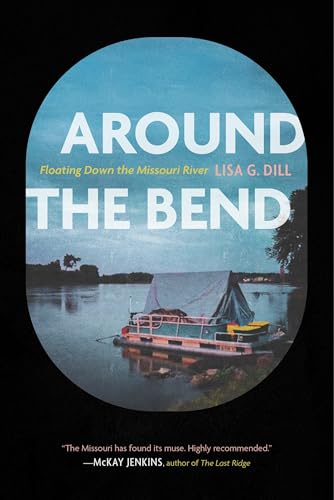
Around the Bend, by Lisa G. Dill

The title is slang for being crazy, and that’s how most people described Lisa Dill’s decision to go, as the subtitle says, Floating Down the Missouri River.

We don’t hear much about the Missouri, despite it being the longest river in the U.S. and one of the most dangerous. There’s the folksong Oh, Shenandoah (another river) with its refrain: “Away, we’re bound away, / Across the wide Missouri.” I’ve read stories set on the Platte, which is a tributary of the Missouri, and of course many stories set on the river it runs into: the Mississippi. Writers like Mark Twain and William Faulkner filled my imagination, enhancing childhood experiences of the Mighty Mississippi such as the night I spent on the Delta Queen, a sternwheel steamboat.

So I welcomed the chance to learn more about the Missouri. It runs from southern Montana through the Dakotas, between Iowa and Nebraska, along Kansas and into Missouri before emptying into the Mississippi. Along the way it gathers strength, not just from the Platte, but also from the Yellowstone River, the Big Sioux River, and many others.

Although she is a college professor in Delaware, Dill has family in Iowa. When she found that four of her mother’s cousins had decided to take their 40-year-old pontoon boat down the river from Sioux City, Iowa, to St. Louis, Missouri, where they would sell it, she jumped at the chance to join them.

True, the somewhat rickety boat was more suited to the lake where they’d always used it than to the powerful Missouri. But two weeks on their old FloteBote would give her a chance to get to know both the cousins and the river.

The book, recommended by the person who gave me Brave the Wild River about two women who paddled down the Colorado River in the Grand Canyon, surprised me by how it held my attention. Dill uses all of our senses to help us share the experience while also exploring some aspect of the Missouri River’s history, ecology, climate, geography, and role in the economy.

There are a few setbacks, like the engine not starting on the first day, and some alarming near misses, but for the most part the pace reflects the rolling of the river. My interest never wavered, and I read the book straight through. The tales Dill tells of recent floods and long-ago explorations, of attempts to tame the river and those who live near it, all provide plenty of drama.

Another reason it’s such a pleasure to read is simply how well Dill writes. Her sentences are clear and varied. They lead one into another in an easy, conversational way that must have been difficult to achieve so consistently. She’s simply an interesting person to hang out with for a while. Also, conversations with the cousins and with people they meet when they tie up for the evening pepper the story, providing a little variety.

Most important of all is the way she structures chapters to be a good balance of her personal experience and information that helps us better understand what we’re experiencing. Even complex information goes down easily; it’s hard not to be interested in such details. In a blog post, Dill writes:

I worked as hard as I could to create transitions, to figure out ways to move gracefully from the complexity of underwater engineering, flood data, and endangered species I hadn’t seen to the experience of sailing what one relative called “elderly flotsam” down the longest river on the continent. I sifted through mountains of research, looking for not just the important historical facts and scientific data, but for ways to connect it to the story of the trip, the story of my family, the story of the 40-year-old pontoon boat that somehow survived 750 miles on the Missouri River intact.

These transitions and connections are what make the story so engaging. I learned a lot about the Missouri, from the number of wrecked steamboats still never recovered to the ongoing attempts to rein in the river’s wanderings. These days I live where a large river joins an even larger river. The Abenaki called the area Wantastegok which means “at the place of the lost river.” We’ve suffered floods and droughts in recent years, so much of the story here resonated with me.

Also, as Dill points out, rivers hold a fascination for cultures all over the world, Often sacred and sometimes symbolic of eternal truths, rivers are as romantic and powerful a part of the landscape of our lives as oceans and mountains.

And then there’s the joy of embarking on a mad adventure like taking an old FloteBote down the river to where it ends.

What do you know about the Missouri River? What mad adventures would you like to undertake?

Walking, by Henry David Thoreau

walking

Thoreau first gave this talk in 1851 at the Concord Lyceum and continued to work on it afterwards. It was published in the Atlantic Monthly after he died in 1862.

My second book of poetry Terrarium is about the influence of place on our lives and personality—the place we grew up, our place in the family, perhaps the place we’ve always wanted to visit. Lately I’ve been thinking a lot about the categories of physical places in my life, a three-legged stool: home, society and the wild. With the pandemic, society is reduced almost completely to faces on the computer, leaving me pondering home and the wild and how we do or do not move among them.

First, let me be clear: wild is a relative term. There is no virgin wilderness here in North America, and never was except perhaps when the first people tramped across the Bering Land Bridge from Siberia. There is untended land, here in New England some of it was once farmland, laboriously carved out of the forest, abandoned when the economy collapsed leaving remnants of stone walls in the woods. There are lightly managed forests, with walking trails and sometimes efforts to remove invasive species. These suffice for my experience of the wild.

Now we have learned through new research that there is more going on in the woods than we realised, that trees communicate with each other and form their own society. Richard Powers’s bestseller The Overstory explores these ideas further through several sets of characters.

The fairy tales we hear as children are often about venturing into the wild—Into the Woods, as Stephen Sondheim put it—and discovering our own talents and values as we encounter its dangers. The journey becomes a metaphorical basis for nearly all of our stories, the hero’s journey described by Joseph Campbell.

And then there’s coming home. For many people, the immediate shock of the pandemic’s stay-home orders was to actually be at home all the time, not spending most daylight hours at work or school or the myriad activities that fill some children’s schedules, not going out in the evenings to a restaurant or concert or pub.

For all the decades I was working a day job, the thought of being at home all day seemed like nirvana. I had worked hard to make my home a place where I wanted to be, that fostered my favorite activities and soothed my soul, yet spent most of my days in offices and laboratories. When I retired a few years ago from that job to write, I feared that being home all the time would not be the paradise I’d expected. Reader, it was. And is. Though I recognise that my personality is particularly well-suited to this life.

I also walk. A lot. Aside from the obvious health benefits of exercise, recent studies have shown the positive effects—mental, physical and emotional—of spending time in nature.

So, belatedly, we come to Thoreau. Most famous for his two years in the woods by Walden Pond, he was fascinated by natural history, anticipating what we now call ecology and environmentalism.

He begins this essay:

I wish to speak a word for Nature, for absolute Freedom and Wildness, as contrasted with a freedom and culture merely civil,—to regard man as an inhabitant, or a part and parcel of Nature, rather than a member of society.

Where he wins my heart comes a little later when he says:

I confess that I am astonished at the power of endurance, to say nothing of the moral insensibility, of my neighbors who confine themselves to shops and offices the whole day for weeks and months, aye, and years almost together . . . I wonder that about this time, or say between four and five o’clock in the afternoon, too late for the morning papers and too early for the evening ones, there is not a general explosion heard up and down the street . . .

He’s not just extolling the opportunity for exercise, but having the time to “walk like a camel, which is said to be the only beast which ruminates when walking.” Also, as a Transcendentalist, he considers what we can learn from nature, extolling even swamps and bogs as jewels.

I will leave you to enjoy the rest of this delightful and thought-provoking essay for yourselves. It’s readily available online. It’s time for me to take a walk.

Where are your favorite places to walk?

Selected Poems II, 1976-1986, by Margaret Atwood

9780395454060_p0_v2_s550x406

I came to Atwood through her fiction, but it is her poetry that has come to mean the most to me. For me, her poems from this period expressed my own complicated mix of sorrow, pity, praise, and controlled rage.

As in her fiction, Atwood sometimes uses a female protagonist to shed new light on social issues. Most poems about the myth of Orpheus focus on his divine music and tragedy of his trip to the underworld to bring his wife Eurydice back to the realm of the living. However, Atwood’s “Orpheus (1)” gives us the voice of Eurydice who says, “the return/to time was not my choice.” She speaks of his “old leash . . . love you might call it” and says:

Before your eyes you held steady
the image of what you wanted
me to become: living again.
It was this hope of yours that kept me following.

In these few lines, Atwood captures the frustration of women wanting to be seen for themselves, not something to be molded to their husband’s fantasy, along with the patient kindness, the desire to spare him hurt that keeps us silent.

Myths and fairy tales are subtexts in many of these poems. In “Variation On The Word Sleep”, she alludes to several fairy tales, including one of my favorites: The Twelve Dancing Princesses.

I would like to give you the silver
branch, the small white flower, the one
word that will protect you
from the grief at the center
of your dream, from the grief
at the center I would like to follow
you up the long stairway
again & become
the boat that would row you back
carefully, a flame
in two cupped hands . . .

Atwood’s Canadian identity has informed much of her critical work, including her landmark book Survival: A Thematic Guide to Canadian Literature. Published in 1972, it makes a case that Canadian literature reflects a unique national identity, one derived from the harsh conditions in the frozen north and the clear-eyed accounts by early pioneers trying to survive in the wilderness. This somber theme works its way through many of the poems in this collection, sometimes emerging in strong, unpretty images. In “Flying Inside Your Own Body”, for example, she describes

Waking, your heart is a shaken fist,
a fine dust clogs the air you breathe in;
the sun’s a hot copper weight pressing straight
down on the thick pink rind of your skull.

That sense of the landscape as something hostile is tempered by her ecological awareness and sometimes difficult love for the things of this world. In “Marsh, Hawk” she describes a swamp and “a mass grave” of detritus—rotten trees, old tires, bottles and cans—that “spreads on the / land like a bruise.” But the poem takes a left turn in the middle, as so many of Atwood’s poems do, as the speaker wants the marsh rushes / to bend aside, the water / to accept us”, to become one with the complicated beauty of the physical world.

In much of her writing, Atwood draws inspiration from historical figures, particularly Canadian ones, such as Susanna Moody. Some of the poems in this collection seem to draw on this awareness. Sometimes she seems to be speaking for those who came before us.

In Negotiating with the Dead, a collection of her Empson lectures, she says, “Not just some, but all writing of the narrative kind, and perhaps all writing, is motivated, deep down, by a fear of and fascination with mortality – by a desire to make the risky trip to the Underworld, and to bring something or someone back from the dead.”

What themes or preoccupations do you see in one of your favorite writers?