The Quiet Librarian, by Allen Eskens

Hana Babić is at work in the stacks of her library in Minnesota when she is approached by Detective David Claypool. He tells her that her best friend Amina is dead, possibly murdered, in a fall from her balcony.

I expected Hana to be shocked and saddened by the news, and she is. What I didn’t expect was for her to immediately become tense and guarded.

Claypool came to Hana because he is investigating Amina’s death, and her will names Hana as the guardian for her young grandson Dylan. Hana responds by stating that there is no way Amina committed suicide. Her firm convictions and thoughts reveal her to be something more than the modest, self-effacing woman her colleagues call “the sweater lady” because of her cardigans.

It turns out that Hana originally lived in Bosnia as Nura Divjak. At the start of the war, 17-year-old Nura vows to find and kill the Serbs who raped her mother and murdered her family. Eventually she joins a militia as a warrior and spy. She’s so feared by the Serbs that a legend grows up around her; they call her the Night Mora. When they put a bounty on her head, the militia help her emigrate to the U.S. with a new identity.

Now she wonders if that 30-year-old bounty is what led to Amina’s death. Amina would never have revealed Hana’s identity and whereabouts; she’d proven her ability to withstand torture back in Bosnia. Hana feels responsible and must protect Dylan as well as find her friend’s murderer.

As the tension grows, the story moves back and forth between the two time frames: Bosnia in 1995, where the details of Hana’s past emerge, and the present day in Minnesota, where she has to decide how much to reveal to Claypool and whether to help him or work independently.

I often wanted to look away, overwhelmed by the tragedies I experienced along with Hana, but I couldn’t. Such a complex and fascinating character! I just wanted to learn all I could about her and her life. The other thing that kept me reading had to do with the way the author withheld and revealed information. I would love to see his map for the book, if he had one.

Eskers also does such a good job of arranging the two storylines so that, despite their covering different places and times and events, the book feels unified. The jump between the two never felt jarring to me. However, it did seem unrealistic that a detective would reveal so much information to a stranger and potential suspect.

I came away with the song War, by Norman Whitfield and Barrett Strong, in my head. What makes people one day turn on their neighbors and believe that they are justified in raping and killing them and stealing their property? If you avenge your family’s death by killing their murderers and then their survivors come after you, where does the cycle of revenge end?

“War . . . What is it good for?”

Have you read an absorbing historical fiction book with a dual timeline?
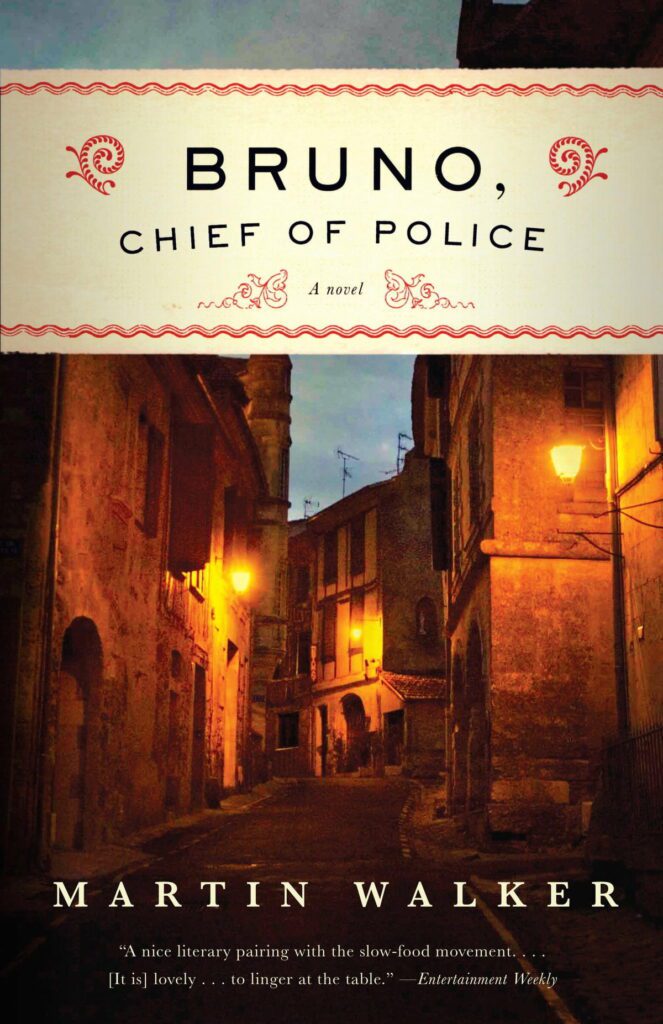
Bruno, Chief of Police, by Martin Walker

In Saint-Denis, a small French village in the Dordogne, Bruno Courrèges is indeed the chief of police. He’s also the only member of the Police Municipale. This fictional village is so quiet that Bruno keeps his gun locked in a safe in his office while he works with the mayor to keep the peace. When not handling the rare parade or dealing with minor matters—the 2,900 denizens love to report each other and mislead the EU’s bureaucrats—he plays rugby and teaches tennis to the town’s children.

The village seems so idyllic, with its slow pace and everyone gathering for coffee in their café of choice, its weekly market and nicknames for everyone, that at first I thought the story must be set in the distant past. However, we learn that Bruno has been chief for ten years, after taking refuge in Saint-Denis following his service in Bosnia with the French Army as part of the UN peacekeeping force. A little addition makes the timing of the story to be shortly before the book was published in 2008.

Bruno seems to be in his thirties and full of surprises. He’s restored a shepherd’s cottage and lives there peacefully with his basset hound Gigi and a wood full of truffles. An excellent cook, he makes use of local ingredients and recipes. The descriptions of meals are simply luscious, worth rereading and salivating over. But when a peace march is disrupted by militants from the anti-immigrant National Front, Bruno’s hand-to-hand fighting skills come to the fore.

Trouble comes unexpectedly when an elderly North African man is found murdered, with a swastika carved into his chest. Bruno knows the family—he knows everyone—and learns that the old man had fought for France in the Algerian war and won the Croix de Guerre. The medal has now been stolen, presumably by the murderers.

That, along with the swastika, lead Bruno and the mayor to think at first that the culprits are Front National types. Anti-Arab sentiment is strong in the village, though most inhabitants consider their neighbors French citizens and support them when militants try to stir things up.

Whether it’s a picnic at sunset or a fight scene in the Mairi, the writing is evocative and absorbing. I especially liked the deliberate pacing of the book. Some might find it too slow, but I thought it suited Bruno’s personality and his calm, thoughtful way of dealing with problems. The solutions he finds are sometimes surprising and always entertaining. The mystery itself is interesting, with some unexpected turns and a satisfying ending.

But it’s the village that will make me pursue the rest of the series. Just as I read Louise Penny’s books mostly to return to Three Pines, I’ll be reading the rest of Walker’s series to return to the Dordogne and inspect the caves in the limestone, to feast on truffle omelets and have a petit blanc at Fauquet’s café.

Despite the murder and the long memories of WWII and the French-Algerian War, Bruno and his village are a delightful place to spend an afternoon. Even Momu, son of the victim, expresses the philosophy that “there were some problems beyond human solution, but none beyond human kindness.”

Have you read a novel recently that made you want to drop everything and go to the place where it is set?

A Life of One’s Own, by Marion Milner

“Perhaps if one really knew when one was happy one would know the things that were necessary in one’s life.” Marion Milner

In 1926 Marion Blackett (later Milner) set out to discover “what kinds of experience made me happy.” Although armed with a First Class Honours Degree in Psychology and working in that field lecturing and researching, the twenty-six-year-old became aware that she was dissatisfied with the life she was living.

Among the possible cures she considered were adopting the habits of her peers or the standards of her parents’ generation. She also discarded the idea of following her own reason or developing a logical argument. She says, “So I began to have an idea of my life, not as the slow shaping of achievement to fit my preconceived purposes, but as the gradual discovery and growth of a purpose which I did not know.”

To learn what made her happy, Marion decided to examine her own perception, that is, her senses. Instead of making “the centre of awareness in my head,” she chose “knowing with the whole of my body.” In doing so, she takes Virginia Woolf’s A Room of One’s Own and expands upon it by offering a potential process for creating space in that room.

The process she chose started with keeping a diary of times she felt happy. Later she added freewriting to examine her entries further. Finally, she began writing this book, partly so she would have a record of this exploration and partly in the hope that others might find the process useful. Many of the epigraphs for the chapters come from Robinson Crusoe, echoing her deliberate isolation in this endeavour.

I wish I’d first read this book when I was young. Now that I’m well gone in years, I find myself greeting many of her discoveries and insights like old friends. For example, she found that once she started noting down when she was happy, she noticed more and more things that brought her joy, anticipating our current interest in paying attention, mindfulness and gratitude. Also, she found that being out in nature brought her joy, as did clearing out the spaces in her home.

Still, I enjoyed following the peculiar track of her mind, as she resists her temptation to control her thoughts instead of leaving them to themselves. Her prose, too, is clear and jargon-free. As someone who has kept a journal for most of my life, I also liked reading her excerpts and her thoughts about the value of her diary entries.

I also found the thoughts and preoccupations of a woman of that time interesting. The seven years she spent on this work held tumult and uncertainty, both personally and politically. During that time, the western world was roiled by the Great Depression and the run-up to World War II. She herself married Dennis Milner, had a child, and moved from Britain to the U.S.

What made me actually pick up the book, though, is that I love reading about people who shrug off society’s roles and rules in order to create their own lives from scratch. Many of us who came of age in the late 1960s and 1970s chose to reject the straitjacket of that era’s roles in order to find our own path, often without any models to guide us. In midlife I found I needed to remake my life, and again after I retired. Perhaps this effort, though most intense when we’re young adults, is one we come back to again and again.

Are you happy with your life? What might you change about it?

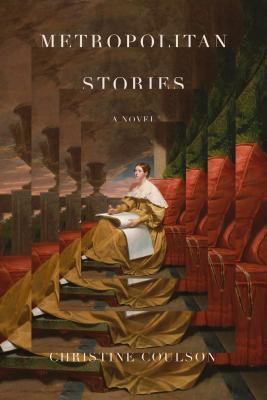
Metropolitan Stories, Christine Coulson

This month’s pick seemed perfect for one of my book clubs. Advertised as a behind-the-scenes look at The Metropolitan Museum of Art in New York by someone who’d worked there for twenty-five years, it seemed designed to appeal to frequent visitors and fans like us. Indeed, we all enjoyed revisiting a favorite place. Most of our group praised it, some enthusiastically, some less so, but still finding it light-hearted fun.

My own reactions were mixed. I found some of the stories amusing, some poignant, and a couple  astonishing. However, I felt perturbed while reading the book, as though I were waiting for it to settle down and actually get started. Part of that feeling came from the declaration on the cover that the book is a novel when it is actually a collection of short stories with almost nothing to connect them except that they all take place at the Met. It is true that occasionally a character or item turns up in another story.

The styles of the stories are inconsistent, ranging from magical realism to satire to naturalism. The surreal aspect to some of the stories—artworks personified, instances of time travel—is well done. Still, the piecemeal nature of the stories left me longing for some kind of thematic through-line other than the museum itself. I wondered if the stories could have been arranged differently to provide better transitions between them. Again, though, almost everyone else in my book club enjoyed it immensely as is.

The other part of my feeling perturbed is a result of my expectations for the book. Not only did it not seem like a novel, there was little of the promised behind-the-scenes aspect. Yes, we visited the basement and the office of the director. We shared a neurotic curator’s worries about an upcoming exhibition and attended a fund-raising dinner. It was rather superficial, though. Once you take away the ghosts and talking artworks, it seemed no different from any other office workplace and many of the characters the sort of people you’d find in any business.

Maybe I shouldn’t have expected much of a theme or emotional depth from what’s clearly meant to be a light read. Yet a couple of the stories do achieve both with brilliant results, so I found myself wishing the author had done more. Even in the superficial stories, there are hints of themes that could be developed.

The Met itself raises some expectations. Despite their delight in the book, some members of my book club were disappointed that with all of the wonderful art at the Met, little was made of the emotional impact of the art itself. We expected more wonder perhaps. A rare exception is this description of one piece of sculpture..

This particular Adam was a favorite of scholars, but not of the visitors who crowded around other, more famous sculptures at the Met. His pure white form was the first life-sized nude of the Renaissance, idealized and simplified, with uninterrupted planes of muscle and a soft, dreamy grace. Supported by his right leg, his left foot lifted lightly off the ground, Adam was an art historian’s work of art: garden sculpture to most, but revolutionary to those who understood his historical force.

Of course, it’s the author’s book and her choice, and readers’ expectations are their problem, not the author’s. However, in this case, expectations could have been managed by not calling it a novel and not emphasizing behind-the-scenes revelations. Another way to manage expectations would be to order the stories to better lead the reader into the world of the museum. For example, I and one other member of my book club were offended by one of the stories, and since it was right up front, it colored my reading of the rest of the book. I might have had a different reaction to the book if that story had been later.

Perhaps some of these decisions came from the publishers. This author clearly had terrific writing skills; the couple of astonishing stories in this collection prove that. I’m saddened to find that she passed away earlier this year, a terrible loss to her friends and family as well as to the literary and art worlds. I wonder if this book might have been different if she’d had more time to work on it. I plan to read her other book and her shorter pieces which are available on her website.

What novel have you read that’s set in a museum?

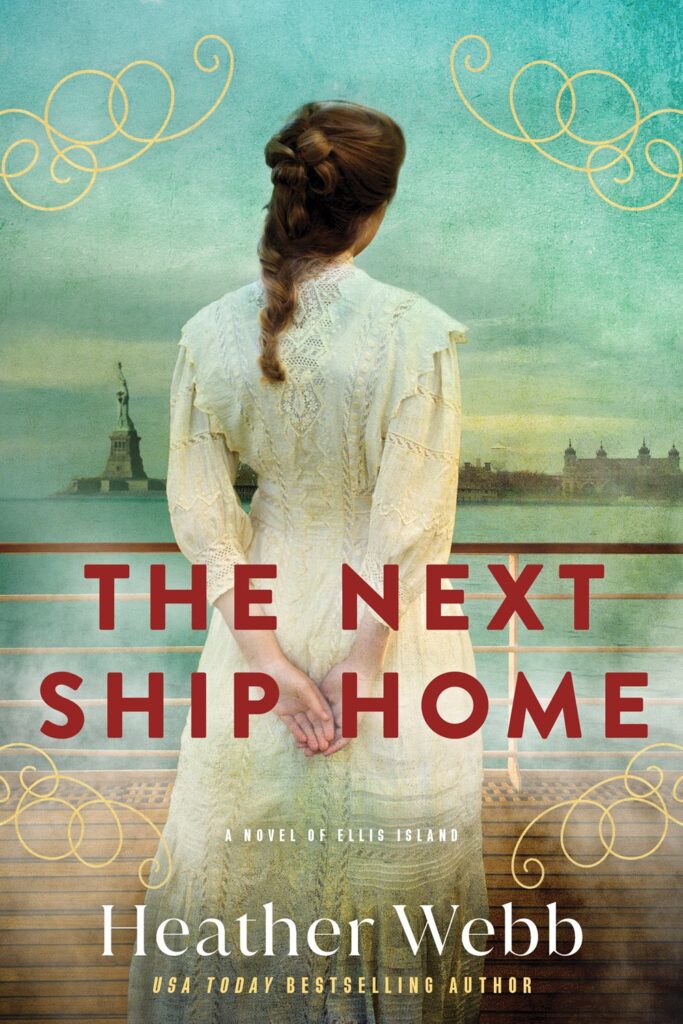
The Next Ship Home, by Heather Webb

Two sisters from Sicily arrive at Ellis Island in 1902 after a nightmare ocean journey. Fleeing their abusive father, they hope to build a new life together in the U.S. However, Francesca worries that her beloved sister Maria will not pass the health exam; she has become ill in the crowded and unsanitary third-class compartment where they were confined. They might both be sent back to Sicily on the next ship.

Meanwhile Alma, a second-generation German-American, lives in a tenement in the Lower East Side’s Little Germany where her stepfather owns and runs a bierhaus in the basement. He thinks Alma is worthless and mocks her interest in learning languages spoken by their Irish and Italian neighbors. Deciding her unpaid labor in the bierhaus and home is not enough, he forces her to take a job at Ellis Island processing new arrivals telling her she must give her pay to him to help support the household.

Although Alma starts her new job filled with the prejudice against immigrants she’s learned at home, her compassion is stirred by the fear and suffering she encounters, and she gradually learns that these are just people like herself. Becoming especially close to Francesca and Maria, Alma works hard at her language skills so she can help by translating for those who don’t speak English. She also tries to find ways around the roadblocks put in place by the bureaucracy and some corrupt officials.

At first Alma doesn’t believe the whispered stories of extortion and abuse at Ellis Island—carefully researched by the author and based on real events—but Francesca has first-hand knowledge of them. The courage of two women and the growing friendship between them are inspiring.

Unlike some historical fiction that glosses over the practical details of everyday life, the author gives us a full picture of these women’s lives. I love that Webb has chosen to portray this neglected but important part of history: the corruption at Ellis Island, the mutual support of the downtrodden, and the dreams that women fight for despite the forces arrayed against them.

The story also follows Francesca after she leaves Ellis Island, providing unusual insight into this critical phase, including the hoops that new immigrants—especially women—must jump through and the traps they must avoid. I’m learning so much these days about the immigration process as I follow the news, so I appreciate the author’s depiction of the inner lives of both Francesca and Alma.

As we confront and protest against the atrocities visited upon legal immigrants in this country by a rogue regime, I found both comfort and inspiration in this story. Corruption and the abuse of immigrants have a long history in the U.S. and Webb’s portrait of the Ellis Island bureaucracy shows the range of workers, from those who actively abuse arriving immigrants to those who look the other way to those who try to help the new arrivals as best they can. At the same time, Webb shows what seemingly powerless people can accomplish by working together.

Can you recommend a fiction or nonfiction book about the history of Ellis Island?