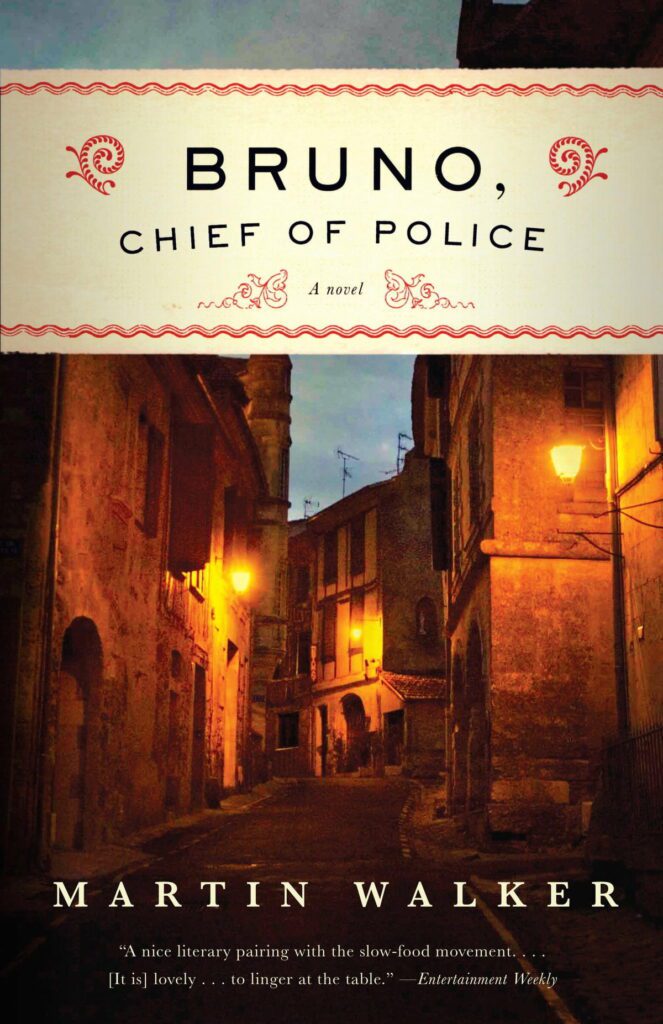
In Saint-Denis, a small French village in the Dordogne, Bruno Courrèges is indeed the chief of police. He’s also the only member of the Police Municipale. This fictional village is so quiet that Bruno keeps his gun locked in a safe in his office while he works with the mayor to keep the peace. When not handling the rare parade or dealing with minor matters—the 2,900 denizens love to report each other and mislead the EU’s bureaucrats—he plays rugby and teaches tennis to the town’s children.
The village seems so idyllic, with its slow pace and everyone gathering for coffee in their café of choice, its weekly market and nicknames for everyone, that at first I thought the story must be set in the distant past. However, we learn that Bruno has been chief for ten years, after taking refuge in Saint-Denis following his service in Bosnia with the French Army as part of the UN peacekeeping force. A little addition makes the timing of the story to be shortly before the book was published in 2008.
Bruno seems to be in his thirties and full of surprises. He’s restored a shepherd’s cottage and lives there peacefully with his basset hound Gigi and a wood full of truffles. An excellent cook, he makes use of local ingredients and recipes. The descriptions of meals are simply luscious, worth rereading and salivating over. But when a peace march is disrupted by militants from the anti-immigrant National Front, Bruno’s hand-to-hand fighting skills come to the fore.
Trouble comes unexpectedly when an elderly North African man is found murdered, with a swastika carved into his chest. Bruno knows the family—he knows everyone—and learns that the old man had fought for France in the Algerian war and won the Croix de Guerre. The medal has now been stolen, presumably by the murderers.
That, along with the swastika, lead Bruno and the mayor to think at first that the culprits are Front National types. Anti-Arab sentiment is strong in the village, though most inhabitants consider their neighbors French citizens and support them when militants try to stir things up.
Whether it’s a picnic at sunset or a fight scene in the Mairi, the writing is evocative and absorbing. I especially liked the deliberate pacing of the book. Some might find it too slow, but I thought it suited Bruno’s personality and his calm, thoughtful way of dealing with problems. The solutions he finds are sometimes surprising and always entertaining. The mystery itself is interesting, with some unexpected turns and a satisfying ending.
But it’s the village that will make me pursue the rest of the series. Just as I read Louise Penny’s books mostly to return to Three Pines, I’ll be reading the rest of Walker’s series to return to the Dordogne and inspect the caves in the limestone, to feast on truffle omelets and have a petit blanc at Fauquet’s café.
Despite the murder and the long memories of WWII and the French-Algerian War, Bruno and his village are a delightful place to spend an afternoon. Even Momu, son of the victim, expresses the philosophy that “there were some problems beyond human solution, but none beyond human kindness.”
Have you read a novel recently that made you want to drop everything and go to the place where it is set?