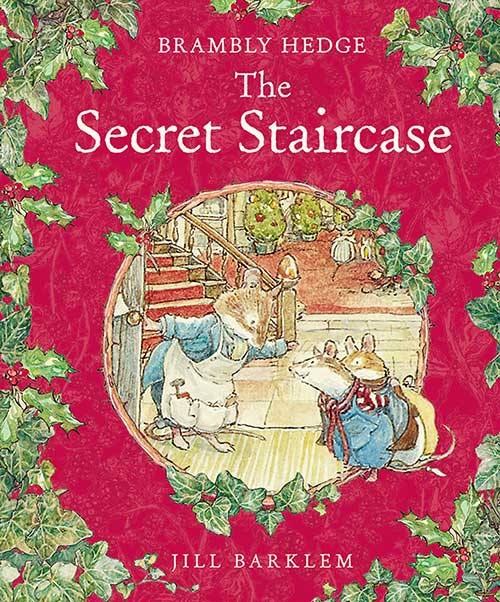
The children in my life love this story, part of the Brambly Hedge series. They are fascinated by the idea of a hidden stair and rooms that have long been locked up. Who isn’t? Surely I wasn’t the only child who went around tapping on walls and measuring the inside and outside of houses, hoping to find a secret passage or cobweb-laden room that no one remembered was there.
In this story, young Wilfred arrives at the Old Oak Palace along with Mr. Apple and the other children to prepare for that night’s big midwinter’s eve celebration. Lord Woodmouse and his daughter Primrose welcome them, and the two children go off to find costumes and to practice the poem they are to recite.
With all the bustling preparations Wilfred and Primrose have trouble finding a quiet place to practice until they enter a crowded storeroom at the end of a passage. However, they get distracted by all the things around them. Primrose explores a dresser and finds a small key in a drawer. Wilfred pulls at a green curtain that reveals a locked door hidden behind it. To their delight, Primrose’s key opens it.
Thus begins their adventure, all the more beguiling because of Barklem’s illustration of a secret stairway within the huge oak tree.
Why are we so drawn to hidden passages, mysterious rooms, and secret gardens? Though I was a practical child, I liked to imagine there was more to the world than the bare bones I could see, hear and touch. It could be a legend, a family story, or a bit of history about a place. It could even be the possibility that a dense forsythia bush hid a unicorn.
J.R.R. Tolkien wrote about adding what he called shimmer to his stories. He said that creating histories and legends around ordinary objects made them more real by adding the dimension of time—hence all his references in The Hobbit and Lord of the Rings to certain legends and songs. Sketching in those shimmering ghosts of the past can deepen the texture of the world in any story.
I’ve always been fascinated by houses anyway. My walk to and from school took me past a variety of houses large and small. I’d try to guess the layout of the bedrooms from what I could see of the windows and decide which room I would want to have. I used one of my favorites as the cover for my poetry collection Terrarium.
Gaston Bachelard in The Poetics of Space says:
. . . if the house is a bit elaborate, if It has a cellar and a garret, nooks and corridors, our memories have refuges that are all the more clearly delineated. All our lives we come back to them in our daydreams . . . In its countless alveoli space contains compressed time. That is what space is for.
Another reason to search for these hidden spaces is the thrill of entering a place where no one has been for years and years. Or perhaps ever: my brother, a lifelong caver, was part of the first team to explore Lechuguilla when it was discovered in New Mexico. He described for me that feeling of being the first person ever to step into a particular chamber.
While that’s not something I’ll probably ever experience, I like the idea of including a little bit of mystery in stories by the discovery of some hidden place. Adding shimmer to the place by giving it a history or legend would deepen its appeal. Perhaps readers would add their own shimmer as they remember being young and looking for a disguised door that might hide a secret staircase.
Did you ever search for hidden passages or secret spaces when you were young?