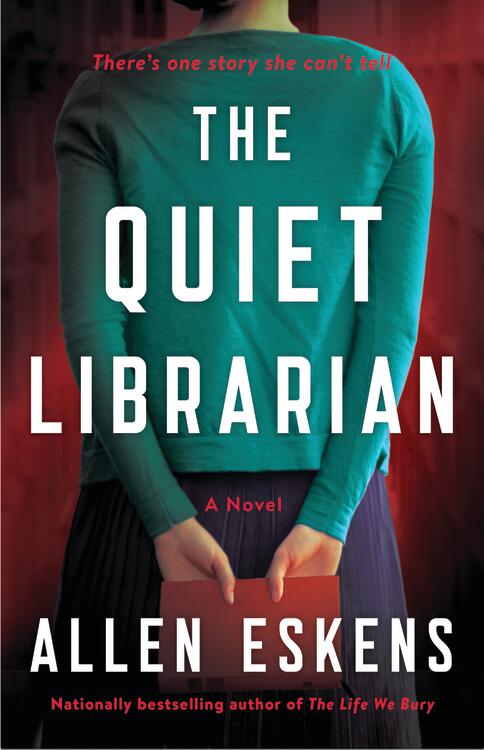
The Quiet Librarian, by Allen Eskens

Hana Babić is at work in the stacks of her library in Minnesota when she is approached by Detective David Claypool. He tells her that her best friend Amina is dead, possibly murdered, in a fall from her balcony.

I expected Hana to be shocked and saddened by the news, and she is. What I didn’t expect was for her to immediately become tense and guarded.

Claypool came to Hana because he is investigating Amina’s death, and her will names Hana as the guardian for her young grandson Dylan. Hana responds by stating that there is no way Amina committed suicide. Her firm convictions and thoughts reveal her to be something more than the modest, self-effacing woman her colleagues call “the sweater lady” because of her cardigans.

It turns out that Hana originally lived in Bosnia as Nura Divjak. At the start of the war, 17-year-old Nura vows to find and kill the Serbs who raped her mother and murdered her family. Eventually she joins a militia as a warrior and spy. She’s so feared by the Serbs that a legend grows up around her; they call her the Night Mora. When they put a bounty on her head, the militia help her emigrate to the U.S. with a new identity.

Now she wonders if that 30-year-old bounty is what led to Amina’s death. Amina would never have revealed Hana’s identity and whereabouts; she’d proven her ability to withstand torture back in Bosnia. Hana feels responsible and must protect Dylan as well as find her friend’s murderer.

As the tension grows, the story moves back and forth between the two time frames: Bosnia in 1995, where the details of Hana’s past emerge, and the present day in Minnesota, where she has to decide how much to reveal to Claypool and whether to help him or work independently.

I often wanted to look away, overwhelmed by the tragedies I experienced along with Hana, but I couldn’t. Such a complex and fascinating character! I just wanted to learn all I could about her and her life. The other thing that kept me reading had to do with the way the author withheld and revealed information. I would love to see his map for the book, if he had one.

Eskers also does such a good job of arranging the two storylines so that, despite their covering different places and times and events, the book feels unified. The jump between the two never felt jarring to me. However, it did seem unrealistic that a detective would reveal so much information to a stranger and potential suspect.

I came away with the song War, by Norman Whitfield and Barrett Strong, in my head. What makes people one day turn on their neighbors and believe that they are justified in raping and killing them and stealing their property? If you avenge your family’s death by killing their murderers and then their survivors come after you, where does the cycle of revenge end?

“War . . . What is it good for?”

Have you read an absorbing historical fiction book with a dual timeline?
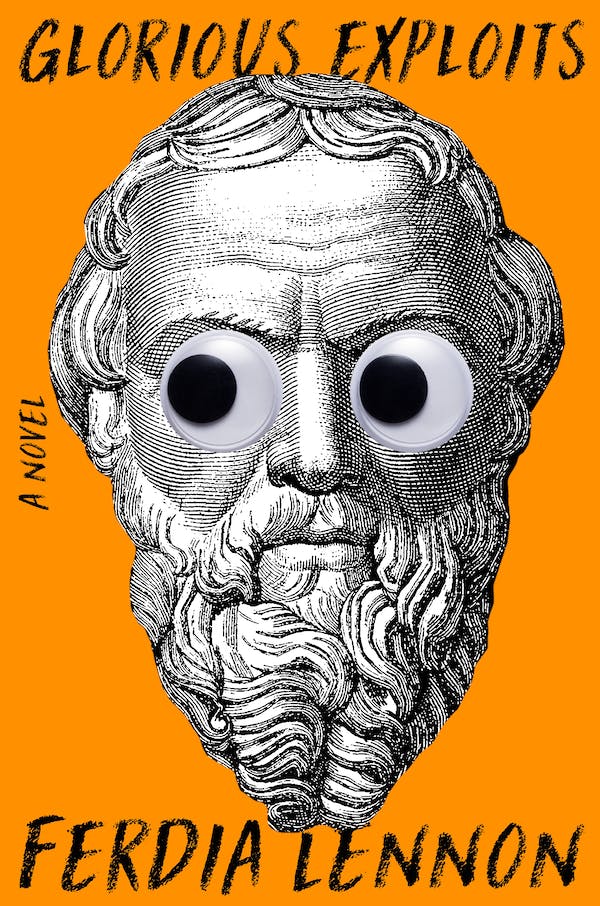
Glorious Exploits, by Ferdia Lennon

Syracuse, 412 BCE: The Athenians’ invasion has surprisingly been defeated and the surviving invaders stuck in an old quarry where they are dying in droves from malnutrition and ill-treatment. According to Plutarch, some of their captors so loved the plays of Euripides that they offered prisoners food in exchange for lines of verse.

Lennon, with degrees in History, Classics and writing, takes this morsel of history and creates something both fantastic and deeply human. Two out-of-work potters—Gelon who loves Euripides’ plays and Lampo who loves wine and fun times—make their way into the quarry armed with olives, bread and wine in search of verse. Eventually they decide to put on a fully staged performance of two plays by Euripides: Medea and The Trojan Women.

Lampo narrates the story in full-blown Irish vernacular, which is a little startling at first. He’s illiterate and doesn’t share his friend Gelon’s devotion to Athenian tragedy, but why not go along with it? He has nothing else to do. “Gelon says that’s what the best plays do. If they’re true enough you’ll recognize it even if it all seems mad at first, and this is why we give a shit about Troy, though for all we know, it was just some dream of Homer’s.”

It does all seem mad. But Lampo’s voice is irresistible. His wisecracks and pranks contribute much of the promised humor. However, as members of my book club said, for a book advertised as a comedy, most of it isn’t funny at all.

At first Lampo gloats about the prisoners’ suffering, saying of the stink in the quarry: “Ah, and I like the way they smell. It’s awful, bult it’s wonderful awful. They smell like victory and more. Every Syracusan feels it when they get that smell. Even the slaves feel it.” Yet, as they proceed with the plays, he cannot ignore the prisoners’ humanity. For me the most interesting aspect of the book is how the characters, especially Lampo, deal with setbacks and successes, finding parts of themselves they never knew existed and looking at others in ways they never thought possible.

I don’t think I’d have read this book if one of my book clubs hadn’t selected it. The premise didn’t seem like something I’d choose, especially in this time of too many stupid wars and inhumane concentration camps. I’m glad I did.

This story surprised me in ways that few novels do these days and moved me even when I didn’t want to be moved. It’s oddly light-hearted despite the grim circumstances. It seems to me to be a buddy caper like Butch and Sundance with a bit of Mickey Rooney/Judy Garland hey-let’s-put-on-a-show’s energy. Lennon doesn’t press his themes hard but leaves us to take what we will from this remarkable story.

What novel have you read that surprised you?

How I Live Now, by Meg Rosoff

9780449819609_p0_v1_s192x300

For once, I saw the film of this award-winning Young Adult book before reading the book itself. I’d taken an excellent workshop led by Rosoff, so when I saw the film listed, I decided to take a look. Only later did I follow up with reading the book, and was glad I did.

As the story begins, fifteen-year-old Daisy arrives in England, sent by her father and new stepmother to visit Aunt Penn, sister to Daisy’s mother who died when Daisy was born. The teen loathes her stepmother, who is pregnant, saying, “If she was making even the slightest attempt to address centuries of bad press for stepmother, she scored a Big Fat Zero.”

Daisy’s voice is the best thing about the book—surly, smart, funny and vulnerable. She’s met by her fourteen-year-old cousin Edmond, who is not only smoking a cigarette but has brought a “falling-apart” jeep in which he will drive her home.

Thus begins her adventures with her charmingly eccentric cousins in an old house in the countryside. Aunt Penn who is important in the government, leaves almost immediately “to give a lecture in Oslo . . . on the Imminent Threat of War.”

Daisy pays little attention to war-talk, since people had been yammering about the possibility for the last five years, though her oldest cousin Osbert can’t get enough of the latest news. She spends her days with Edmond, his twin Isaac, and their little sister Piper, and assorted dogs, goats and other animals. They fish and swim and picnic.

Then comes the invasion.

This is when the film blew me away. Watching it without knowing the story at all, I thought if a war came, it would be like the Land Girls or children being moved to the countryside during the Blitz, as in Lissa Evans’s Crooked Heart.

I was wrong. The images of rural England occupied by an enemy force—villages turned into military encampments, cars abandoned on country lanes for lack of petrol—shocked me deeply. And, to my shame, showed me just how superficial my empathy is for other countries trapped by warring armies: Sarajevo, Aleppo, so many others. Not England, I kept thinking.

Shameful, indeed.

I’m glad I went on to read the book. Not only is it more detailed and nuanced—movies must necessarily leave out much of what’s in a book—but Daisy’s voice is so true as she tries to keep her head above water, waters that get deeper and more treacherous as the story goes on. I felt I experienced every minute with her, every shifting emotion. We are all flawed beings; Daisy is no different, yet in rising to the occasion she finds an unexpected heroism. I felt privileged to spend these pages with her.

Have you read a book recently that showed you something new about yourself, perhaps something you’re not proud of?