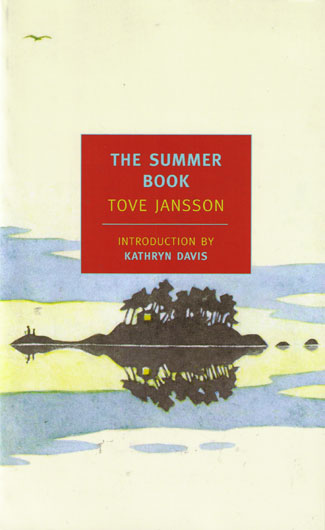
The Summer Book, by Tove Jansson

The twenty-two chapters that make up this brief novel combine surprisingly poignant discussions between two women, one very young and one very old, with closely observed details of the natural world. The girl and her grandmother spend their summers together on a tiny island in the Gulf of Finland, while Papa is also somewhere about, working. Jansson, author of the Moomintroll comic strip and books, apparently based much of it on her own summers on a similar island.

Early on, six-year-old Sophia “woke up and remembered that they had come back to the island and that she had a bed to herself because her mother was dead.” Although this death, almost an aside, is not mentioned again, we are reminded that summer and death go hand in hand: “summer’s lease hath all too short a date.” The transitory nature of life haunts the story and adds depth to the exchanges between Sophia and her grandmother.

The chapters are deceptively plain yet leave the reader aware that each seemingly normal summer adventure—diving into water, entertaining a friend, studying worms—holds a deeper meaning. Jansson’s simple and direct language invites consideration of subtext and metaphor. It leaves a silence similar to the white space around a line of poetry, space where a reader can bring forward her own memories. Surely you, too, have been here: “The forest was full of rustling and whispering. There was a wonderful smell of pine and damp moss. Everything was soft and springy underfoot. You could see a long way between the tree trunks, and here and there sunlight fell on patches of berries.”

I know Sophie and her grandmother as surely as though they are real people in my life. Avoiding sentiment and stereotypes, Jansson gives us a child with strong opinions who feels safe enough to voice them, and a grandmother who is ill and often in pain but who wants to help this child while she can. They speak the truth to each other—how rare is that between the very old and the very young? Such bluntness sometimes means expressing irritation or anger, yet they always speak with love.

They cheat at cards and argue about God. “Sophia asked how God could keep track of all the people who prayed at the same time. ‘He’s very, very smart,’ Grandmother mumbled sleepily under her hat. ‘Answer really,’ Sophia said. ‘How does He have time?’ ‘He has secretaries…’ “

A postcard of Venice leads the grandmother to explain that the city is sinking, and they build their own version of Venice, creating palazzos, bridges and gondolas: “There is something very elegant about throwing the plates out the window after dinner, and about living in a house that is slowly sinking to its doom.”

Most of all, they wander about exploring the island. They walk the shore looking for what the sea has washed up in the night. They are careful not to step on the fragile moss. “Step on it once and it rises the next time it rains. The second time, it doesn’t rise back up. And the third time you step on moss, it dies.” Fragility and protection run through the book. Sophia helps her grandmother when they crawl into the Magic Forest, a dense tangle of dead and living trees, twisted by the wind. Trying to clear a path or separate them “might lead to the ruin of the magic forest,” but left alone, “the trees slipped deeper and deeper into each other’s arms as time went by.’

Although the publisher indicates that the book is about a single summer, there are indications that these are fragments from several summers, floating up as memories do, one calling another, each so unexpected, so vivid, yet mysteriously connected. I came away thinking about the ways we take care of each other and of the natural world. I think about how we connect and what we pass on. This is a book I will come back to again and again.

Summer is a little more than half over for most of us. What has been your favorite summer read?
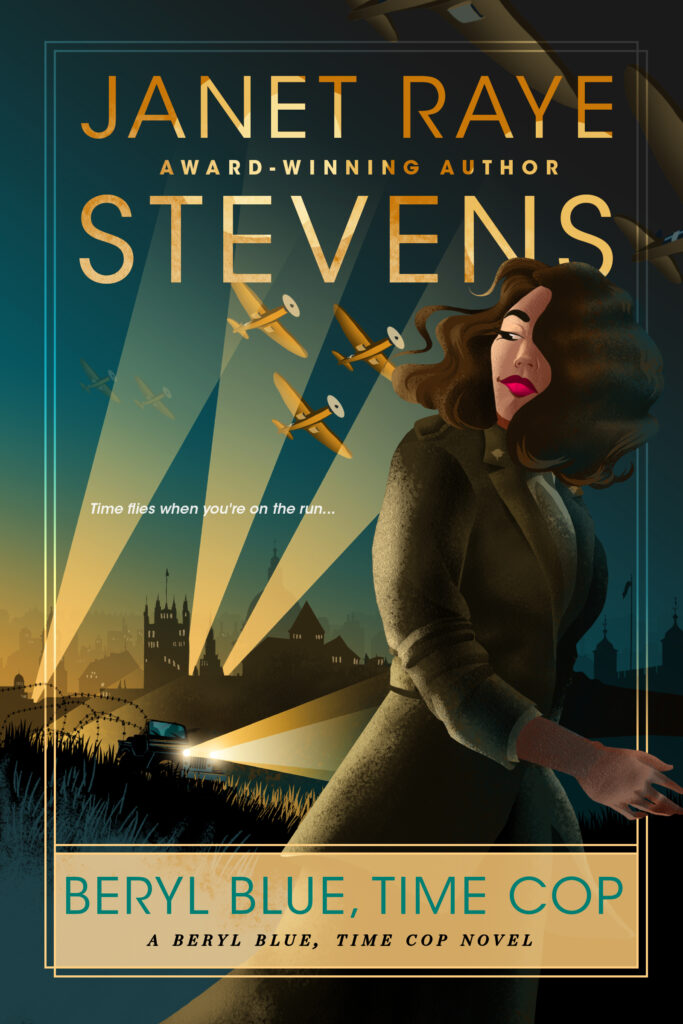
Beryl Blue, Time Cop, by Janet Raye Stevens

Librarians! I admire them all. They know so much and are incredibly generous. So when I met a librarian who’d written a suspense story about a time-traveling librarian, how could I resist?

Beryl Blue, librarian-in-training, is going about her business one day in 2015—her business at that moment being shelving books—when she falls off a ladder and into an adventure. Caught by the mysterious Glo Reid who materializes from 2031, Beryl is given a mission to go back to 1943, where World War II is in full swing, and prevent a man from being killed. She—this perfectly ordinary young woman—is the only one who can eliminate the assassin.

It sounds far-fetched, but we quickly learn enough about her past—and her tendency to run away from trouble—to go along with it. To her consternation, the place where she has landed is her very own town, at least a past version of it.

Beryl’s story makes for an entertaining summer read. I especially liked the details from 1943: the slang, the music, the clothes. From the rooming house to the nightclubs, Beryl sticks with Sergeant Tom Sullivan and his mates while they celebrate their embarkation leave. He thinks he’s protecting her, while she knows it’s the other way around.

While keeping an eye out for the assassin even though she knows she’d never be able to actually kill him, Beryl struggles to answer Sully’s questions about where she’s from and why she—a single woman—is on her own. Her 21st century views on things like smoking and women’s roles are challenged by the mores of the period. Meanwhile, she is wondering why this one man’s life is essential to saving the future as she knows it.

Plot twists abound, challenging Beryl’s understanding of herself and leading to a satisfying conclusion. There are three more books in the series: something to look forward to.

What books do you turn to for light-hearted entertainment?

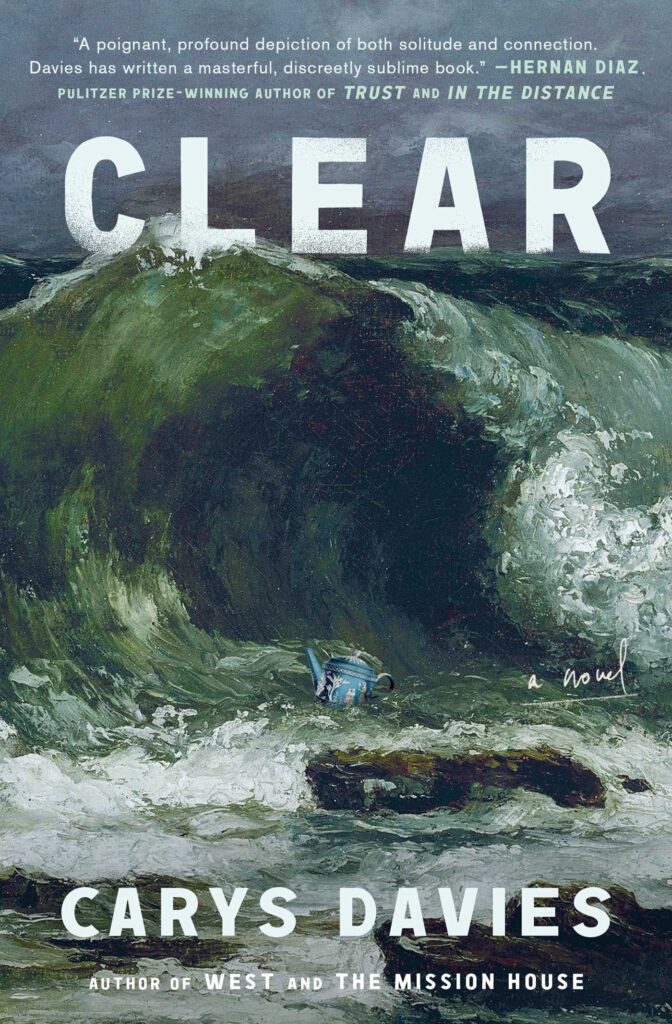
Clear, by Carys Davies

In 1840s Scotland, John Ferguson makes the difficult decision to become one of the evangelical ministers leaving the Church of Scotland to help form the Free Church of Scotland. It means giving up his job and income, but at least his church will be free of patronage and interference from the British Government. Also, it’s not the life he’d promised his wife Mary, but she accepts his choice.

The other major political upheaval besides the Disruption of the Church of Scotland is the ongoing Highland Clearances in Scotland which saw wealthy rural landowners evicting tenant farmers to clear the land for cattle or sheep. Most of the people in my book club were not familiar with the Clearances, which caused immense poverty and fury among the rural poor. A couple of us knew about them through our reading or family stories, but none of us had heard of the Disruption.

Desperate for funds, John jumps at the offer of a temporary, well-paying job as a factor. His assignment is to travel to a remote Scottish island and evict the lone remaining inhabitant—Ivar—so the island may be turned over to sheep. However, soon after arriving on the island he’s badly injured in a fall from a cliff.

Ivar finds the unconscious man and takes him into his home to nurse him. For a long period, John does not remember why he is there and busies himself learning Norn, the ancient language used by Ivar, so the two can communicate.

This lovely story is told in through three perspectives: Ivar, John and Mary. The author’s descriptions of the lonely island and Ivar’s life there are stunning both for their beauty and their authenticity. I especially enjoyed the language lessons, using actual Norn words that are poetic in their precision, such as the word “for the moment before something happens; for the state of being on the brink of something.”

It’s also a story of connection, of how a life of isolation and solitude can be transformed by the arrival of another human being. The author’s spare, elegant prose turns the book into, as one member of my book club said, a real gem.

Curiously, everyone in the book club understood the ending differently. No spoilers here, though many reviewers have criticised the ending as abrupt and unearned. For us, even though we read it aloud several times, we still understood it to mean different things.

That’s okay with me. I don’t mind endings where the story seems to go on after you close the book. In fact, the different endings we came up with said more about each of us that they did about the book. One person suggested we write to the author and ask her to write a sequel, though that mostly reflected our desire to spend more time with the characters.

I do mind when the ending is unearned. I believe the story could have prepared the ground for it a little better, but I actually liked it as it is.

If you enjoyed Small Things Like These, you might enjoy this story. I certainly did, and that was one thing that my book club did agree on: we all were immensely glad to have read it.

What books set on a Scottish island have you enjoyed?

The Strand Magazine, Issue LXXV 2025

A new story by Graham Greene? And a new one from Ian Fleming, too? Wow! I had to send for this issue.

Greene’s story is a departure from his usual explorations of moral ambiguity in the worlds of diplomats and spies, which he knew from having been recruited by MI6, as well as the Catholic faith and imperialism. “Reading at Night” is an entertainment indeed: a ghost” story, reminiscent of classic British ghost stories such as those described in Ghostland, by Edward Parnell.

A man who is traveling on the Côte d’Azur stays in a borrowed house has a nervous disposition, traumatised by a boyhood reading of Dracula. He picks up an anthology of stories to read himself to sleep, but unfortunately the one he lights on . . . Well, Greene shares the story with us and it’s disturbing and mysterious. When our man becomes too terrified to read any more, he puts the book aside and turns out the light. Then . . .

I found myself going back to look for what Donald Maass calls promise words: words that tell you what to expect in the story. I found plenty that helped create the ominous atmosphere, the sense of being outside of the natural world, and the suspense.

Ian Fleming’s “The Shameful Dream” is not about James Bond, but rather a story of psychological suspense as a successful literary editor, Caffrey Bone, drives toward the home of the Chief. Lord Ower has invited Bone for the evening at The Towers and to spend the night. Gradually, though, we learn the reasons why he wishes the invitation had been sent to someone—anyone—other than himself. Plenty of promise words in this sentence alone:

Bone stared moodily ahead at the rain and the dripping hedgerows and at the shaft of the headlights probing the wet tarmac of the secondary road which would bring him in due course to The Towers.

I had heard of The Strand Magazine in its British incarnation. From 1891-1950 it published short fiction and general interest articles and was perhaps best known for being the first in the U.K. to publish Arthur Conan Doyle’s Sherlock Holmes stories and some of Agatha Christie’s. I somehow missed that it was revived in 1998 in the U.S. The magazine features stories from emerging crime and mystery writers in addition to stories by established writers. These are genres that I often turn to, and I thoroughly enjoyed this entire issue.

Aside from the stories by Greene and Fleming, there are two by writers I’m familiar with—Denise Mina and C.J. Box—and two by authors new to me—Mike Adamson and John M. Floyd. All are excellent. What a box of wonders! To top it off there’s a fascinating talk with Amor Towles, author of A Gentleman in Moscow and The Lincoln Highway, and pages of reviews of additional mysteries and thrillers.

Sometimes it seems as though there are too many magazines and too little time, but The Strand is one I now intend to make time for.

Have you read a magazine full of short stories lately? Tell me about it.