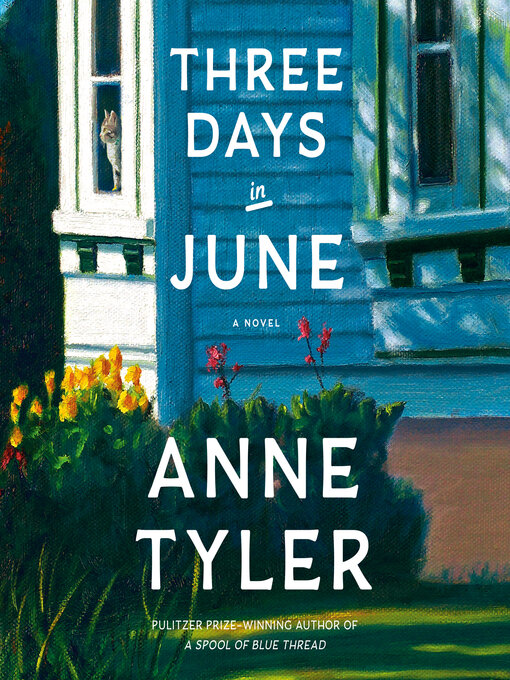
Three Days in June, by Anne Tyler

I’ve been a fan of Anne Tyler’s novels from the get-go. She writes about my kind of people and the place I lived in for most of my life. I slip into her stories as though they’d been tailored just for me—and never more so than with this latest book.

Assistant head in one of those posh private schools Baltimore is known for, Gail is shocked one Friday morning when her boss discloses that she’s decided to retire, and the new head is bringing her own assistant with her. Gail’s response is to simply walk out of the school, leaving everything behind her.

She thinks that maybe she could go back to teaching math somewhere, but first she must deal with her daughter’s wedding on Saturday. The future mother-in-law has taken over arranging everything, and Gail feels obliged to leave her to it since the in-laws are paying for everything.

Her boss says Gail lacks people skills, but she does have a sharp eye and a tart tongue. I found myself snorting with laughter over her asides, laughing more at myself than at her. “I wondered why it was that I had so many irritating people in my life.” She reminds me of my grandmother when she was feeling cranky. She reminds me of myself.

It is Gail’s voice as narrator that truly carries the story and makes it impossible to put down. She may hide her emotions from others but she’s scrupulously open when it comes to her own thoughts. She says, “Sometimes when I find out what’s on other people’s minds I honestly wonder if we all live on totally separate planets.”

Just as she is settling into her day at home, the doorbell rings and it is her ex-husband Max, who’s brought along a cat he is fostering and thus cannot stay with his daughter; her fiancé is allergic. Thus begins three days of the two of them bumping up against each other, falling into familiar patterns and even developing new in-jokes.

The marriage of your only child rouses echoes of the past, in Gail’s case exacerbated by one of her former boyfriends turning up at the wedding. We gradually come to understand how Gail and her family got to where they are now and what choices they are going to have to make.

One of the things I’ve always loved about Anne Tyler’s books is her compassion for her characters, all of them. I truly felt that I knew Gail and commiserated with her as she tries to find her footing in a changing world. I’m charmed by this portrait of a marriage, odd and bumpy and interrupted as has been through the years.

Do you have a favorite Anne Tyler book?
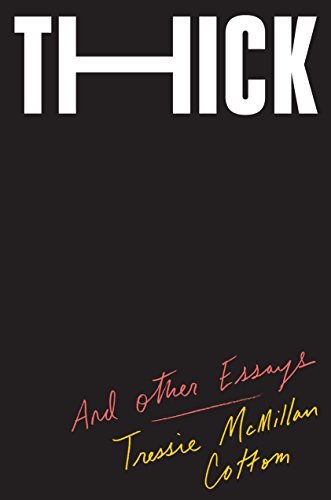
THICK and Other Essays, by Tressie McMillan Cottom

Reading this collection of essays has been like sitting down with a friend and asking, So tell me—what do you really think? Cottom draws on her academic training and her lived experience to create pieces that blur the line between sociology and personal essay. One editor said she was “too readable to be academic, too deep to be popular, too country black to be literary, and too naïve to show the rigor of my thinking in the complexity of my prose.”


If in her academic life she is chided for her popular success on social media and for using herself as a subject, she responds that “The personal essay had become the way that black women writers claim legitimacy in a public discourse that defines itself, in part, by how well it excludes black women.” Writing about your personal experience is a way in because your authority about your own self cannot be denied. Also, by its very form the personal essay invites empathy from readers.


I was, like many young women, expected to be small so that boys could expand and white girls could shine. When I would not or could not shrink, people made sure that I knew I had erred….[I was] thick where I should have been thin, more when I should have been less.

She writes about black women’s (and girl’s) problems, ones that are too often dismissed by others, in lucid prose that invites you into the conversation. But don’t be fooled by the casual tone. Yes she can be snarky and funny, but she can also pull out the statistics to support her statements and references to the work of other academics and deep thinkers. I often found myself setting the book aside between essays to follow the links in the endnotes for more detail.


I especially appreciate that she keeps probing at an issue. For example, in “Dying to Be Competent” she starts from our common desire to be able to manage our own lives, despite the fact that much of what happens to us is unpredictable and outside of our control. She goes on to tell a heart-wrenching story of trying to navigate the healthcare system, and the shock that despite her academic credentials and middle-class status markers, she has to fight for treatment and medication because the staff assume that she is incompetent and ignorant and thus can be ignored.


All this is presented in a cool tone and then buttressed by study after study about the high mortality rate of black women giving birth in the U.S., as well as by the example of what even celebrity tennis superstar Serena Williams had to go through to get a needed treatment, one that likely saved her life.


But Cottom doesn’t stop there. “Sociologists try to figure out how ideologies like race and gender and class are so sticky . . . The easiest answer is that racism  and sexism and class warfare are resilient and necessary for global capitalism.” A further analysis takes us to Patricia Hill Collins’s idea of “controlling images, those stereotypes that are so powerful they flatten all empirical status differences among a group of people to reduce them to the most docile, incompetent subjects in a social structure.” Such reduction is needed because “This moment of global inequality demands incompetent subjects.”


This is just one example from one essay. If I’ve made it sound like heavy going, believe me when I say that it is not. I read most of the essays twice, just for the sheer delight of following her argument. This is a book that has given me much to think about.


What book or podcast or blog has given you new insight into our culture?


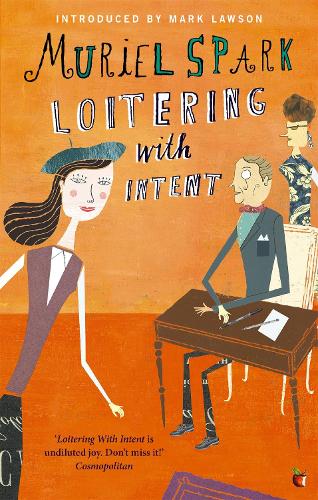
Loitering with Intent, by Muriel Spark

We meet Fleur Talbot sitting in a graveyard in Kensington writing a poem, when a young policeman approaches her. It’s 1949. Young Fleur, eager to collect experiences that she can use in her writing, rejoices in “how wonderful it feels to be an artist and a woman in the twentieth century.” She makes friends everywhere “almost by predestination.” When the friendship pales, she says, “You didn’t think of discarding them just because you didn’t altogether like them.”

Her friend Dottie—one of many hilarious and perfect names in this book—is ”a Catholic, greatly addicted to the cult of the Virgin Mary about whose favors she fooled herself quite a bit.” She seems unconcerned that Fleur is having an affair with her lackluster husband Leslie. Fleur says she loves him “off and on, when he doesn’t interfere with my poetry and so forth. In fact I’ve started a novel which requires a lot of poetic concentration, . . . So perhaps it will be more off than on with Leslie.”

Light-hearted Fleur gaily sidesteps small matters like having money for rent and other necessities while she finishes her first novel, Warrender Chase. When a friend finds her a job at the Autobiographical Association, helping its posh members write their memoirs, she is eager to observe them. The Association is the brainchild of  Baronet Sir Quentin Oliver. He set it up so that the memoirs will not to be published for 70 years to avoid offending anyone named in them.

There we meet a truly quirky crew. The one who most delights me is Sir Quentin’s elderly and outrageous mother Edwina. She comes out with the most inconvenient truths and loses control of her bladder at will, much to Sir Quentin’s embarrassment. The two tangle constantly, and it is ruthless Edwina who usually comes out the winner.

Almost immediately Fleur becomes suspicious of Sir Quentin’s intent, eventually calling him a “psychological Jack the Ripper.” However, she believes in writing about terrible sins ”with a light and heartless hand. It seems to me a sort of hypocrisy for a writer to pretend to be undergoing tragic experiences when obviously one is sitting in relative comfort with a pen and paper.”

She’s surprised to find that Sir Quentin seems to become more and more like her protagonist Warrrender Chase. Then the lives in the memoirs she’s typing up begin to mirror other characters in her novel, leading Sir Quentin to threaten to sue her publisher to stop publication of her novel. She claims that her novel came first, but this slippery novel keeps you wondering who is making up what, and how on earth it will all work out.

It may be offbeat and joyful, but the novel offers plenty of plot twists—a stolen manuscript, suspicious deaths—and for those who care to look deeper, some interesting things to say about a writer’s purpose and methods, not to mention their sources of inspiration. Underlying the witty story is a Modernist conundrum about whether people give rise to literary characters or vice versa. How do we construct the selves we present to the world or to ourselves?  

Or you can ignore all that and just enjoy the sparkling dialogue. The unexpected lurks around every corner, and you never know when Edwina will let loose a “fluxive precipitation.”

What Muriel Spark novels have you read?

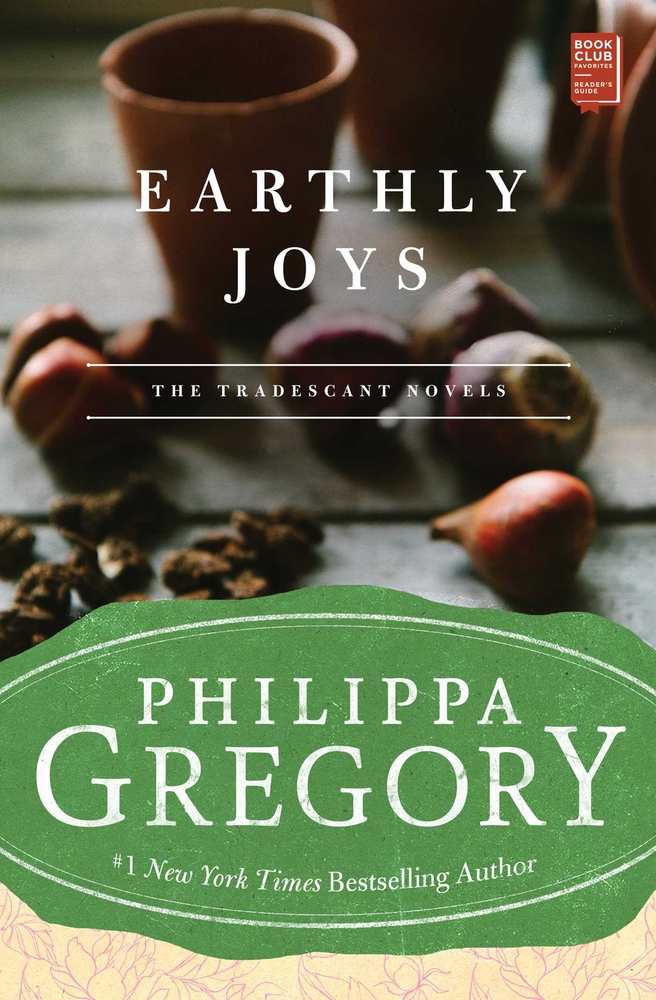
Earthly Joys, by Phillipa Gregory

We meet John Tradescant, gardener to Sir Robert Cecil, as he discusses the state of the gardens with his master in preparation for the visit of the new king: James I. Since Queen Elizabeth died without heirs, James—son of Mary, Queen of Scots and already King of Scotland—has ascended to the throne of England. The story is told by John himself, who is based on the real John Tradescant the Elder, the most celebrated horticulturalist and naturalist of his age.

As a gardener, John has no power in politics; he keeps his gaze focused on the plants and trees that he loves. However, knowing that “he could keep a secret, that he was a man without guile, with solid loyalty,” Cecil uses this principled and practical man as a sounding board, confiding that he has been working in secret to prepare James Stuart to rule in England. James brings two great advantages: he already has two sons and a daughter, and he is Protestant. Thus, it’s assumed he will end the turmoil over the succession and the bitter and deadly religious wars.

John is asked to design magnificent gardens at Hatfield, Windsor, and others. In his work for Cecil and later other lords and James’s successor Charles I, John is sent abroad in search of rare plants. His finds are described with such care that I could see, smell and feel them: the smoothness of a horse chestnut seed, the rainbow sheen of tulips, the scent of cherry blossoms. It turns out that he loves traveling and finding exotic varieties of plants and rarities, much to the dismay of his wife and son, left at home.

This book was recommended to me for its evocation of Tudor and Stuart era gardens, making it an appropriate read for this blossoming midsummer. I was also intrigued by my memory of Gregory’s amazing nonfiction book Normal Women that spoke to the range and depth of her research into the period. What I didn’t consider was how much the concerns of people in 17th century England would echo ours today.

As they discuss the new king, John tells Cecil, “When you have a lord or king . . .  you have to be sure that he knows what he’s doing. Because he’s going to be the one who decides what you do . . . Once you’re his man, you’re stuck with him  . . . He has to be a man of judgment, because if he gets it wrong then he is ruined, and you with him.”

And James is not a man of judgment. He immediately begins plundering the treasury Elizabeth amassed to protect England, squandering it on his own pleasures and rewards to his friends, while ignoring the discontent, poverty and starvation of his subjects. A favorite emerges in his hedonistic court: the Duke of Buckingham: young, beautiful, and self-indulgent. After Cecil’s death, Buckingham brings John to work for him as gardener and personal servant, even taking him into battle.

Civil war is brewing, as the people protest. Parliament is furious when the King takes over their power to impose taxes and sends them home as no longer needed. The King then gets needed income by selling baronetcies and other dignities. Many begin to question the traditional concept of the divinity of kings, seeing James as not someone ordained by God, but rather as simply a man and a repulsive, dishonest one at that.

John, however, is loyal, too loyal according to his wife. John is challenged not just by her, but also by his increasingly radical son who argues that people should be free to obey their own principles, not be ordered what to think by kings and lords. While John’s obdurate loyalty to his masters—even when he thinks they are wrong—can be frustrating for a reader today, it reflects the culture of the time, which was only just beginning to hear the whispers of the individualism we take for granted today.

Another aspect that is true to the time but troubling today is the quantity of foreign plants that John introduces to England. Many have become common to English gardens and forests today, but I couldn’t help thinking about the dangers of invasive species: plants and creatures that originally seemed innocent or useful but have become a nightmare.

While politics and philosophy struck surprisingly close to home for me, they took second place to the gardens. I luxuriated in descriptions of planning everything from orderly knot gardens to seemingly natural meadow gardens. I felt I was laboring along with John and his wife and son to build these joyful works of art. 

Are you a gardener?

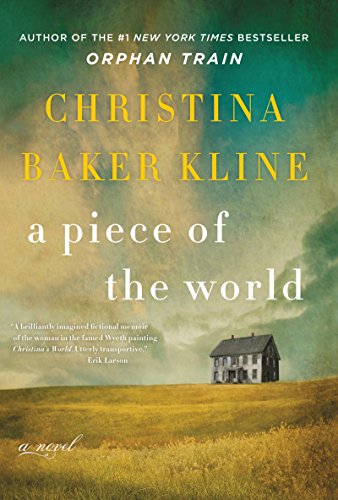
A Piece of the World, by Christina Baker Kline

Most people are familiar with Andrew Wyeth’s painting Christina’s World at New York’s Museum of Modern Art. However, little has been known about Christina Olson herself aside from the fact that she had a degenerative muscular disorder that eventually made her unable to walk. Another tidbit of knowledge has been that Wyeth often painted not only Christina and her brother, but also the house on the Olson farm in the small town of Cushing, Maine.

My interest in Andrew Wyeth’s work intensified when I visited a 2014 exhibition at the National Gallery of Art in Washington, D.C. Looking Out, Looking In concentrated on Wyeth’s paintings of windows. I already loved his famous Wind from the Sea, and became fascinated by his spare watercolors of other windows in the Olson house and others nearby. There are no people in these works, but their lives are somehow embedded in these spaces.

In his Director’s Note to the catalogue, Earl A. Powell III calls Wyeth’s window paintings “skillfully manipulated constructions deeply engaged with the visual complexities posed by the transparency, beauty, and formal structure of windows.” For my part, the theme named in the title remains a powerful one. Whether we are looking out or in, we see both the wide outside and the very personal interior. Also, I am deeply in love with houses, especially those which hold the story of my life.

In this novel, Kline has taken the woman whose image is so familiar and opened her life to us. In her own words, Christina recounts her childhood as a smart girl who wanted to become a teacher but had to leave school to help at home. She has a brief period of social life and a chance at love before her increasing disability keeps her tied to the farm while her friends went on to marry and have children. When one of her friends marries Wyeth, he and Betsy begin spending summers in Cushing, and he starts painting at the Olson’s.

It is Christina’s voice, though, that fascinates me. Amid the constant domestic toil, the brief joy of sweetpeas blooming, the interactions with her parents and brother, her growing friendship with Wyeth, her voice is genuine: stoic and reserved, occasionally ecstatic. I felt as though I lived through each day with her, each turn of the season.

I am wary of novels with real people as characters; it feels like an invasion of privacy to create a story of someone without their permission or knowledge. However, I loved Kline’s thoughtful understanding of what it might mean for a sensitive young woman to have to live such a restricted life—not just her physical restrictions, but also the small town, the confining house, the loneliness as friends and neighbors pull away. I had a tiny surprise: the Olsons were related to Nathaniel Hawthorne, as I am myself, making Christina perhaps a distant cousin.

The limitations of her life mean the story is thin on plot, and Wyeth himself is but a minor character. The real joy of this story for me is the immersion in this woman living a life I could so easily have fallen into. In the story, Christina says of the famous painting:

He did get one thing right: Sometimes a sanctuary, sometimes a prison, that house on the hill has always been my home. I’ve spent my life yearning toward it, wanting to escape it, paralyzed by its hold on me. (There are many ways to be crippled, I’ve learned over the years, many forms of paralysis.) My ancestors fled to Maine from Salem, but like anyone who tries to run away from the past, they brought it with them. Something inexorable seeds itself in the place of your origin. You can never escape the bonds of family history, no matter how far you travel. And the skeleton of a house can carry in its bones the marrow of all that came before.

Have you read a book inspired by a painting?