The Real Mrs. Miniver, by Ysenda Maxtone Graham

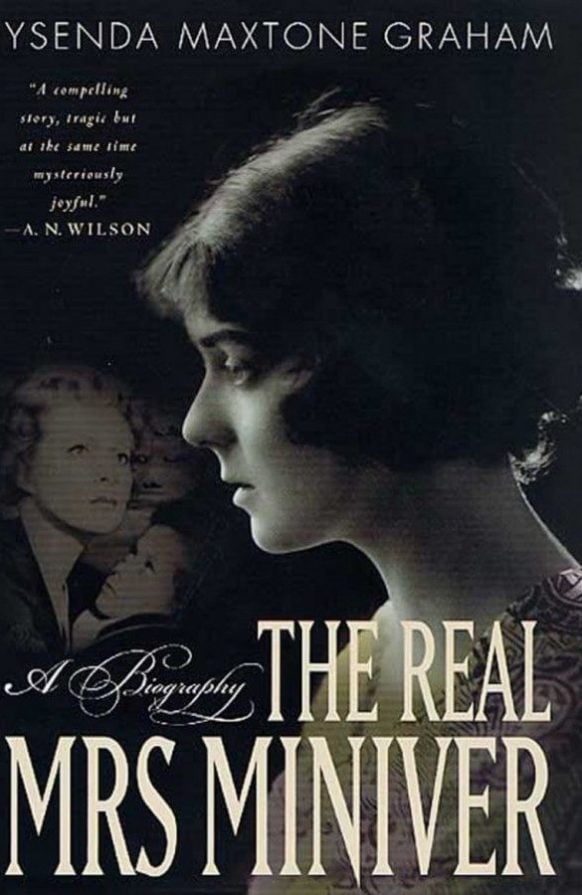
The Real Mrs. Miniver, by Ysenda Maxtone Graham

We’ve seen the movie, of course, and thought it a sentimental film about a woman who is practically perfect in every way keeping her family together and holding the home front together during the Blitz—the bombing of London during WWII. The book the film is based on, a collection of columns from the London Times, was something else altogether: an idealised portrait of an ordinary upper middle class woman’s life in pre-WWII England.

Those columns were written by Joyce Maxtone Graham (née Anstruther) using the name Jan Struther, and she modeled the family on her own husband and three children. However, as we learn from this biography by her granddaughter, the loving Miniver family was a far cry from Joyce’s own. Her marriage to Tony Maxtone Graham, initially fun-loving and amusing, had dried up as he’d been taken hostage by golf, leaving Joyce to her articles and poems many of which were published in Punch among other periodicals.

Joyce had been a tomboy as a child, loathing the ceremonial tea parties and dance lessons, preferring to run and shoot with the boys. She and Tony initially shared a comic view of the world. I loved the way they shared the silly things they noticed during their days: pebbles, as she called them, like children turning out their pockets at the end of the day. As they drew further apart, Joyce fell deeply in love with Dolf Placzek, a penniless Jewish refugee from Austria gifted with intelligence and a strong appreciation for the arts.

The Mrs. Miniver columns depict a happy, loving marriage that was a far cry from what Joyce’s had become. Yet for many, those columns embodied an England that was being destroyed by the war and a reminder of what they were fighting for. Mrs. Miniver’s upper middle class life was comfortable, with a London house and a weekend cottage in Kent, a son at Eton, and servants to do the chores. The columns contain the small things she notices during the day, some pleasurable, some not—like the pebbles she and Tony used to exchange. While Mrs. Miniver could be critical of her social circle, she was alive to its charms.

Joyce—now Jan all the time—was shocked by the surprising success of the book and the reading tours and talks that followed. She came to be haunted by Mrs. Miniver. Many fans assumed they were the same person. She struggled to finding a firm place to stand.

Of all emotions, she perhaps felt the emotion of missing most acutely. At a party, she missed solitude. Abroad, she missed home. Cut off from her children, she longed to be with them again. When she was, she longed again for solitude. The raggle-tangle gypsy in her head beckoned her to escape.

Why read biographies? In my twenties I read lots of biographies of women writers and artists, looking for inspiration during a time when women were second-class citizens when it came to the arts. I was also looking for ideas for how to write while wrangling two babies and an ex who refused to contribute. Just keeping the heat on and some kind of food on the table was a miracle. Forget about finishing a story and sending it out.

These days I still look for inspiration from brave women and men as I struggle with how to live a moral life in an increasingly compromised and chaotic world. I’m especially drawn to women living during dark times. I’m also interested in the wide range of life choices people make. One thing that is so fascinating in this book is the contrast between the life of Mrs. Miniver—a model for womanhood at the time—and that of the woman who created her.


Sometimes with a biography, it is enough to see myself in a reckless tomboy unwilling to knuckle under to social norms or an almost accidental writer. Now if only I can catch the zeitgeist the way Jan Struthers did! Perhaps it’s better I don’t. Her story is yet another cautionary tale of how too much success and celebrity can wreck a person.

It’s been difficult lately to find books that hold my interest. My reading record is full of DNFs. This one, though, fascinated me and kept my attention right through to the end. Jan reinvented herself several times over, which I find wonderful. And she changed the course of history, inadvertently perhaps and not alone, but for sure. What kind of world would we be living in today if the U.S. had refused to join the Allies fighting Hitler and Mussolini in Europe and Africa?

I take courage from her story and the stories she wrote about the ordinary people of Britain as we fight today’s fascism.

Have you read a biography that inspired you?

The Child from the Sea, by Elizabeth Goudge

Little is known of Lucy Walter whose son James was the oldest child of King Charles II. From those few facts, Goudge has spun an entrancing story of a vibrant girl whose great love for the prince—whose father ruled England, Scotland and Ireland as King Charles I—lasted a lifetime. We first meet Lucy as a child in Wales, where she lived with her family in Roch Castle and thought herself part buccaneer, roaming the countryside experiencing all of creation with a dazzling joy.

It was then she became aware of the birds. They were coming down from the sky like drifting autumn leaves, martins, chaffinches, goldfinches and linnets, finding their way to the bracken-sheltered hollows and the warm dry hedges and the safe crannies of the rocks. Lucy had watched the bird migrations before but she had never seen one halted like this, halted as the warning sounded along the shore.

She stood still, scarcely breathing, her arms out and her face turned up to the darkening sky, and they had no fear of her. A wing brushed her cheek and just for a moment some tired little being alighted on her hand, putting on one finger for ever the memory of a tiny claw that clung like a wedding ring. It was for her a moment of ecstasy, of marriage with all living creatures, of unity with life itself, and she whispered in Welsh, ‘Dear God, this happiness is too great for me!’

In London she glimpses the young prince from a bridge over the Thames, and they seem to have even in that brief moment a special connection, one that grows naturally over the years as they encounter each other, until they finally discover the wonder of first love. Though lost in their mutual fervor, Lucy insists on marriage first which, in this historical fiction, was performed by her beloved local parson before the marriage was consummated. It had to be kept secret because the political situation had become fraught.

However, this book is so much more than a love story. Charles’s father, Charles I, was under attack for his belief in the divine right of kings. He argued with Parliament by illegally levying taxes without their consent and alienated others during this time of religious disputes by marrying a Catholic and trying to enforce high-church Anglican practices. Charles I was successor to his father James I both of whom I encountered recently in Phillipa Gregory’s Earthly Joys.

The reader stays with Lucy as she tries to navigate these tumultuous times of civil unrest and debates over the power of the king and Parliament while staying true to her own Prince Charles. As we move between revolution and exile and betrayals, Lucy’s story illuminates themes of forgiveness, loyalty and enduring love. Given our own fraught times, her story is a welcome reminder of these virtues. They may not protect us from harm, but we can stay true to ourselves.

This final book from the beloved author of adult and children’s books abounds in such hard-won wisdom. I read it when it first came out in 1970 and at the time was absorbed in the romance of these two young people and of the Stuart kings about whom I’d read so much.

On this reading, though, I was looking for and found insight from Goudge, who was 70 at the time and had lived through both World Wars and the great changes and horrors of the Twentieth Century, as recounted in her memoir The Joy of the Snow. For example, the description of Elenor Gwinne, Lucy’s grandmother, the peace she had attained and how, struck me as a genuine example of wisdom one might come to in the course of a long life.

The other advantage of this late-in-life novel is that Goudge is writing in the fullness of her powers, as shown in the richness of the story, the interweaving of fact and fiction into a story that keeps the reader enchanted from first page to the last. We move from place to place but each one comes to life because we encounter them through Lucy’s eyes.

I was especially taken by the way Goudge uses description to evoke a response, everything from the smallest image to passages that capture your heart. A particularly thoughtful image is spoken by one of Charles’s friends: “ ‘ . . . loyalty is one of the most difficult of virtues, a flower with all its petals pointing in different directions.’ ” And a passage that thrilled me is:

The birds sang for joy of the growing light, and when Lucy opened her window to hear them, the air smelt of violets, though as yet she had found none under the dead leaves in the unicorn wood. But she found minute buttons of coral buds on the brambles and the green of dog’s mercury among the leaves, and when she left the wood and looked back from the far end of the field, she saw how the trees in the silvery sunshine were clothing themselves in pale amethyst and paler coral, in faint crimson and dun gold, one colour fading into the other as the colours do on the iridescent breast of a bird. 

Lucy never loses her thrilling response to the world, whether it’s a sailing vessel or a homely fire. She is no saint but is constantly reminded—and reminds us—that there are good people in the world and that even in the midst of danger we can keep a loving heart.

What historical fiction or nonfiction have you read that gives you courage in our dark times?

Gemma Sommerset, by Jill McCroskey Coupe

The story opens at a summer camp in the Blue Ridge mountains where fourteen-year-old  Gemma undergoes a transformative experience. In 1957 girls’ roles were strictly defined, especially in the South, but away from home and facing a surprising danger, she finds a new sense of herself. The problem then becomes what to do with that when she returns home.

Gemma is part of an in-between age group: too late to be part of the WWII generation and too soon for the Sixties with its peace-and-love. This new novel from Jill Coupe explores how throughout her life she balances her desire for adventure and accomplishment with society’s restraints and expectations.

She dreams of studying French in Paris but ends up in a traditional marriage, home with a baby while her husband continues up his professional path. I’m reminded of Philip Larkin’s poem “Afternoons” where he describes young mothers watching their children at a playground, ending with: “Something is pushing them / To the side of their own lives.” Gemma’s one joy is watching the sun rise each morning, its beauty a reward, its freshness a promise.

The wonderful editor Dave King once wrote about what he called the gentle genre: “straightforward tales of ordinary people in mostly every-day, low-key situations.  No psychotics, no wrenching twists, no gore, no vampires or werewolves or demons.” These stories were popular in the early part of the 20th century, from writers such as Jan Karon, Angela Thirkell, D. E. Stevenson, Elizabeth Cadell, R. F. Delderfield, and Wendell Berry.

The problem with writing such a story is how to create enough tension and suspense to propel the reader through to the end when you can’t throw in a gang war or vampire to liven things up. Dave King defines two ways to keep a gentle story going without letting it become either boring or saccharine. One is for the author to pay close and detailed attention to the characters so the reader will recognise that even small things hold deep meaning for them. The other is to set the story in a small town where you can’t avoid interactions with your neighbors, even if their opinions differ from yours.

In terms of the first method, we do get to know Gemma and the experiences that shape her and her refusal to be pushed to the side of her life. Since the story is told from her point of view, we learn about the other characters as she does. As for the second, her life revolves around her family so they, rather than the small city where she lives, become the community she defines herself within. Conflicts with her parents, husband, and daughters animate Gemma’s story as she strives to carve out a space where she can be herself while still caring for them. As Dave King says, gentle books—of which this is one—are “driven by love.”

Stories driven by love are a much-needed balm these days. Gemma Sommerset reminds me about the importance of family and community. We might disagree, but we can do so with love. So maybe Gemma’s not so far away from the Sixties generation as I thought.

What novel have you read lately that reminded you of what really matters?

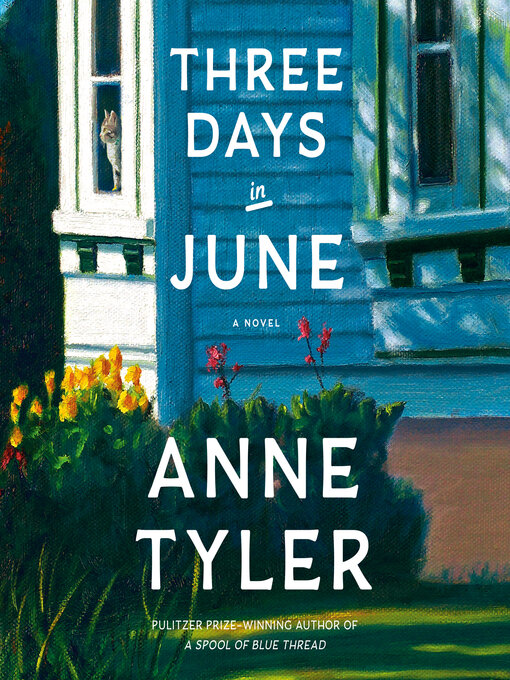
Three Days in June, by Anne Tyler

I’ve been a fan of Anne Tyler’s novels from the get-go. She writes about my kind of people and the place I lived in for most of my life. I slip into her stories as though they’d been tailored just for me—and never more so than with this latest book.

Assistant head in one of those posh private schools Baltimore is known for, Gail is shocked one Friday morning when her boss discloses that she’s decided to retire, and the new head is bringing her own assistant with her. Gail’s response is to simply walk out of the school, leaving everything behind her.

She thinks that maybe she could go back to teaching math somewhere, but first she must deal with her daughter’s wedding on Saturday. The future mother-in-law has taken over arranging everything, and Gail feels obliged to leave her to it since the in-laws are paying for everything.

Her boss says Gail lacks people skills, but she does have a sharp eye and a tart tongue. I found myself snorting with laughter over her asides, laughing more at myself than at her. “I wondered why it was that I had so many irritating people in my life.” She reminds me of my grandmother when she was feeling cranky. She reminds me of myself.

It is Gail’s voice as narrator that truly carries the story and makes it impossible to put down. She may hide her emotions from others but she’s scrupulously open when it comes to her own thoughts. She says, “Sometimes when I find out what’s on other people’s minds I honestly wonder if we all live on totally separate planets.”

Just as she is settling into her day at home, the doorbell rings and it is her ex-husband Max, who’s brought along a cat he is fostering and thus cannot stay with his daughter; her fiancé is allergic. Thus begins three days of the two of them bumping up against each other, falling into familiar patterns and even developing new in-jokes.

The marriage of your only child rouses echoes of the past, in Gail’s case exacerbated by one of her former boyfriends turning up at the wedding. We gradually come to understand how Gail and her family got to where they are now and what choices they are going to have to make.

One of the things I’ve always loved about Anne Tyler’s books is her compassion for her characters, all of them. I truly felt that I knew Gail and commiserated with her as she tries to find her footing in a changing world. I’m charmed by this portrait of a marriage, odd and bumpy and interrupted as has been through the years.

Do you have a favorite Anne Tyler book?

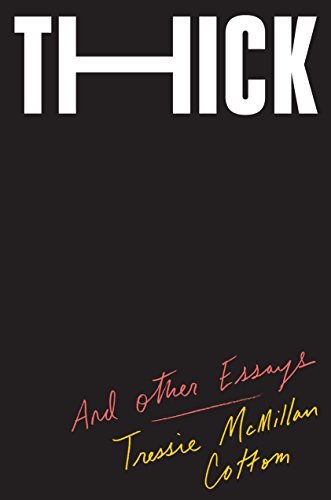
THICK and Other Essays, by Tressie McMillan Cottom

Reading this collection of essays has been like sitting down with a friend and asking, So tell me—what do you really think? Cottom draws on her academic training and her lived experience to create pieces that blur the line between sociology and personal essay. One editor said she was “too readable to be academic, too deep to be popular, too country black to be literary, and too naïve to show the rigor of my thinking in the complexity of my prose.”


If in her academic life she is chided for her popular success on social media and for using herself as a subject, she responds that “The personal essay had become the way that black women writers claim legitimacy in a public discourse that defines itself, in part, by how well it excludes black women.” Writing about your personal experience is a way in because your authority about your own self cannot be denied. Also, by its very form the personal essay invites empathy from readers.


I was, like many young women, expected to be small so that boys could expand and white girls could shine. When I would not or could not shrink, people made sure that I knew I had erred….[I was] thick where I should have been thin, more when I should have been less.

She writes about black women’s (and girl’s) problems, ones that are too often dismissed by others, in lucid prose that invites you into the conversation. But don’t be fooled by the casual tone. Yes she can be snarky and funny, but she can also pull out the statistics to support her statements and references to the work of other academics and deep thinkers. I often found myself setting the book aside between essays to follow the links in the endnotes for more detail.


I especially appreciate that she keeps probing at an issue. For example, in “Dying to Be Competent” she starts from our common desire to be able to manage our own lives, despite the fact that much of what happens to us is unpredictable and outside of our control. She goes on to tell a heart-wrenching story of trying to navigate the healthcare system, and the shock that despite her academic credentials and middle-class status markers, she has to fight for treatment and medication because the staff assume that she is incompetent and ignorant and thus can be ignored.


All this is presented in a cool tone and then buttressed by study after study about the high mortality rate of black women giving birth in the U.S., as well as by the example of what even celebrity tennis superstar Serena Williams had to go through to get a needed treatment, one that likely saved her life.


But Cottom doesn’t stop there. “Sociologists try to figure out how ideologies like race and gender and class are so sticky . . . The easiest answer is that racism  and sexism and class warfare are resilient and necessary for global capitalism.” A further analysis takes us to Patricia Hill Collins’s idea of “controlling images, those stereotypes that are so powerful they flatten all empirical status differences among a group of people to reduce them to the most docile, incompetent subjects in a social structure.” Such reduction is needed because “This moment of global inequality demands incompetent subjects.”


This is just one example from one essay. If I’ve made it sound like heavy going, believe me when I say that it is not. I read most of the essays twice, just for the sheer delight of following her argument. This is a book that has given me much to think about.


What book or podcast or blog has given you new insight into our culture?


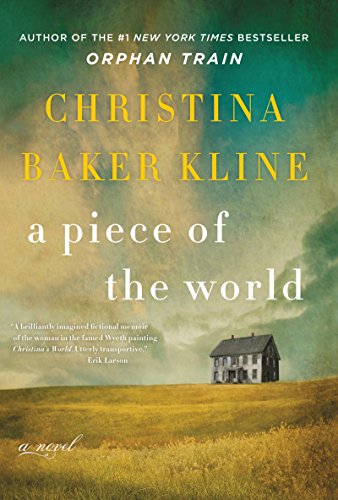
A Piece of the World, by Christina Baker Kline

Most people are familiar with Andrew Wyeth’s painting Christina’s World at New York’s Museum of Modern Art. However, little has been known about Christina Olson herself aside from the fact that she had a degenerative muscular disorder that eventually made her unable to walk. Another tidbit of knowledge has been that Wyeth often painted not only Christina and her brother, but also the house on the Olson farm in the small town of Cushing, Maine.

My interest in Andrew Wyeth’s work intensified when I visited a 2014 exhibition at the National Gallery of Art in Washington, D.C. Looking Out, Looking In concentrated on Wyeth’s paintings of windows. I already loved his famous Wind from the Sea, and became fascinated by his spare watercolors of other windows in the Olson house and others nearby. There are no people in these works, but their lives are somehow embedded in these spaces.

In his Director’s Note to the catalogue, Earl A. Powell III calls Wyeth’s window paintings “skillfully manipulated constructions deeply engaged with the visual complexities posed by the transparency, beauty, and formal structure of windows.” For my part, the theme named in the title remains a powerful one. Whether we are looking out or in, we see both the wide outside and the very personal interior. Also, I am deeply in love with houses, especially those which hold the story of my life.

In this novel, Kline has taken the woman whose image is so familiar and opened her life to us. In her own words, Christina recounts her childhood as a smart girl who wanted to become a teacher but had to leave school to help at home. She has a brief period of social life and a chance at love before her increasing disability keeps her tied to the farm while her friends went on to marry and have children. When one of her friends marries Wyeth, he and Betsy begin spending summers in Cushing, and he starts painting at the Olson’s.

It is Christina’s voice, though, that fascinates me. Amid the constant domestic toil, the brief joy of sweetpeas blooming, the interactions with her parents and brother, her growing friendship with Wyeth, her voice is genuine: stoic and reserved, occasionally ecstatic. I felt as though I lived through each day with her, each turn of the season.

I am wary of novels with real people as characters; it feels like an invasion of privacy to create a story of someone without their permission or knowledge. However, I loved Kline’s thoughtful understanding of what it might mean for a sensitive young woman to have to live such a restricted life—not just her physical restrictions, but also the small town, the confining house, the loneliness as friends and neighbors pull away. I had a tiny surprise: the Olsons were related to Nathaniel Hawthorne, as I am myself, making Christina perhaps a distant cousin.

The limitations of her life mean the story is thin on plot, and Wyeth himself is but a minor character. The real joy of this story for me is the immersion in this woman living a life I could so easily have fallen into. In the story, Christina says of the famous painting:

He did get one thing right: Sometimes a sanctuary, sometimes a prison, that house on the hill has always been my home. I’ve spent my life yearning toward it, wanting to escape it, paralyzed by its hold on me. (There are many ways to be crippled, I’ve learned over the years, many forms of paralysis.) My ancestors fled to Maine from Salem, but like anyone who tries to run away from the past, they brought it with them. Something inexorable seeds itself in the place of your origin. You can never escape the bonds of family history, no matter how far you travel. And the skeleton of a house can carry in its bones the marrow of all that came before.

Have you read a book inspired by a painting?

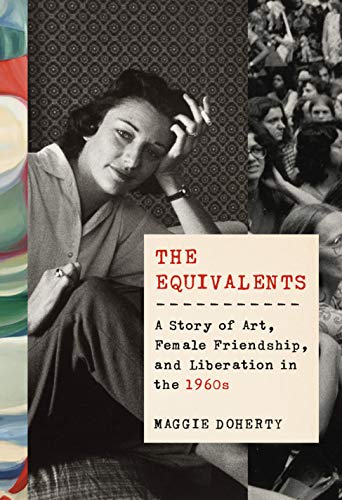
The Equivalents, by Maggie Doherty

Subtitled A Story of Art, Female Friendship, and Liberation in the 1960s, Doherty’s fascinating new book tells of a “messy experiment” at Radcliffe College. President Mary Ingraham Bunting became concerned with what happened to the graduates of this all-women college. Since at that time women were expected to marry and spend their time caring for their husbands and family, these educated women were expected to give up their academic or creative pursuits, or reduce them to hobbies, in order to become what Virginia Woolf called “the angel in the house.”

Remembering her own career as a microbiologist–and now college president–while raising a family, Bunting created the Radcliffe Institute for Independent Study in 1960. Fellowships provided a stipend, office space, and a like-minded community to help women advance their careers as scholars and artists while also caring for a family. For a two-year period, the Institute would provide a fellow the prerequisites for creative work, as described by Woolf in her famous essay “A Room of One’s Own.”

Doherty concentrates on a few of the first fellows: poets Anne Sexton and Maxine Kumin, writer Tillie Olsen, sculptor Marianna Pineda and painter Barbara Swan. They called themselves The Equivalents per the Institute’s requirement “that applicants have either a doctorate or ‘the equivalent’ in creative achievement.” Her extensive research underlies this engaging story of five very different women and their creative journeys. And the book is so much more: a cultural history of the time, an in-depth look at creativity—what enhances it and what destroys it—and an examination of privilege.

I confess that it is the latter that most interests me because, after all, even in the 1950s and 1960s, while White women in droves were immersing themselves in being housewives, Black and working class women were already working while trying to raise a family. I appreciate that in covering the nascent second wave of feminism, Doherty includes the Black women’s movement. While acknowledging it isn’t “her” experience, she does examine the very real problems Black women had with what became the  mostly middle- and upper-class White women’s movement.

Tillie Olsen’s story provides a needed corrective to Sexton’s upper-class privilege and that of the others’ somewhat lesser privilege. Olsen was “a first-generation, working-class American, an itinerant, and an agitator” who said outright that “the true struggle was the class struggle.” After early publication and literary acclaim, she had been side-tracked by the overwhelming labor of house, family, and dead-end job. Eventually the author of the best-seller Silences, she was alert to all the things that keep us from creating.

The way Doherty sensitively examines these women’s different struggles and achievements lifts this narrative above the ghoulish interest in Sexton’s suicide attempts and the tendency to concentrate on those artists who have been anointed as important—almost exclusively White males at the time, or the handful of women championed by them—to look at a broad range of circumstances and personalities.

She acknowledges the privilege but goes deeper. As Olsen said, “There’s nothing wrong with privilege except that not everybody has it.” This is as true today as it was in the 1960s. Fellowships, grants, prizes are wonderful but not everyone has the resources—time and money—to pursue and take advantage of them. As a single parent working two and sometimes three jobs to support my family, my own writing career had to be mostly put on hold for years.

I highly recommend this book to anyone who is interested in the creative life and what can inspire or hinder it. It’s also a wonderful portrait of that era and of these remarkable women.

Do you have a room of your own?

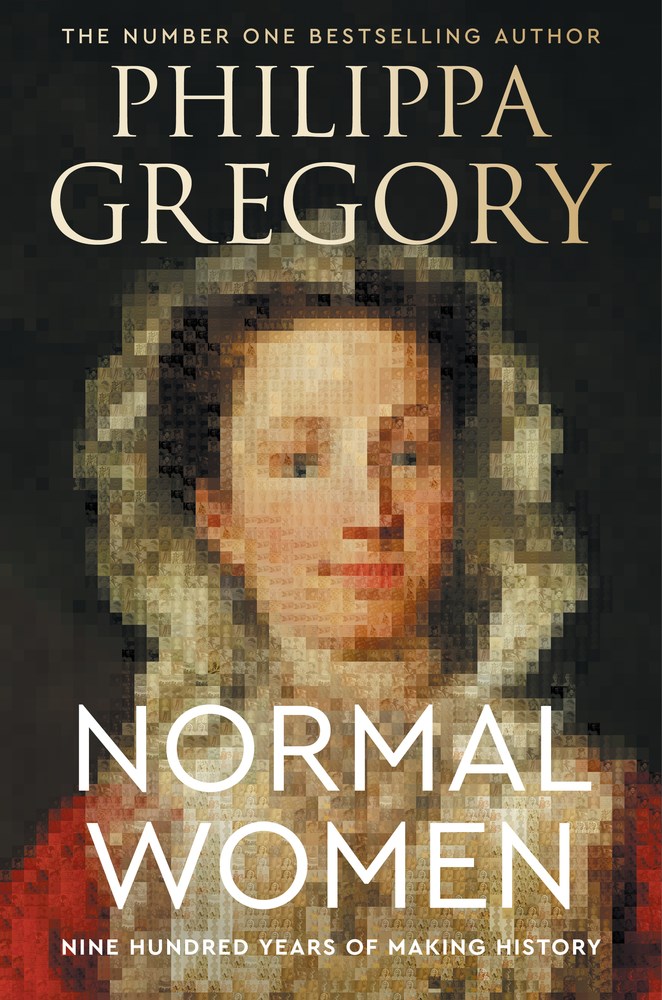
Normal Women, by Phillipa Gregory

If you’re going to read the history of women in England for the last 900 years, then you can’t be surprised that it is a huge book. Long? Yes. Also, fascinating and infuriating.

Women have suffered ever since William the Conqueror brought his patriarchal ideas about the superiority of men over women to England in 1066, obliterating the more equitable society he found there. Sound like a generalisation? Read this book, where each assertion is backed up by example after example drawn from primary sources, starting with the Norman laws that dictated the so-called natural inferiority of women, morally, mentally, and physically.

Gregory’s extensive research yields statistic after statistic, example—by name—after example of women doing the work of society while having no power. She divides the book by eras and, within each presents a cogent description of areas such as the status of women’s health, marriage rights, widows, work (paid and unpaid), female soldiers, sexuality, slavery, rape, and prostitution.

Bottom line? Every time things start to look better for women, every time they are given a modicum of power, the immediate reaction by terrified men shoves them backwards. Think it’s all in the past? Look at how the percentage of rapes of women that are investigated by British police—already appalling low—have declined in recent years. If I remember correctly, the most recent figure in the book is from about ten years ago and is shockingly only two percent. Two percent!

Century after century, women are excluded from profitable work, from unions and guilds, from being able even to train for better work. All this while they are the ones feeding the family, more often than not. Elite women cheerfully throw their lower class fellow females under the wheels of their chariots.

A lot of this I already knew, but the tsunami of detail, of individual stories, really brought the horror of this persistent imbalance of power home to me. One area I hadn’t realised is that women were the true force behind the great resistance movements in England, the ones that pushed back against enclosure of common lands, automation, and other power grabs by the wealthy that left everyone else to starve. The Peasants’ Revolt of 1381 was sparked by two women from Kent, Joan Hampcok and Agnes Jekyn protesting a poll tax, not Wat Tyler, as the history books would have it.

If you think that 500+ pages of this would be boring, think again. There are surprises everywhere. Did you know that boxing was primarily a women’s sport in the early 18th century? Gregory writes with a cool attention to story, grabbing the reader’s attention and not releasing it. You cannot even turn away from her ten pages listing names of women murdered in Britain in 2019, nearly all dying from domestic violence. She tells us of the broken ribs and deformed bodies of women laced into too-tight corsets, of women colliers dragging coal out of mines like pit ponies.

She reminds us of how men of every period attempted to define women—quoting their very words—in ways that demeaned them and reinforced male dominion. All these unscientific theories of women’s nature spoke of her weakness of body, mind, and morals.

We are introduced to so many extraordinary women in these pages, but the author reminds us to look around us. “The history of women is a struggle over identity and inclusion: we are all ‘normal’ women even when we have been described as exceptional or deviant or inadequate, even when our vanity prompts us to stand apart, or our ambition to compete with each other.”

Yes, it’s a long book. You may want to pace yourself, though I confess that I tore through it. This is the book that I’m recommending to everyone this year.

Have you read any part of this remarkable book? What did you think about it?

The Personal Librarian, by Marie Benedict and Victoria Christopher Murray

I recently toured Ventfort Hall Mansion and Gilded Age Museum in Stockbridge, Massachusetts. Many folks might recognise it as the location used for the film of The Cider House Rules. I was intrigued because the house was built in 1893 for George and Sarah Morgan, Sarah being the sister of J.P. Morgan, and I happened to be in the middle of reading this story of J.P.’s librarian.

The tour was fascinating, with much detailed information and background. I was drawn to a display about the book and its protagonist Belle da Costa Greene, hired in 1905 as Morgan’s personal librarian to build and curate his library, and the first director of the Morgan Library and Museum after his death.

Belle, as we know now, was a woman of color passing as White. Even as a White woman, her being awarded this position shocked the male-dominated world of the early twentieth century. She went on to become fabulously successful. Intelligent, witty and well educated, she outmaneuvered others to acquire rare and valuable books for the library.

The authors have filled out the few records of Belle’s life to create a stirring portrait of this complicated woman. Her father Richard Greener was the first Black graduate of Harvard, a lawyer and professor who worked for civil rights causes all his life. However, her mother Genevieve decided that the only way for her children to succeed in a prejudiced world was to pass for White. To that end, she moved with the children to New York City and changed their name to da Costa Greene to bolster her claim of Portuguese heritage.

The accounts of Belle’s complicated relationship with Morgan, the enmity of his daughter Anne, and Belle’s adventures in the world of rare books keep the story moving. The real driver of the story, though, is her inner life as she wrestles with her identity and preserving her role, including leaving behind her birth name Marion.

Of course, we don’t know how the real Belle felt about any of it. This is historical fiction. However, its consistency and psychological acumen make it thoroughly believable. I have some qualms about books like this one that interpret the life of a real person, someone who isn’t here to correct mistakes. However, without such books, few of us would know about someone like Belle, long forgotten by history.

While the second half of the book dragged a bit as she goes from success to success, it is still an enjoyable read, and a good complement to Anderson Cooper’s Vanderbilt: The Rise and Fall of an American Dynasty, which I read recently. In Stockbridge, I learned a bit about its other Gilded Age “cottages” which, like the New York mansions in Vanderbilt, competed to outdo each other in size and excessive expenditure. And all, including Ventfort, were quickly disposed of by succeeding generations due to bankruptcy or lack of interest. Ozymandias indeed.

How do you feel about historical fiction based on real people?

The Lighthouse Keeper’s Daughter, by Hazel Gaynor

I first heard of Hazel Gaynor through her partnership with Heather Webb. They are co-authors of a number of delightful novels, including Meet Me in Monaco about Grace Kelly’s wedding. Here, Gaynor again gives us historical fiction based on real events. In one of two braided stories, twenty-two-year-old Grace Darling helps her father operate the Longstone Lighthouse on the Farne Islands in Northeast England. The family lives there, as well as being responsible for the light itself.

My sister Thomasin used to say she imagined the stairwell was a long vein running from the heart of the lighthouse. In one way or another, we have all attached human qualities to these old stone walls so that it has become another member of the family, not just a building to house us.

When a terrible storm erupts in 1838, Grace and her parents are the only ones home, her brothers elsewhere. When the paddle steamer Forfarshire is wrecked on the rocks, she insists that she and her father should try to rescue the survivors despite the raging sea and high winds. That feat made her famous, to her dismay, bringing reporters, tourists, and portrait painters to their previously lonely outpost.

One hundred years later, nineteen-year-old Matilda finds herself banished to another lighthouse in Newport, Rhode Island, to spare her parents back in England the shame of her unwed pregnancy. The lighthouse is run by a distant relative, a grim, reclusive woman.

As Matilda tries to find a way to connect to Harriet, she becomes intrigued by the lighthouse itself and soon begins to learn about its history and operation. In a trove of family artifacts she learns about her ancestor, Grace Darling. She’s also curious about Harriet’s mysteries and secrets.

The 1938 New England Hurricane, one of the deadliest and most destructive ever to hit the United States, requires both women to summon reserves of courage and love if they and the lighthouse are to survive.

In spite of the hurricanes and other tragedies, this novel was the absorbing comfort read I was looking for. I couldn’t help but cheer on these women who worked so hard and set themselves such high standards. The relationships within the families and with those in the wider world were presented with nuance and depth.

I might have liked a little more development of some of the secondary characters, but that’s a minor quibble. There were a few anachronisms in each of the time periods, which gave me a chuckle.

Still, I treasured the insights about what it takes to operate a lighthouse in each time period, and the attendant duties, such as rescuing shipwrecked people. I had no idea that women had been lighthouse keepers, though—of course—why not?

Like Gatsby and Woolf’s Mrs. Ramsey, I used to live with a distant light, a lighthouse on the Chesapeake Bay that lit my bedroom and dreams for years. I once tried to swim to it. It seemed so close! But it was not; it was beyond my power to reach.

So Gaynor had me at “lighthouse.” Then came the bonus of just the sort of story I was looking for: one that held my attention, gave me a break from the anxieties of current events, and even taught me some things I didn’t know.

Have you read a novel or a nonfiction book about a lighthouse and/or its keeper?