The Marriage Portrait, by Maggie O’Farrell

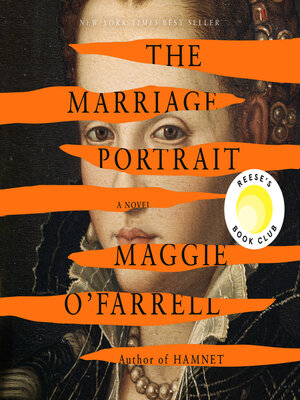
In my book club’s choice for this month, Lucrezia de’ Medici, third daughter of Cosimo de’ Medici, and the Duke of Ferrara, Alfonso d’Este, step out of Robert Browning’s poem “My Last Duchess” and are brought to life by the author of Hamnet.  When her older sister dies suddenly, Lucrezia is forced to take her place in the politically important marriage with Alfonso. Only 16, she is married to him and carried off to Ferrara in 1560. A year later she is dead, rumored to have been poisoned by her husband.

That much is true, though today historians think she died of tuberculosis. O’Farrell expands the story, creating a rich tapestry of the time and a deep dive into a sensitive young woman’s experience. The narrative alternates between the last few months of Lucrezia’s life when Alfonso has removed her from the castello to a remote fortezza, and the fuller story of her life leading up to this ending.

During her childhood in Florence, Lucrezia leads a limited life, confined to the nursery area where she feels different from her many siblings, older and younger. Imaginative and artistic, she has a rich inner life. And she’s a fierce child, pushing against restrictions and yearning to see the tiger her father has had imported for his personal zoo in the lower reaches of the palazzo.

Since we know from the historical note at the beginning that she will die, the suspense that powers the novel—jacked up every time we return to the threatening fortezza—comes from wondering why it must come to that and whether she is able to resist in any way. Even in the other sections, there are hints and warnings, such as her learning about the Trojan War and how Agamemnon sacrifices his own daughter Iphigenia after pretending she is to marry Achilles.

O’Farrell’s luscious writing pulled me in. I felt the prick of hairpins in Lucrezia’s hair, the stiff material of her gown. The “sweet, cloying smell” of lilies in her chamber came to me as did the “waterfall of noise” that “crashes down on her” when “[t]he gates creak open” and the glare in her eyes as she steps out of the palazzo where a carriage waits to take her to her wedding.

After the wedding, she and her maid are carried off to a villa in rural Tuscany. “They travel along a wide road, on either side of which are rows and rows of fruit trees—Lucrezia could, for a while, make out branches heavy with the round curves of peaches and perhaps the tear shape of lemons. But now it is too dark to see anything at all.” Meanwhile, Alfonso has been called back to Ferrara to deal with an emergency: his mother and oldest sister refusing to give up the new, forbidden Protestantism.

Some people in my book club considered the portrayal of a noble woman such as Lucrezia objecting to a political marriage to be an anachronism. Marriage at that time was considered a transaction, especially for rulers. Women such as these were raised knowing that marriages would be arranged for them based on political and/or economic benefits. Instead, this story projects modern-day women’s expectations of personal agency and a loving marriage on both Lucrezia and Alfonso’s sister Elisabetta, who is dallying with one of the guards.

Since I’m also reading Phillipa Gregory’s magnificent nonfiction book Normal Women: Nine Hundred Years of Making History, I’ve learned that some women did rebel against being subjugated and treated as property, even during this period. Therefore, I didn’t find it hard to believe that, out of all the women in the book who made no complaint about their arranged marriages, there could be a child such as Lucrezia, raised in  isolation and temperamentally different from her siblings, who would find it a terrifying prospect. Nor that Elisabetta, with all the dissension and rebellion within her own family, might give in to the attractions of a handsome guardsman.

I do agree, though, that many—most?—historical novels feature women and sometimes men whose modern sensibilities are at odds with their time period. I assume this is a necessary adjustment to attract the attention of modern readers.

One drawback of being exclusively in Lucrezia’s point of view is that her interest in and understanding of the other characters is limited. Thus, we don’t get to know them very well. I did find Alfonso interesting, with his combination of ruthlessness—necessary for anyone trying to rule in such embattled times—and aesthetic awe of the castrati’s music, not to mention his rare whimsy. I would have liked to know more about Lucrezia’s maid Emilia, too.

The way O’Farrell orchestrates verb tenses captured my attention. Most chapters are in present tense, some, such as the one about the tiger, in past. And there’s even at least two sections in future tense. Usually, as is normal, the past tense is used for memories and flashbacks in present-tense sections, but now and then it is the past perfect. These are not errors, I believe, but a subtle way of capturing the multiple currents of time that swirl around us.

My book club discussed the ending at length. Some found it ambiguous and, indeed, came up with a few different interpretations. I won’t go into that, of course, but would love to hear what you thought of it, if you read the book.

Do you enjoy historical fiction based on the lives of real people? Why or why not?

Dance of the Happy Shades, by Alice Munro

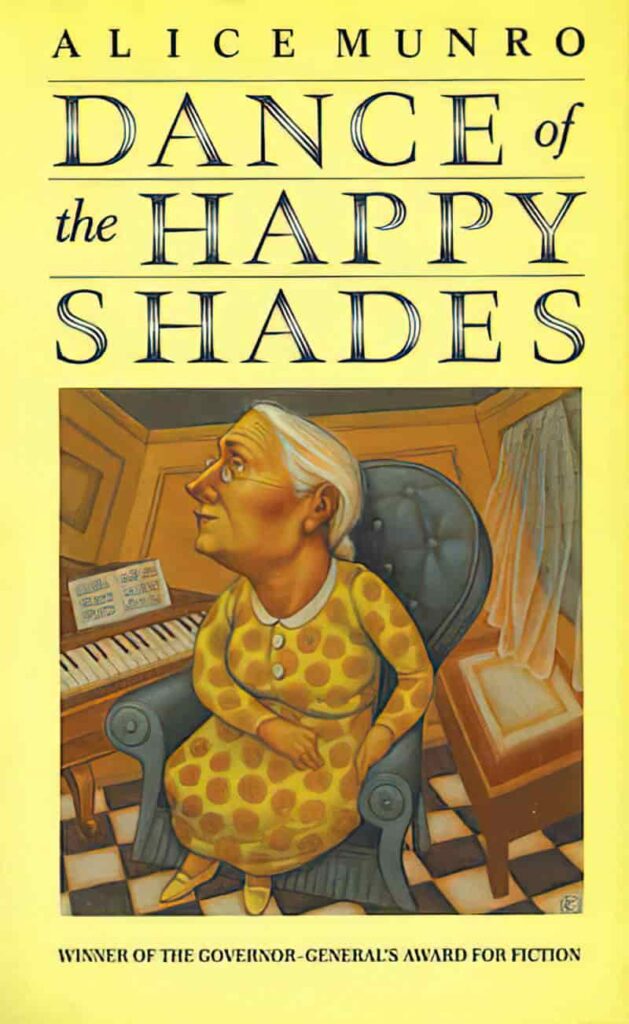
Hearing of Munro’s death sent me back to this, her first book, winner of the Governor General’s Award in 1968. One of my favorite authors, Munro wrote short stories exclusively, forcing her to master the art of compression. Even these early stories demonstrate—to my delight—the kind of concise writing we expect in poetry. Munro is lauded for capturing the life of small towns in rural Ontario, drawing on her experience of growing up in one such town where she was born in 1931. As Hermione Lee writes in the New York Review:

Munro’s “real life” ingredients become enormously familiar to us: the childhood in the fox farm on the edge of town, the mother with incurable Parkinson’s, the studious girl reading her way out of the country into university, the expectations for young women in 1940s and 1950s provincial, conservative, colonial Canada; the early marriage and motherhood in Vancouver, the condescending young husband, the adultery, the divorce, the deaths of her parents, the returns home.

Yet even when I come across some of these familiar details, each story feels new to me and each character a new and different person. She establishes the new character immediately, sometimes by starting in media res, sometimes by giving her an unmistakably original voice.

Afterwards the mother, Leona Parry, lay on the couch, with a quilt around her, and the women kept putting more wood on the fire although the kitchen was very hot, and no one turned the light on . . . “The Time of Death”

Now that Mary McQuade had come, I pretended not to remember her. It seemed the wisest thing to do. She herself said, “if you don’t remember me you don’t remember much.” “Images”

Setting and mood, as well, are deftly established with just a few sentences. Here, the narrator has returned to her hometown for a visit and is sitting on the steps with her sister Maddy in the quiet night.

At 10:30 a bus goes through the town, not slowing much; we see it go by at the end of our street. It is the same bus I used to take when I came home from college, and I remember coming into Jubilee on some warm night, seeing the earth bare around the massive roots of the trees, the drinking fountain surrounded by little puddles of water on the main street, the soft scrolls of blue and red and orange light that said Billiards and Café . . . “The Peace of Utrecht”

This story also illustrates why I value Munro’s work so highly. The tangled relationship between the two sisters, one who stayed to care for their aging mother and one who left, is the fire smoldering between lines laying out the events and memories, the encounters and discords. No story I’d read before this one truly captured the roiling emotions and testy skirmishes between sisters that I’d experienced. Munro is someone who gets me. Was.

Stories, such as “Boys and Girls” where the narrator rejects her mother’s homemaker-in-training chores to join the boys doing far more fun farmwork, speak to me childhood. Others could have been written about my life as a young mother. “The Office” begins:

The solution to my life occurred to me one evening while I was ironing a shirt. It was simple but audacious. I went into the living room where my husband was watching television and I said, “I think I ought to have an office.”

Girls and young women populate the stories in this first collection. I’ve read many of her later stories, which only get better, and now am looking forward to reading her last two books.

Have you read Alice Munro’s work? What is your favorite story?

The Radiant Way, by Margaret Drabble

014da15c5ec21f89a0db55f7511a3ccc

I dove into this 1987 novel, having long been fascinated by the way Drabble uses the closeup of individual lives to chronicle social history. We begin at a New Year’s party in 1980 with three longtime friends, now approaching midlife turning points, even as Britain itself enters a decade of change wrought by Prime Minister Margaret Thatcher and her cronies.

At the party Liz Headland, a psychologist, finds that her marriage to Charles, long tamed by child-rearing and busy careers, is falling apart. Alix Bowen is becoming disillusioned with her work as a teacher within Britain’s social-welfare network, feeling that the progressive fervor of the previous decades has not accomplished much. Artist Esther Breuer, pessimistic about the role of art in a changing society, contemplates leaving London for good and moving to Italy.

The three had met at Cambridge twenty-five years earlier, their social and academic success there promising brilliant careers. In a nod to The Prime of Miss Jean Brodie, they are “the crème de la crème” of their generation. However, at this point, Liz is the only one of the three to be financially stable, though even that might change with her divorce. Alix and Esther do piecemeal work and are often criticised for wasting their brains and for lacking ambition.

While wrestling with their own disappointments and demons, they navigate a society that is turning away from the socialism that has helped Britain recover from WWII, to a ruthless capitalism that rewards winners and ignores the suffering of losers.

In much of my reading over the last few months I’ve been looking at how writers balance the personal lives of their characters with the larger events in their world. In some cases, such as Sisters of Night and Fog by Erika Robuck, the correlation is obvious and inescapable. In others, such as Wives and Daughters by Elizabeth Gaskell, it is more subtle. Here I feel Drabble’s social context—miner’s strikes, social service cuts, a serial killer—sometimes overwhelms her characters’ lives.

I know from reading other novels by Drabble that her style is rather dense, with more exposition and fewer dramatic scenes than we are used to in today’s fiction. That’s okay with me—I search out these novels that call for a little more attention. I enjoyed the deep dive into the minds and hearts of these three women. The other characters are well-drawn and fascinating, not only within themselves but also how they interact with and affect Liz, Alix and Esther.

The novel is a wonderful portrait, not only of these characters, but of a decade whose changes are only now starting to lose steam. I found its paean to friendship between women equally fascinating, especially the way their bond survives even as each of them transforms in the course of the novel.

What novel set in the 1980s have you enjoyed?

Displaced Dolls and Oviducts, by Marigo J. Stathis

Displace Dolls

These are some meaty poems from my friend Marigo Stathis! The cover might give you a clue as to what you are in for, but when you dive in you’ll see these are not so much protest poems as heartfelt support for all women on “the female warrior’s path to self-worth and discovery.”

Homeless angels, naked shepherds, broken Barbies will find a welcome here. So will feisty women who defy fortune tellers and speed limits to sport their tattoos and midnight dance moves. They will find acceptance in these poems and, even more important, proof that their voices have been heard.

Many of these poems are packed with details, a feast for the senses. Your mind scrambles to grasp them even as each one lays bare your memories. Here’s the first stanza of “Clarity:”

This night smells of poetry,
amidst cricket cacophony,
with a climate that quavers
of exhaustion, lust,
and crouched cats with
cutting claws to pounce,
in promise:
prey on the way.

Or this description that begins “Mimi:”

On Sunday mornings,
        we woke to light clinks of the prayer string;
as your spotted, once smooth skin
        touched each bead,
with every psalm,
        I wondered how long
        the cross would remain warm in your palm,
that felt like crumpled velvet
        caressing our small faces.

Stathis also uses rhythm to enhance the mood, whether it’s the nostalgic pebbles of memory in “shrewd games of Scrabble. // Pink bubbles, bursting;” the ominous opening “An eclipse was promised that night;” or the “thrashing thoughts, ionic tumble, / altered orbit—stutter, stumble—“ of an “ardent love-storm.”

These poems are full of love, the kind that links arms with you and walks beside you in a world where often justice is missing and others are constantly trying to shape you. Be yourself, these poems urge. I’m with you.

What poetry collection have you read that felt like a feast?

The Testament of Mary, by Colm Tóibín

0f88819e74d566105d87d4314b00ef6a

There are some authors whose every book is a must-read for me. Tóibín is one, ever since I picked up a battered copy of The Heather Blazing at a used book and tool sale in a market town in England twenty years ago. I persuaded my book club to read it as well and they’ve gone on to enjoy other novels by him. You’ll find several of his books in my blog: Brooklyn, New Ways to Kill Your Mother, The Empty Family, Nora Webster, and The Magician.

Not having been raised Catholic and a longtime feminist, I’ve given little thought to the culture that has built up around Mary, aside from discarding the stereotype of her as docile and obedient that many people hold up as the ideal toward which all women should strive. As a mother, I could feel her horror and grief at the death of her son, but that made me dislike even more the priestly glorification of human sacrifice. Well, I guess they would say half-human.

However, this first-person narrative captured me immediately, giving me a new and completely plausible image of an historical Mary. Here, she is older and alone, living in Ephesus, a city known for its Temple of Artemis, located in what is now Turkey, thus far enough away from Rome to offer safe haven from her Roman pursuers. There, she is visited by two of her son’s disciples who watch and support her even as they question her repeatedly about her son’s life to bolster their own narratives. She says:

They think that I do not know the elaborate nature of their desires. But nothing escapes me now except sleep . . . They are too locked into their vast and insatiable needs and too dulled by the remnants of a terror we all felt then to have noticed that I remember everything. Memory fills my body as much as blood and bones.

She considers those who followed her son a “group of misfits he gathered around him, men who could not look a woman in the eye,” and judges herself with the same brutal clarity. In this slim novella, she tells us her story, the one she holds in every part of her body.

And it is an utterly credible story. If there truly was an historical Jesus—his name is never mentioned in this book—then this portrait of a happy, playful child grown into a cold and distant man is one I can believe. It is the story of too many men, and a few women, who have embraced the portrait of themselves they see in others’ eyes and the power that comes with it.

It is not the story that has come down to us; that’s the one crafted by his followers, the one she disputes. It is still an enthralling one. A mother, telling us about her son—her son. She discounts the stories she hears about his so-called miracles as exaggerations by the crowd that follows him. Even her glancing acquaintance with the results, such as meeting the undead Lazarus, are ambiguous.

Tóibín has crafted a tender and agonizing book that has changed my view of Mary and her son.

What novel of Colm Tóibín’s have you read? What did you think about it?

The Years, by Annie Ernaux

s-l300

Writing guru Donald Maass—writer, agent, and writing teacher—reminds us to include what’s going on in the world in our stories, partly because our characters will probably be thinking about current events and reacting to them. Mostly, though, because including specific details and big-picture events helps make the world of our story seem real to the reader.

In this book, Ernaux has gone further, focusing on the larger life of a society and placing the life of one woman within that.

. . . the idea had come to her to write “a kind of woman’s destiny” set between 1940 and 1986.

Ernaux’s genre-bending experiment adds a new dimension to the field of life writing. She goes beyond memoir—a subjective view of events in the author’s personal life—and autofiction—a reexamination and fictionalisation of those events—to create a new form that melds both of these with sociology and history. She has captured the sweep of the lifetime simultaneously with that of a person and a generation.

Everything will be erased in a second. The dictionary of words amassed between cradle and deathbed, eliminated. All there will be is silence and no words to say it. Nothing will come out of the open mouth, neither I nor me. Language will continue to put the world into words. In conversation around a holiday table, we will be nothing but a first name, increasingly faceless, until we vanish into the vast anonymity of a distant generation.

Time is the only narrative structure in this collage of private memories, public events, photos, songs, brand names, television, advertising, headlines. There’s no plot, no protagonist, no story question. Instead, we are given “abbreviated memories” spun together, some personal and some common.

It will be a slippery narrative, composed in an unremitting continuous tense, absolute, devouring the present as it goes.

I especially like the way Ernaux, looking back on a long life, refers to the past as a series of “palimpsests.” It’s an effective way to describe the veils that layer over each other as we try to recall how we were.

At first, I felt overwhelmed by the flow of historical events, popular culture, and experiences. I could barely grasp each fragment before it was replaced by another, perhaps because I was listening to the audio version, beautifully performed by Anna Bentinck. Eventually, though, I began to recognise how artfully they had been assembled to create a continuous narrative.

More importantly, I came to feel a part of the story, engrossed in the passing decades and fascinated by the ways my own life interacted with this collective story, merging and sliding apart, only to merge again and again slip away. I began to feel as though she were telling me the story of my own life, with occasional diversions.

Perhaps I should have first mentioned the unique point of view. Unlike most life writing, there is no “I” in the book. Instead—and fittingly for the story of a generation—it is narrated by “we,” as though by a chorus of voices. Apparently, in the original French version, the pronoun used is “on” which is the generic he/she that English is lacking, though it could be translated as “one.” The translator, Alison L. Strayer, has chosen instead to use “we,” which works brilliantly to capture the voice of the collective sections.

Some parts are about a specific woman, spoken of as “she.” As she nears the end of life, she begins to write this book to defy death’s erasure.

By retrieving the memory of collective memory in an individual memory, she will capture the lived dimension of History. This will not be a work of remembrance in the usual sense, aimed at putting a life into story, creating an explanation of self. She will go within herself only to retrieve the world, the memory and imagination of its bygone days, grasp the changes in ideas, beliefs, and sensibility, the transformation of people and the subjects that she has seen.

I plan to delve into other books by Ernaux, winner of the 2022 Nobel Prize in Literature. I can see why this particular book was longlisted for the 2019 International Man Booker Prize. Without getting into the controversy over whether it qualifies as fiction (a requirement for the Booker), I have to rank it high on my list of best books ever. To reach into my own past: it blew my mind.

Have you read a book by Annie Ernaux? What did you think about it?

A Thousand Ships, by Natalie Haynes

1k ships

It starts with fire—after the muse has her say about the poet’s invocation, of course. Creusa, wife of Aeneas, awakens to find the Citadel, the highest point of the city of Troy on fire. Her husband and five-year-old son missing, and the fire is rapidly spreading throughout the city.

The city is falling. But that’s impossible. Troy has won the war. Just a few days earlier, they had seen the ships sail away, the Greeks finally giving up after ten grueling years of war without winning back Helen, who had started it all. And yesterday for the first time in all those long years, the gates of Troy were opened and its citizens walked out, only to find a magnificent offering to the gods left by their enemies on the beach: a huge wooden horse.

Haynes deftly slips in this background as Creusa frantically tries to escape the burning city. This outstanding book is a reimagining of the events around the Trojan War through the eyes of the women involved: Greeks, Trojans, goddesses, muses, Fates. As the muse Calliope says:

There are so many ways of telling a war: the entire conflict can be encapsulated in just one incident. One man’s anger at the behaviour of another, say. A whole war – all ten years of it – might be distilled into that. But this is the women’s war, just as much as it is the men’s, and the poet will look upon their pain – the pain of the women who have always been relegated to the edges of the story, victims of men, survivors of men, slaves of men – and he will tell it, or he will tell nothing at all. They have waited long enough for their turn.

Even with a multitude of voices, the reader is always firmly grounded: only one narrator per chapter, with the name and often some explanatory information as the chapter title. Plus there are subtle clues in the beginning of the chapter to explain who the woman is. For example, here is the first paragraph of “Theano, wife of Antenor (advisor to Priam) mother of Crino:”

Theano, wife of Antenor, mother of four sons and one daughter, bent over to light the candle and blinked in its small, smoky flame. Mother of four sons who would not bury her, when her time came. Four sons who had not survived the war. Sons obliterated by the folly of another woman’s son. Her tears came from the smoke, and also from the anger which burned at her core, like the wick of the candle she carried to the table and placed in its centre. Her husband sat opposite her, his head in his gnarled hands. She had no pity for him: the war was raging through its tenth year outside the city walls and he was too old to fight. She would have given his remaining life – lived uncomplaining as a widow – to spend a single moment with one of her dead sons.

The through-line of the book follows the women of Troy from the night of Troy’s fall through what happens to them at the hands of the Greek conquerors, while weaving in events from the past and future. For example, there are several letters to Odysseus from Penelope. As she waits the long ten years for his return after the fall of Troy, her tone becomes increasingly barbed.

The bards all sing of the bravery of heroes and the greatness of your deeds: it is one of the few elements of your story on which they all agree. But no one sings of the courage required by those of us who were left behind. It must be easy to forget how long you have been gone, as you bound from one misfortune to another. Always having to make impossible choices, always seizing opportunities and taking risks. That passes the time, I would imagine. Whereas sitting in our home without you, watching Telemachus grow from a baby into a child, and now a handsome youth, wondering if he will ever see his father again? That also takes a hero’s disposition. Waiting is the cruellest thing I have ever endured. Like bereavement, but with no certainty. I’m sure if you knew the pain it has caused me, you would weep. You always were prone to sentiment.

We also get the events that led up to the war and to the fatal night. Haynes’s orchestration of these various pieces is an incredible achievement. Some incidents are slowly unpeeled like an onion, with chapters about other events interspersed between layers. Others are placed just where they will have the most emotional impact or when the reader needs to know about them to understand the next chapter or to see the previous chapter in a new light.

The women are presented so realistically, even the goddesses, that they could easily be people you know. I’ve quoted generously from the book to show how accessible it is to any reader. Haynes includes enough information to orient those who are not familiar with the events described in the Iliad and Odyssey, yet presents all of it in such a novel way that it is fascinating all over again for those who are.

The book reads so easily that I was surprised by the description in the Afterword of Haynes’s extensive research. The historical record of women’s lives from that period is almost nonexistent, so the author really had to dig to find anything about the women in this book, fragments that Haynes could then supplement with her imagination.

I cannot recommend this book highly enough. It is not just a mesmerizing story, one that I could not put down despite knowing how it would all turn out. It is also a textbook for writers on how to reveal information and backstory. And it is a psychological masterpiece, a gorgeous tapestry of women’s lives and ideas and reasons. You’ll never think of the Trojan War—or any war—in quite the same way again.

Every now and then a book comes along that I want to send to everyone I know. What book have you read recently that you’ve recommended to your friends?

How the One-Armed Sister Sweeps Her House, by Cherie Jones

sister

This debut novel with an intriguing title is set in Barbados in 1984 where Lala makes a living braiding hair for tourists on the beach. She lives right there in a rickety shack with her husband Adan, a petty thief. Eight months pregnant, she strains to manage the steep, railingless stairs to their home.

When she goes into labor she struggles through the night looking for her husband. Washing up against a gate in the tourist enclave, she rings the bell, only to have Adan himself appear. As they race to the hospital on his bicycle, Lala hears a scream, one that will echo in her throughout the book.

We move between Lala and Mira Whalen, originally a poor white from Barbados, whose wealthy white English husband Peter has been killed in a bungled robbery. The couple has come to Barbados on holiday, Peter hoping to win back Mira’s love after she’s had an affair. Even as the two women highlight the differences between wealthy tourists and poverty-stricken Bajans, Mira’s grief and regret resonate with Lala’s increasing recognition of the mistake she made in marrying the sociopathic Adan.

Jones deftly weaves in stories of Lala and Mira’s mothers and grandmothers and how their lives echo—or not—their daughters’. Jones also brings in other other characters such as Adan’s friend Tone, whose concern for others contrasts with Adan’s violence.

And there is a lot of violence. This is a terrible and devastating story, certainly centering on threats women face, but also touching on men and the things they are driven to do. We move back and forth in time, unearthing secrets buried too long, coming to know all these characters. This book is a brilliant example of how to bring in backstory: only telling us a story from the past when we need it to understand something that is happening in the present.

I listened to the audio book, not sure at first how far I wanted to go into such a story, but found myself riveted by the prose and seduced by narrator Danielle Vitalis‘s voice. It was so soft and lilting, so gentle that I sometimes had to shake myself to remember that these were stories of abuse and injustice and helplessness in the face of danger.

My only quibble with the book is that the ending tied everything up a little too fast and a little too neatly.

If you are willing to face the underside of life on a Caribbean island and recognise that poverty’s insults and injuries aren’t that different even in paradise, this is the book for you. Gorgeous prose, great pacing, vivid characters: this first novel has it all, if you can bear it.

What first novel have you read that you thought brilliant?