Still Life, by Sarah Winman

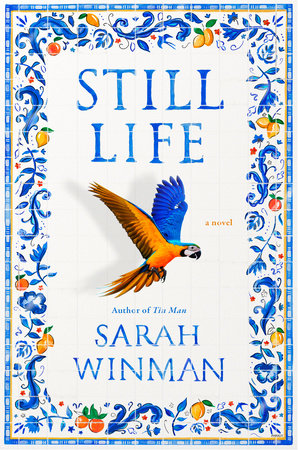
Tuscany, August, 1944. Taking a walk after lunch, Evelyn Skinner sees a jeep and waves it down. As an art historian with decades of experience, she’s in Italy to help with the artworks from museums and churches that have been hidden in the hills during the war, identifying them and assessing the damage. She asks the young English soldier driving the jeep, Private Ulysses Temper, to help her contact the Allied Military Government.

Even in this brief scene, these two people capture the imagination, while Tuscany itself seizes the senses. Ulysses is on his way to pick up Captain Darnley, who has opened his eyes to glories of Italy and art and literature, and takes Evelyn along. Then we jump to London where we meet Ulysses’s wife Peg, Col who runs the bar where she sings, Cress who converses with a tree, the parrot Claude who lives in the bar and quotes Shakespeare, and others. From that point on the novel alternates between London and Florence.

I picked up this book wanting to spend some time in Italy in the middle of the twentieth century. The description are luscious, but the true beauty of the book comes from showing how the fragile threads we throw out to each can, over time, become a beloved community and a motley group of eccentrics can become a family.

There’s never any confusion with the wide cast of characters spread between the two cities. Each person vibrates with life, their adventures by turns dangerous, hilarious and poignant. We meet them as they gather in the sort of places we’ve started to call the commons: a pub, a café, a plaza. We follow them over the decades as they, and we, begin to see how these relationships that began so casually have become a web that can support them during the worst times.

Some people in my book club were bothered by the many unlikely coincidences, but most of us enjoyed the fairy tale quality of the story. We also appreciated the subtle use of symbols and the way different kinds of arts were folded into the story: music, paintings, sculpture, poetry, literature. The descriptions of places and people seduced me, and the dialogue is some of the best I’ve read.

However, the decision to present dialogue without quotation marks poses a problem. It’s a cool, modern thing to do, but this fiction is set in the past. Worse, I often couldn’t tell what was dialogue and what was narrative. Some stories manage to make this clear without the punctuation, but not this one. Most of the people in my book club had trouble getting into the book; they started and stopped, tempted to give up, or they had to reread parts near the beginning a few times before taking the plunge. They thought the lack of quotation marks played a part in their confusion.

Writers often struggle with beginnings and endings. In some of my reviews, you’ll find a complaint about an ending that seems too abrupt or that ties things up too neatly. Here, I found the opposite problem: the last section should have been cut. Unfortunately it leaves behind the rich cast of characters we’ve come to love in order to follow a single one, and introduces a slew of new characters here at the end of the book. The section is well-written, but unnecessary to the story. It felt like padding. I was disappointed, too, that it took some wonderfully evocative allusions from earlier in the book and ran them into the ground, just in case we didn’t get them. 

Yet even with these concerns, I don’t know when I’ve enjoyed a novel as much as this one.  Each time I picked it up, I felt as though I were sinking into a rich, delicious dream. What a wonderful, luxurious summer read!

What novel set in Tuscany have you enjoyed?

Clear, by Carys Davies

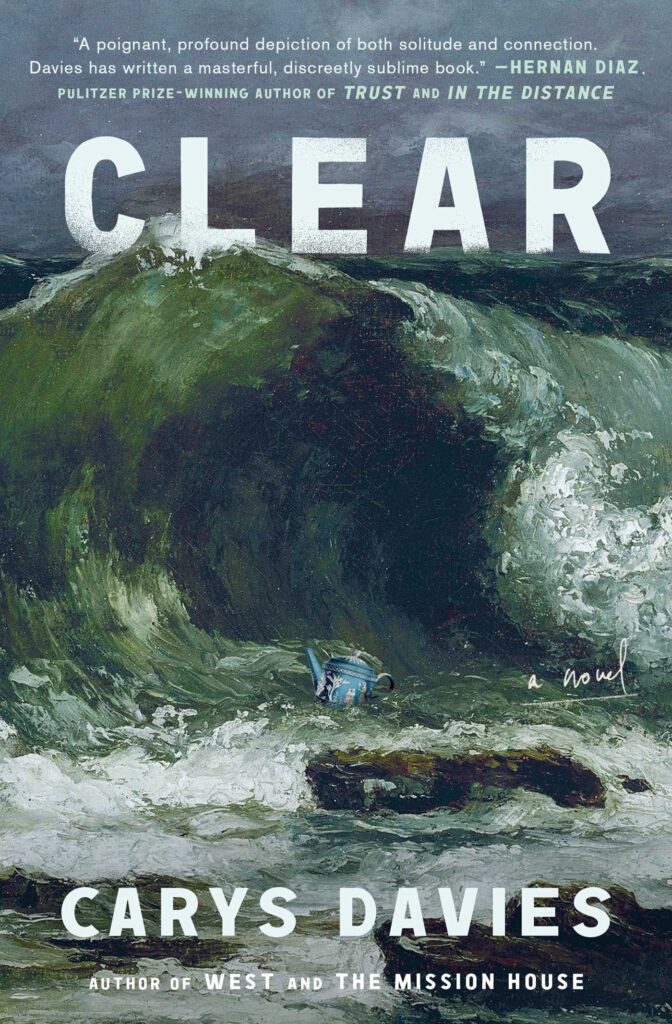
In 1840s Scotland, John Ferguson makes the difficult decision to become one of the evangelical ministers leaving the Church of Scotland to help form the Free Church of Scotland. It means giving up his job and income, but at least his church will be free of patronage and interference from the British Government. Also, it’s not the life he’d promised his wife Mary, but she accepts his choice.

The other major political upheaval besides the Disruption of the Church of Scotland is the ongoing Highland Clearances in Scotland which saw wealthy rural landowners evicting tenant farmers to clear the land for cattle or sheep. Most of the people in my book club were not familiar with the Clearances, which caused immense poverty and fury among the rural poor. A couple of us knew about them through our reading or family stories, but none of us had heard of the Disruption.

Desperate for funds, John jumps at the offer of a temporary, well-paying job as a factor. His assignment is to travel to a remote Scottish island and evict the lone remaining inhabitant—Ivar—so the island may be turned over to sheep. However, soon after arriving on the island he’s badly injured in a fall from a cliff.

Ivar finds the unconscious man and takes him into his home to nurse him. For a long period, John does not remember why he is there and busies himself learning Norn, the ancient language used by Ivar, so the two can communicate.

This lovely story is told in through three perspectives: Ivar, John and Mary. The author’s descriptions of the lonely island and Ivar’s life there are stunning both for their beauty and their authenticity. I especially enjoyed the language lessons, using actual Norn words that are poetic in their precision, such as the word “for the moment before something happens; for the state of being on the brink of something.”

It’s also a story of connection, of how a life of isolation and solitude can be transformed by the arrival of another human being. The author’s spare, elegant prose turns the book into, as one member of my book club said, a real gem.

Curiously, everyone in the book club understood the ending differently. No spoilers here, though many reviewers have criticised the ending as abrupt and unearned. For us, even though we read it aloud several times, we still understood it to mean different things.

That’s okay with me. I don’t mind endings where the story seems to go on after you close the book. In fact, the different endings we came up with said more about each of us that they did about the book. One person suggested we write to the author and ask her to write a sequel, though that mostly reflected our desire to spend more time with the characters.

I do mind when the ending is unearned. I believe the story could have prepared the ground for it a little better, but I actually liked it as it is.

If you enjoyed Small Things Like These, you might enjoy this story. I certainly did, and that was one thing that my book club did agree on: we all were immensely glad to have read it.

What books set on a Scottish island have you enjoyed?

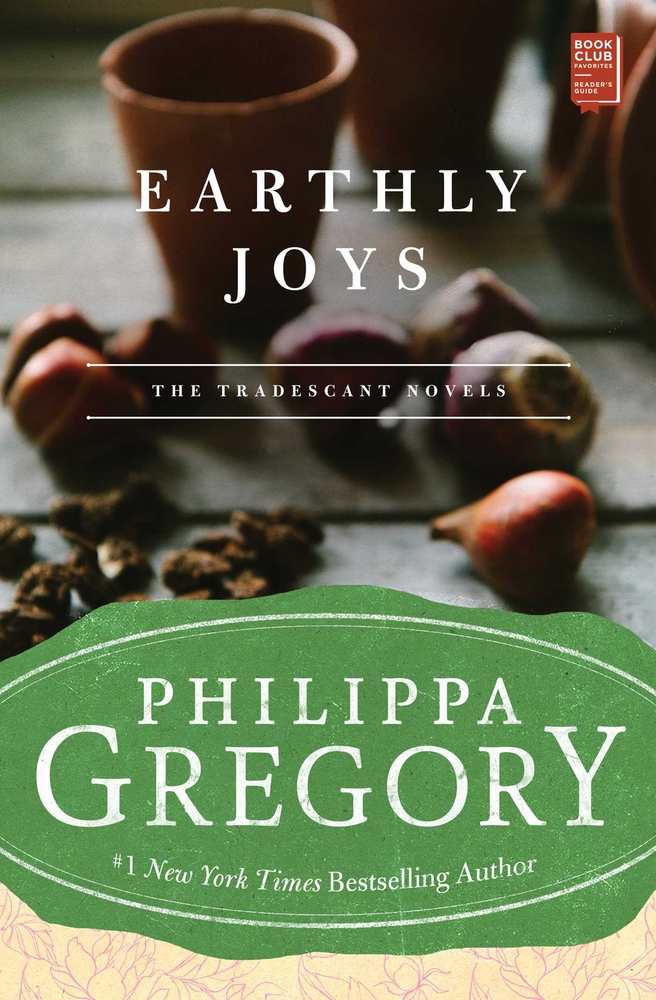
Earthly Joys, by Phillipa Gregory

We meet John Tradescant, gardener to Sir Robert Cecil, as he discusses the state of the gardens with his master in preparation for the visit of the new king: James I. Since Queen Elizabeth died without heirs, James—son of Mary, Queen of Scots and already King of Scotland—has ascended to the throne of England. The story is told by John himself, who is based on the real John Tradescant the Elder, the most celebrated horticulturalist and naturalist of his age.

As a gardener, John has no power in politics; he keeps his gaze focused on the plants and trees that he loves. However, knowing that “he could keep a secret, that he was a man without guile, with solid loyalty,” Cecil uses this principled and practical man as a sounding board, confiding that he has been working in secret to prepare James Stuart to rule in England. James brings two great advantages: he already has two sons and a daughter, and he is Protestant. Thus, it’s assumed he will end the turmoil over the succession and the bitter and deadly religious wars.

John is asked to design magnificent gardens at Hatfield, Windsor, and others. In his work for Cecil and later other lords and James’s successor Charles I, John is sent abroad in search of rare plants. His finds are described with such care that I could see, smell and feel them: the smoothness of a horse chestnut seed, the rainbow sheen of tulips, the scent of cherry blossoms. It turns out that he loves traveling and finding exotic varieties of plants and rarities, much to the dismay of his wife and son, left at home.

This book was recommended to me for its evocation of Tudor and Stuart era gardens, making it an appropriate read for this blossoming midsummer. I was also intrigued by my memory of Gregory’s amazing nonfiction book Normal Women that spoke to the range and depth of her research into the period. What I didn’t consider was how much the concerns of people in 17th century England would echo ours today.

As they discuss the new king, John tells Cecil, “When you have a lord or king . . .  you have to be sure that he knows what he’s doing. Because he’s going to be the one who decides what you do . . . Once you’re his man, you’re stuck with him  . . . He has to be a man of judgment, because if he gets it wrong then he is ruined, and you with him.”

And James is not a man of judgment. He immediately begins plundering the treasury Elizabeth amassed to protect England, squandering it on his own pleasures and rewards to his friends, while ignoring the discontent, poverty and starvation of his subjects. A favorite emerges in his hedonistic court: the Duke of Buckingham: young, beautiful, and self-indulgent. After Cecil’s death, Buckingham brings John to work for him as gardener and personal servant, even taking him into battle.

Civil war is brewing, as the people protest. Parliament is furious when the King takes over their power to impose taxes and sends them home as no longer needed. The King then gets needed income by selling baronetcies and other dignities. Many begin to question the traditional concept of the divinity of kings, seeing James as not someone ordained by God, but rather as simply a man and a repulsive, dishonest one at that.

John, however, is loyal, too loyal according to his wife. John is challenged not just by her, but also by his increasingly radical son who argues that people should be free to obey their own principles, not be ordered what to think by kings and lords. While John’s obdurate loyalty to his masters—even when he thinks they are wrong—can be frustrating for a reader today, it reflects the culture of the time, which was only just beginning to hear the whispers of the individualism we take for granted today.

Another aspect that is true to the time but troubling today is the quantity of foreign plants that John introduces to England. Many have become common to English gardens and forests today, but I couldn’t help thinking about the dangers of invasive species: plants and creatures that originally seemed innocent or useful but have become a nightmare.

While politics and philosophy struck surprisingly close to home for me, they took second place to the gardens. I luxuriated in descriptions of planning everything from orderly knot gardens to seemingly natural meadow gardens. I felt I was laboring along with John and his wife and son to build these joyful works of art. 

Are you a gardener?

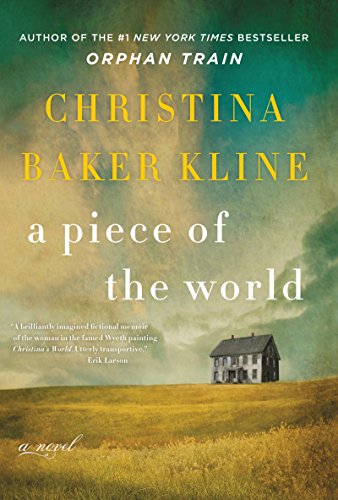
A Piece of the World, by Christina Baker Kline

Most people are familiar with Andrew Wyeth’s painting Christina’s World at New York’s Museum of Modern Art. However, little has been known about Christina Olson herself aside from the fact that she had a degenerative muscular disorder that eventually made her unable to walk. Another tidbit of knowledge has been that Wyeth often painted not only Christina and her brother, but also the house on the Olson farm in the small town of Cushing, Maine.

My interest in Andrew Wyeth’s work intensified when I visited a 2014 exhibition at the National Gallery of Art in Washington, D.C. Looking Out, Looking In concentrated on Wyeth’s paintings of windows. I already loved his famous Wind from the Sea, and became fascinated by his spare watercolors of other windows in the Olson house and others nearby. There are no people in these works, but their lives are somehow embedded in these spaces.

In his Director’s Note to the catalogue, Earl A. Powell III calls Wyeth’s window paintings “skillfully manipulated constructions deeply engaged with the visual complexities posed by the transparency, beauty, and formal structure of windows.” For my part, the theme named in the title remains a powerful one. Whether we are looking out or in, we see both the wide outside and the very personal interior. Also, I am deeply in love with houses, especially those which hold the story of my life.

In this novel, Kline has taken the woman whose image is so familiar and opened her life to us. In her own words, Christina recounts her childhood as a smart girl who wanted to become a teacher but had to leave school to help at home. She has a brief period of social life and a chance at love before her increasing disability keeps her tied to the farm while her friends went on to marry and have children. When one of her friends marries Wyeth, he and Betsy begin spending summers in Cushing, and he starts painting at the Olson’s.

It is Christina’s voice, though, that fascinates me. Amid the constant domestic toil, the brief joy of sweetpeas blooming, the interactions with her parents and brother, her growing friendship with Wyeth, her voice is genuine: stoic and reserved, occasionally ecstatic. I felt as though I lived through each day with her, each turn of the season.

I am wary of novels with real people as characters; it feels like an invasion of privacy to create a story of someone without their permission or knowledge. However, I loved Kline’s thoughtful understanding of what it might mean for a sensitive young woman to have to live such a restricted life—not just her physical restrictions, but also the small town, the confining house, the loneliness as friends and neighbors pull away. I had a tiny surprise: the Olsons were related to Nathaniel Hawthorne, as I am myself, making Christina perhaps a distant cousin.

The limitations of her life mean the story is thin on plot, and Wyeth himself is but a minor character. The real joy of this story for me is the immersion in this woman living a life I could so easily have fallen into. In the story, Christina says of the famous painting:

He did get one thing right: Sometimes a sanctuary, sometimes a prison, that house on the hill has always been my home. I’ve spent my life yearning toward it, wanting to escape it, paralyzed by its hold on me. (There are many ways to be crippled, I’ve learned over the years, many forms of paralysis.) My ancestors fled to Maine from Salem, but like anyone who tries to run away from the past, they brought it with them. Something inexorable seeds itself in the place of your origin. You can never escape the bonds of family history, no matter how far you travel. And the skeleton of a house can carry in its bones the marrow of all that came before.

Have you read a book inspired by a painting?

The Light Between Oceans, by M. L. Stedman

In 1926 Tom Sherbourne becomes the lighthouse keeper on Janus Rock, a lonely spot off the southwestern coast of Australia. It’s a lonely job, with a supply boat only visiting once a quarter, but Tom enjoys it. After a shattering four years fighting in WWI, Tom returned to Australia and began learning the lighthouse trade, attracted by the quiet life, the precision required, and the opportunity to save lives. On a rare shore leave he meets and marries Isabel who adjusts quickly to life on the island and looks forward to raising a family.

Unfortunately she suffers two miscarriages and a stillbirth. So when a boat washes ashore with a dead man and a live baby, she calls it a miracle. Tom, a principled man, wants to report it immediately, but Isabel persuades him to wait, arguing that the mother must have been washed overboard and drowned. The stillbirth is recent enough that Isabel is able to nurse the baby.

Stedman wonderfully evokes the fierce love of parents for a child, as well as Tom’s love for Isabel. Their quiet, isolated life on the island is idyllic. However, when the child is two, they have leave to go to town on the mainland for the first time in three years and, during that visit they are forcibly reminded of the lives of others. While Isabel is fixated on the child, Tom finds himself in a moral quandary.

Stedman’s debut novel appealed to me first because of the setting; I love a lighthouse novel. Tom also appealed to me in some ways: reserved and moral, meticulous in his care of the light, steadfast in his love for Isabel and Lucy. However, I found the book’s premise hard to believe unless the characters were completely self-centered, but then I’ve always held to the philosophy that children come first; what’s best for them is my priority. Too many of these characters give that idea lip service and then do what they want.

I still enjoyed much of the story, though. I recently read a post by Leigh Stein on her Attention Economy Substack where she mentioned the work of Dr. Jennifer Lynn Barnes, a novelist and former psychology professor. I also watched the Grammar Girl interview of Barnes on YouTube that Stein mentions. Believing that novels succeed when they provide their readers with pleasure, Barnes took a scientific approach to identifying the primary pleasure buttons. She came up with six: beauty, money & wealth, status & power, sex & touch, competition, and danger.

It’s an interesting idea, and one that fits this popular novel. The landscape of the light, the sea, and the sky is beautifully drawn. Of all the senses, touch is the one that stays with me from this story: Lucy’s soft cheek, the feel of salt spray from a rough sea. There’s competition and danger, and the potential loss of status and power. The only pleasure button missing is money, which is not a motivation for anyone in the story, but there’s another kind of wealth: family and community.

And I did take pleasure in this story, despite the unlikely premise and some unlikeable characters. It captures the joy of bathing a baby and playing with a toddler. It made for good bedtime reading.

What novel have you read recently that gave you pleasure? What about it made you feel that way?

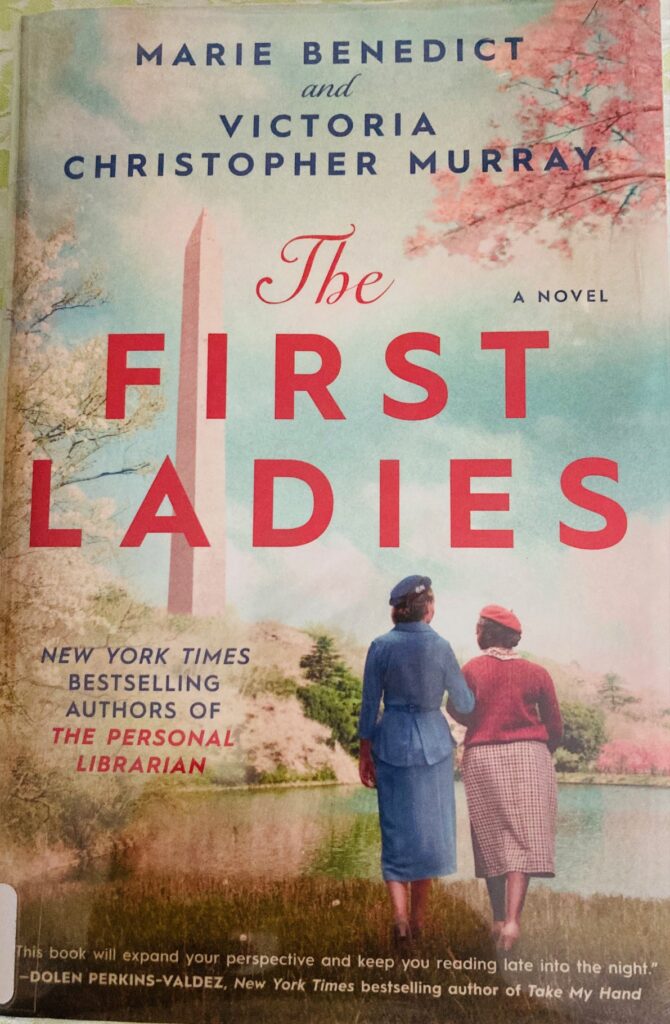
The First Ladies, by Marie Benedict and Victoria Christopher Murray

Benedict and Murray, authors of The Personal Librarian, once again join forces to bring us a well-researched and fascinating story of a friendship that helped form the foundation for the modern civil rights movement. Eleanor Roosevelt’s work as First Lady of the United States is legendary; less well known is Mary McLeod Bethune’s work, which led to her being called the “First Lady of Negro America” by Ebony magazine.

The daughter of a formerly enslaved couple, Mary Bethune became a fearless and passionate Civil Rights activist. Among her many accomplishments, she founded the American Council of Negro Women, and a private school (which later became Bethune-Cookman University) for Black students in Florida.

The friendship between the two women lasted many years, through the 1920s and 1940s, during which they partnered to push for equal rights. They first connected over a shared commitment to women’s rights and education, which later evolved to include equal rights for people of color. In this story—and this was one of the most interesting parts of the story for me—Eleanor gradually begins to recognise her personal shortcomings and blind spots around race. Their friendship is powerful enough to enable Mary and Eleanor to talk honestly about racial issues, to give and receive advice. And to understand that the work is never done.

The women partnered to work directly—Eleanor trying persuade Franklin to ensure Black citizens reaped the benefit of the New Deal jobs, for example, which led to Mary heading the Negro Division of the National Youth Administration—and indirectly. During a time when even driving in a car together was “not done,” they not only did that, but also met in public, shared a table for  tea in a restaurant, attended each other’s events, etc. By doing so, they changed public perceptions, normalising integration and promoting equality.

Their story is a good reminder that the fight for civil rights in the U.S. began before the 1960s. But the story isn’t all politics. We learn about the family relationships that offer a context for each woman. I found it fascinating to see the ways status and power shifted back and forth between them as the relationship between the two women deepened. As friends and admirers of each other, they rose above such petty concerns. They shared secrets and dreams. They supported each other through disappointments and tragedies.

Readers might be familiar with Eleanor’s struggle with her overbearing mother-in-law Sara and heartbreak over Franklin’s affair with his secretary Lucy Mercer. However, both receive even-handed treatment here, as we see Franklin’s early ideals clashing with the political realities of getting the New Deal laws through, and how Sara’s early support of equal rights for women and people of color influenced Eleanor.

Mary’s handling of daily insults and microaggressions, her insistence that she be addressed as Mrs. Bethune in professional settings rather than by her first name as though she were a servant, are inspiring. When one of her students got appendicitis and was refused treatment at the local hospital, she raised money and founded a hospital for people of color. When her grandson was refused access to a segregated beach, she collected investors and bought a stretch of the beach and waterfront, which they then sold to Black families–and White people were allowed to visit the beach. She invested in Black businesses, including a newspaper and several life insurance companies.

Bear in mind that these two amazing women led active political lives. Historical fiction comes in many flavors, so it’s important to adjust your expectations. I enjoy a light, historical romance as much as anyone else (Georgette Heyer, anyone?), but that is not what we have here. While we do get insight into the personal lives of these two women, for them the personal is political, as the saying goes. Much of the book shows how their personal beliefs and experiences motivate their political work. Thus the pace is sometimes leisurely and the story is rich with historical detail.

I especially appreciated the historical notes from each of the authors at the end, clarifying what came from the historical record and what was added by the authors. I also enjoyed the authors’ discussion of their collaboration. The narrators of the audiobook, Robin Miles and Tavia Gilbert, did an excellent job of bringing this story to life.

Especially in these difficult times, the story of these two women, their courage and commitment, their comradeship and deep friendship, is inspiring.

Who are you turning to for inspiration these days?

Best Books I Read in 2024

As a writer, I learn something from every book I read. In no particular order, these are ten of the best books I read in 2024. Please check the links to the blog archive for a fuller discussion of those I’ve reviewed.

Note: I did not include poetry here, though I read the work of some amazing poets, such as Richard Wilbur, Sam Schmidt, Linda Pastan, Ellen Bryant Voight, and Mahmoud Darwish. If you’re interested in reading a wider range of poets, consider joining in on the monthly Poetry Discussion Group I host. Free, no experience necessary, and copies of the poems are provided. Details on my website.

Fiction

  1. Our Missing Hearts, by Celeste Ng

Twelve-year-old Noah Gardner receives a letter from his mother, who disappeared several years earlier. It has been opened by the authorities of course, and is covered with drawings of cats. Noah and his father, formerly a linguistics professor but now demoted to a janitor, live in a U.S. that shows what our current country could easily become. Noah decides to find out once and for all what happened to his mother, a famous Chinese-American artist. A powerful story that puts our current social and political tensions into a (so far) fictional authoritarian world.

  1. The Cartographers, by Peng Shepherd

Nell Young loves maps and once dreamed of working with her brilliant father in the Map Room of the New York Public Library. Her even more brilliant cartographer mother died when Nell was a toddler. When Nell gets an emergency call from the New York Public Library, she embarks on a quest to identify the monster behind a string of thefts and murder. The delightfully complicated plot uses maps in surprising and satisfying ways.

  1. The American Queen, by Vanessa Miller

This fascinating novel is based on the true story of twenty-four-year-old Louella Bobo who in 1865 leads a group of her fellow former slaves to build a community in the Carolinas. The part I enjoyed most was the building of the Happy Land: how Louella managed to negotiate what they needed, the ways they found to make the money they needed, and the success of their communal sharing of all resources.

  1. Small Mercies, by Dennis Lehane

Mary Pat Fennessy just wants to find her daughter. It’s 1974, and life is hard in the grinding poverty of South Boston’s housing projects. She’s buried both her first husband and her son, who fought in Vietnam but came home to Southie to overdose on heroin. Her beloved second husband left her, and now her remaining child, Jules, has not come home from a night out with friends. In this complex story, Lehane shows how difficult it is to go against your tribe. It is a cracking good read, and accurate in its depiction of the time and place, at least according to my memories.

  1. The Old Capital, by Yasunari Kawabata

Chieko lives with her parents in the same building that houses their shop in Kyoto. This gentle story of a few months in her life begins with three images that embody themes central to Japanese literary tradition while later, more modern themes emerge. The microcosm of Chieko and her family holds a much larger story about how we handle the past—what we keep and what we discard—not only traditions but also our memories and our own identities.  This beautifully written story is one that will haunt me.

Nonfiction

  1. Vesper Flights, by Helen MacDonald

The author of the exquisite and deeply moving memoir H Is for Hawk returns with this collection of essays. She compares them to the objects you might find in an 18th-century cabinet of curiosities. As MacDonald opens the doors on these wonders of the natural world, she encourages us to see nature as something other than a reflection of ourselves. I read and reread these essays, loving the way she communicates the “qualitative texture of the world.”

  1. Burning Questions, by Margaret Atwood

Subtitled Essays and Occasional Pieces, 2004 to 2021, this is Atwood’s third collection of essays, speeches, book introductions, and reviews. What astonished me was how readable this heterogeneous collection is. Of course, we have Atwood’s voice throughout: intelligent, calm, learned, self-deprecating, and witty. For a more global understanding of the issues facing us, their interconnectedness, and how we can move forward, this book cannot be beat.

  1. Normal Women, by Phillipa Gregory

This astonishing book should be required reading everywhere in the Western world. This history of women in England for the last 900 years is fascinating and infuriating. Women have suffered ever since William the Conqueror brought his patriarchal ideas about the superiority of men over women to England in 1066, obliterating the more equitable society he found there. In this book, every assertion is backed up by example after example drawn from primary sources, starting with the Norman laws that dictated the so-called natural inferiority of women, morally, mentally, and physically. As the book progresses through the centuries, we get stories of many extraordinary women and their struggles.

  1. The Equivalents, by Maggie Doherty

Subtitled A Story of Art, Female Friendship, and Liberation in the 1960s, Doherty’s fascinating new book tells of the Radcliffe Institute for Independent Study, created in 1960 to provide a stipend, office space, and a like-minded community to help women advance their careers as scholars and artists while also caring for a family. Doherty concentrates on a few of the first fellows: poets Anne Sexton and Maxine Kumin, writer Tillie Olsen, sculptor Marianna Pineda and painter Barbara Swan. The book provides fascinating insight into the creative life and what can inspire or hinder it. It’s also a wonderful portrait of that era and of these remarkable women.

  1. Proust’s Duchess, by Caroline Weber

Even those who don’t care who inspired Proust’s Duchess of Guermantes may enjoy this biography of three fascinating women in fin-de-siécle Paris. At a time and in a society where women had no power, these three embarked upon “a conscious strategy of self-promotion.” Like so many today, they became famous for being famous. However, Weber goes beyond that easy judgment and delves into their lives, showing us that in striving to be celebrities, they wanted to be noticed. They wanted to assert some agency over their lives.


What are the best books you read in 2024?

The Secret Library, by Kekla Magoon

I like to read a mix of books, so this week’s review is of a middle-grade book. As the story opens, eleven-year-old Delilah “Dally” Peteharrington has lost her beloved grandfather, whose son—her father—died some years earlier. As a result, her mother is left to manage the family’s extremely wealthy businesses. Already uptight and business-oriented, she rises to the challenge, but is determined that Dally will be trained to take over. That means tutoring in business after school, and no time for other, more interesting activities.

Dally, however, takes after her father and grandfather: two adventurers who wanted to get out and explore what life has to offer. The mysterious letter that comes to her from her grandfather leads her to the Secret Library, which is not in itself secret but rather a repository of secrets. She eludes her mother’s control to delve into her family’s past and learn the secrets hidden there.

As is Octavia Butler’s Kindred, she is actually transported into the past, resulting in wonderful adventures but also creating some problems for the author. Dally is biracial—her father Black and her mother White—so she encounters the explicit racism that up to now she’s only heard about.

Pirate ships, the Underground Railroad, Jim Crow, slavery: there’s a lot here, brought to life through her adventures. The author goes further, having her encounter same-sex relationships, trans persons, Black persons passing as White, etc. While I enjoyed the story, and in most cases felt like it was a good introduction for 8-12 year-olds to some of this history, it began to seem like a lot.

Worse, as the story went on, my credulity was strained to the breaking point. For example, I had trouble believing Dally’s mother could be so entirely cold and controlling: the worst sort of businessperson stereotype. At times, the characters perform physically impossible feats. And, unlike in Kindred, there are no consequences when Dally acts like a modern person of color around White people in pre-Civil Rights eras. There are many more examples, but I don’t want to include too many spoilers.

I love the idea of a magical library. I enjoy stories about uncovering family secrets. I even like young people wanting adventures and experiences, though I’m not fond of the anti-education slant here. I respect and admire the challenge this author has set themselves: creating a coming-of-age story mixed with fantasy and historical fiction that is based on themes of identity, racism, LGBTQ+, friendship, inheritance, and family.

I found the story engrossing, and even stayed up late to finish it. It would be fine for a twelve-year-old, but any younger than that I think I’d want to read it with the child and be ready to do a lot of explaining.

Have you read a story about a magical library?

The Personal Librarian, by Marie Benedict and Victoria Christopher Murray

I recently toured Ventfort Hall Mansion and Gilded Age Museum in Stockbridge, Massachusetts. Many folks might recognise it as the location used for the film of The Cider House Rules. I was intrigued because the house was built in 1893 for George and Sarah Morgan, Sarah being the sister of J.P. Morgan, and I happened to be in the middle of reading this story of J.P.’s librarian.

The tour was fascinating, with much detailed information and background. I was drawn to a display about the book and its protagonist Belle da Costa Greene, hired in 1905 as Morgan’s personal librarian to build and curate his library, and the first director of the Morgan Library and Museum after his death.

Belle, as we know now, was a woman of color passing as White. Even as a White woman, her being awarded this position shocked the male-dominated world of the early twentieth century. She went on to become fabulously successful. Intelligent, witty and well educated, she outmaneuvered others to acquire rare and valuable books for the library.

The authors have filled out the few records of Belle’s life to create a stirring portrait of this complicated woman. Her father Richard Greener was the first Black graduate of Harvard, a lawyer and professor who worked for civil rights causes all his life. However, her mother Genevieve decided that the only way for her children to succeed in a prejudiced world was to pass for White. To that end, she moved with the children to New York City and changed their name to da Costa Greene to bolster her claim of Portuguese heritage.

The accounts of Belle’s complicated relationship with Morgan, the enmity of his daughter Anne, and Belle’s adventures in the world of rare books keep the story moving. The real driver of the story, though, is her inner life as she wrestles with her identity and preserving her role, including leaving behind her birth name Marion.

Of course, we don’t know how the real Belle felt about any of it. This is historical fiction. However, its consistency and psychological acumen make it thoroughly believable. I have some qualms about books like this one that interpret the life of a real person, someone who isn’t here to correct mistakes. However, without such books, few of us would know about someone like Belle, long forgotten by history.

While the second half of the book dragged a bit as she goes from success to success, it is still an enjoyable read, and a good complement to Anderson Cooper’s Vanderbilt: The Rise and Fall of an American Dynasty, which I read recently. In Stockbridge, I learned a bit about its other Gilded Age “cottages” which, like the New York mansions in Vanderbilt, competed to outdo each other in size and excessive expenditure. And all, including Ventfort, were quickly disposed of by succeeding generations due to bankruptcy or lack of interest. Ozymandias indeed.

How do you feel about historical fiction based on real people?

The Girl Who Wrote in Silk, by Kelli Estes

Inara Erickson faces a difficult return to Orcas Island in the San Juan Islands. A childhood of wonderful summers visiting her Aunt Dahlia ended when her mother was killed in a car accident on Orcas. When Aunt Dahlia dies and leaves the large house and estate to her, Inara has to overcome her reluctance and get the property ready to sell. Then she can take up the corporate job her father has arranged for her, and make use of her new business degree.


However, she begins to fall under the island’s spell again and, while working in the house, finds a beautifully embroidered silk sleeve. She wonders who could have done this spectacular work, why it had been cut from a robe, and how it came to be hidden here.


In an alternate story line, a second generation immigrant in Seattle named Mei Lien lives with her father and grandmother above their dry goods shop until a violent mob ousts them. The Chinese Exclusion Act of 1882, reflecting the anti-immigrant emotions common once the Chinese were no longer needed to build the railroads, results in the mob bent on ethnic cleansing. They force hundreds of Chinese residents onto a ship captained by Duncan Cameron, supposedly to be sent to San Francisco and then to China.


This debut novel has a lot to recommend it. Based on true events, the descriptions of Mei Lien’s life are particularly rich. Everyone in my book club found things they enjoyed, such as the setting on Orcas Island, the detailed description of the embroidery, the deep dive into Chinese spirituality, and the historical information about the plight of the Chinese residents—so relevant to today.


At the same time, we were put off by the multitude of coincidences powering the plot, as well as some plot points that were just too unrealistic. Also, while we were captivated by the first part, our interest waned as the story began to concentrate on the two young women’s rather predictable romances. Most of us felt that, instead of a dual timeline, a novel about Mei Lien alone would have been something really special.  


Still, our curiosity about the sleeve and our fondness for Inara and Mei Lien carried us through, and we all concluded that we enjoyed the book and were glad we read it. I, for one, look forward to the author’s future novels, as her skills—already great—grow even more.


Do you like dual timeline stories? Can you recommend a good one you’ve read?