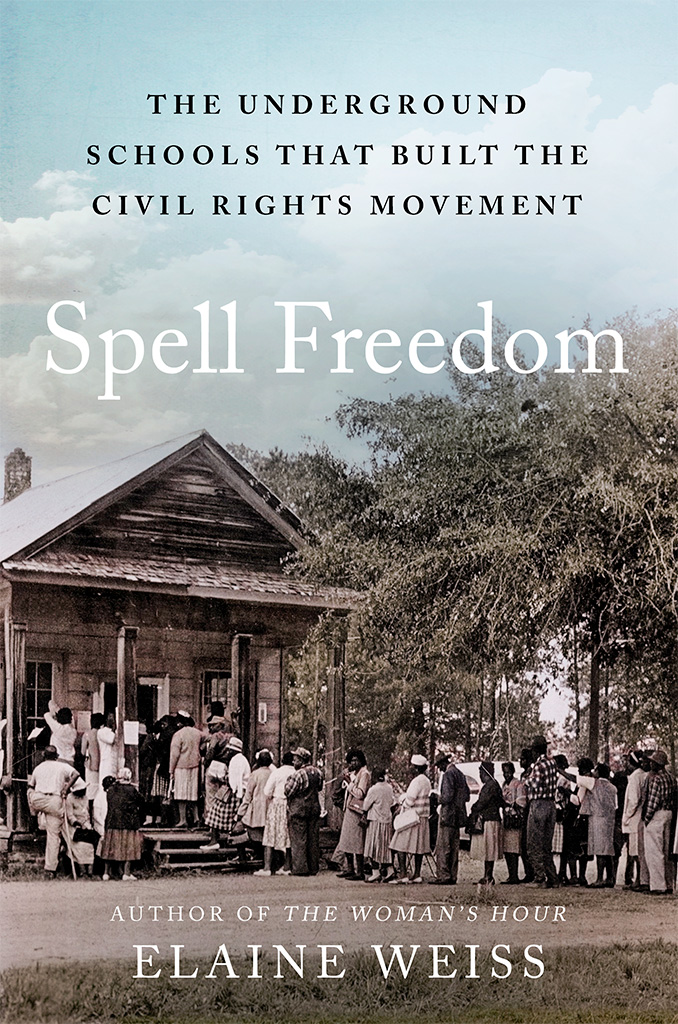
Spell Freedom, by Elaine Weiss

Many people contributed to the success—partial as it was—of the Civil Rights Movement of the 1960s. We’ve all heard the names of the famous leaders, their words and deeds. In this book, subtitled “The Underground Schools That Built the Civil Rights Movement,” Elaine Weiss tells the story of some of those we haven’t heard of, courageous people who came before the famous speeches and laid the foundations for success by creating the citizen schools that prepared Black Americans in the Jim Crow South to register to vote.

These unsung heroes had to start the school in secret, sometimes in the back room of beauty parlor, and create their own materials, adapted to the needs of an illiterate or barely literate adult population. Weiss doesn’t shy away from the difficulties, the terrible repercussions they all risked from a South wedded to White Supremacy.

Participants in the schools learned not just how to read and write, but also how to decipher the voter registration literacy tests intended to keep them from voting. They also learned what their rights were and gained the confidence to exercise them. By the time the Voting Rights Act passed in 1965, these secret schools had spread across the South, helping thousands of people register to vote.

I came to this book reluctantly when it was selected by my book club for this month. I figured I already knew about the Civil Rights Movement. I couldn’t miss it, growing up in Baltimore in the 1950s and 1960s. And then there are all the books, articles and discussions I’ve absorbed since. Yet once I started reading, I was hooked. And as it turns out, most of the book was new to me.

Weiss begins with the 1954 Brown v. Topeka Board of Education ruling that said racial segregation of public schools was unconstitutional. She shows how that news was received by Septima Clark, a 56-year-old teacher from South Carolina; Esau Jenkins, a Sea Island aspiring businessman and bus driver; and Bernice Robinson, a beautician from Charleston. The three of them understood that doing away with segregation would take work, dangerous yet necessary work.

Septima Clark came to the Highlander Folk School in rural Tennessee, a training ground for labor organizing created by Myles and Zilphia Horton that was pivoting to support civil-rights activism. Initially mistrustful of the fully integrated school, Mrs. Clark was shocked to share a room with a White person and sit at a table with White people for the first time. Yet the vision of White and Black people working together day after day to come up with practical plans for challenging segregation is one that would stay with her and encourage her for the rest of her life.

She brought Mr. Jenkins and Mrs. Robinson to Highlander. The compelling portraits of these three unlikely leaders fuel the story: ordinary people doing extraordinary things. The writing is clear and compelling; Weiss transforms her extensive research into riveting stories. We do meet the famous leaders in these pages but usually in the context of these unsung heroes.

Weiss also doesn’t shy away from the movement’s internal struggles and the sexism of its leaders. Most of all she brings home to the reader the terrible dangers faced by these teachers and organizers, as well as by everyone sitting in at a store counter or trying to register to vote. They are fired from jobs, kicked out of their homes, beaten and shot.

We need their stories today. We need to remember how hard they had to fight for the right to vote—now in danger once again—and that they did win again and again. We have much to learn from Mrs. Clark, Mr. Johnson, and Mrs. Robinson: the way they organised within their communities, found creative ways to help people, and got up each time they were knocked down.

Elaine Weiss kindly came to our book club meeting and proved to be a fascinating speaker with a sure command of her material. She said that her interest in this story began when she heard of the March 2019 firebombing of the current Highlander Center, complete with White Nationalist symbols. She wondered what this place could be doing that it should still be such a powerful symbol. 

Then she was curious about people like Septima Clark, whom most people haven’t heard of. She found a brief autobiography, Ready from Within, that Mrs. Clark wrote of her early life and an academic biography, Freedom’s Teacher, that focuses on her teaching techniques. In her research, Weiss was shocked by the systematic oppression and the economic punishment for attempting to vote. She reminded us that Septima Clark was financially insecure for the rest of her life; her friends had to get together to pay for her grave marker.

I hope many people will read this book. There is so much that will fire your imagination and strengthen your resolve in these dark times. Elaine Weiss said that in tough moments she often thinks What would Septima do? From now on I will, too.

Where are you finding courage these days?

Incidental Inventions, by Elena Ferrante

“I have to say that I write with greater dedication when I start digging into common, I would almost say trite, situations and feelings, and insist on expressing everything that—out of habit, to keep the peace—we tend to be silent about . . . I’m interested in the ordinary or, rather, what we have forced inside the uniform of the ordinary. I’m interested in digging into that and causing confusion, pushing myself to go beyond appearances.”

That’s Elena Ferrante in her essay “Digging,” one of 51 brief essays in this collection. Originally published in the Guardian every week for a year, she wrote them in response to a question from an editor. This was at her request, because she “had no experience with that type of writing” and was both “flattered” and “frightened.”

Oddly enough, that’s the same way Jan Struther (AKA Joyce Maxtone Graham) wrote the Mrs. Miniver columns. When the London Times wanted her to write a column about ‘an ordinary sort of woman – like yourself,’ she asked them to provide a question or prompt.

I did not expect much from these essays, each only about 500 words. And yet I found myself reading the next and the next, unable to stop until other voices called me away. Part of what makes them so addictive is that for all she talks about constructing a public image—“[Daniel Day-Lewis] is a sort of title by which I refer to a valuable body of work . . . If he should suddenly be transformed into a flesh-and-blood person, poor him, poor me.”—and for all she conceals her own identity, there is an openness in her writing that makes me believe she is opening her most secret self and telling the truth.

She writes about keeping a diary and why she avoids exclamation points, about lying and insomnia, about long marriages and her fear of plants. She writes about the positive side of change, and yet “We cannot tear off what once seemed to be our skin without pain; something endures and resists.” She writes about her favorite film and why it “seduces and sometimes scares me.” And every now and then she talks about writing.

In her introduction, she says she usually writes by “putting one word after another . . . what I find at the end—assuming that I find something—is surprising, especially to me. It’s as if one sentence had generated the next, taking advantage of my still uncertain intentions.” Yet here, constrained by time and space, she “rummaged through memory in search of small illustrative experiences; impulsively drew on convictions formed by books read many years ago . . . pursued sudden intuitions . . .”

And yet, each essay is tightly constructed. They begin with a clear statement such as: “I was a terrible mother, a great mother.”  Or “Stereotypes are crude simplifications, but generally they don’t lie.” Then we are off into memories and thoughts until a punchy last line, such as “We’ll always know too little about ourselves.”

These are the two sides of writing: the mystery of how one word or thought leads to another with sometimes surprising results and the careful crafting of that hot mess into a clear and cogent whole. She says:

My effort at faithfulness [in writing] cannot be separated from the search for coherence, the imposition of order and meaning, even the imitation of the lack of order and meaning. Because writing is innately artificial, its every use involves some form of fiction. The dividing line is rather, as Virginia Woolf said, how much truth the fiction inherent in writing is able to capture.

She admits that “The yearning to give written form to the world isn’t a guarantee of good literature.” Also, even when our efforts succeed, “We remain dissatisfied and, successful or not, the writing will continue to remind us that it’s a tool with which one can extract much more than we have been able to.”

Still, the energy that drives these essay, and all of her writing, is “the wonder—the wonder of knowing how to read, to write, to transform signs into things.”

The illustrations by Andrea Ucini at the start of each essay are not only charming, but also add another layer to the piece. The cover illustration of a woman peeking out from among the pages of a book is the one for “Keeping a Diary.”

What draws you to Elena Ferrante’s writing?

Mrs. Dalloway, by Virginia Woolf

Reading this classic novel now, more than fifty years since I first encountered it as an undergrad, is quite a different experience. Back then I was confused and thrilled by Woolf’s modernist, experimental style that expanded forever my idea of what a novel could be.

Now I see it as a story of midlife, in several senses of the word. The story unfolds as a day in the lives of a handful of people in London going about their ordinary business, and we get thrown right into the middle of things. Clarissa Dalloway is preparing to give a party. Newly returned from India, Peter Walsh sets out to recapture the past by exploring London and visiting Clarissa, his first love. Richard Dalloway is off to lunch with old friend Hugh Whitbread at Lady Bruton’s. Septimus Smith, a damaged veteran of the Great War, and his wife Rezia are walking through the park, on their way to an appointment with a doctor.

Since Clarissa, Peter and others are in their early fifties, we have another sense of midlife. It’s a time of life when we look back nostalgically, but also when we measure ourselves—and others—assessing how we have changed with age, and calculating what we have made of our years. Have we measured up to our early promise?

Time comes up frequently, not just in the characters’ reflections on how they and each other have aged, their memories of the past, and the bustling busy lives of their present; but also in the more linear sense of the clocks sounding the hours of the day. Time in this novel is both infinite and finite.

Another sense of midlife underpins the story: the Bible’s “Media vita in morte sumus”—“In the midst of life we are in death.” Death comes up frequently, whether it’s Septimus thinking of suicide or Clarissa hearing old Mrs Hilbery at the party say “how it is certain we must die.” Clarissa herself has recently been ill which has turned her hair white and left a concern still about her heart.

In my youth the book’s theme that struck me most strongly centered on solitude versus society. Plunging into this novel, we have opportunities to see most of the characters alone—really see them; right into their jumbled, chaotic thoughts, sublime ideas, and snarky digs. We see Peter like his namesake in Kensington Gardens never having fully grown up, and Clarissa awash in memories of a golden childhood and gloriously loving her present life—until she’s brought low by self-doubt or sensing criticism from others.

We also see them with others, whether through intimate conversations or Clarissa’s crowded party. In some instances simply exchanging a look with someone else—a young woman in the park or an elderly woman in a window across the street—becomes a vital communication.

Clarissa believes that her strength is that she knows what other people are feeling. In fact, all the characters think they do, but they are mistaken. Richard is certain that Clarissa will know he loves her without his saying so. Peter thinks he and Clarissa read each other’s minds. The worst offenders are the two doctors to whom Septimus goes for treatment; they burst with confidence that they know what is wrong with him, but their pompous, one-size-fits-all solutions are worse than useless.

There’s a reason why so many books and essays and dissertations have been written about this novel. It is so rich—so full of life. You can look at it through the lens of class or gender; you can hold it up to Woolf’s own life; or consider the fragility of a world that is on the cusp of change—the book came out in 1925, so this year is its centennial.

For me in this reading it is the sense of time that demands my attention. Like these characters I strain to reckon the long years behind me: the golden times that I weave into stories for my grandchildren and the bitter griefs and regrets that I keep to myself. I consider what I will do with the few years that remain, knowing how much I value being alone and how much I enjoy being with others.

We are all born and we all die. That is what we have in common. What comes in between is our own unique story. By slicing one day out of the lives of this small group of people, Woolf gives us a glimpse of the extraordinary richness of the lives humming all around us.

If you’ve read Mrs. Dalloway, what did you think about it? If you’ve reread it, did your opinion change?

Note: My thanks to Tash for her discussion of the novel on her Woolfish! Substack and to all the commenters there as well for expanding my understanding of the novel.

Ghostwalk, by Rebecca Stott

I’ve been on a bit of a Cambridge streak in my reading lately, so here we are again. Stott’s debut novel opens like a mystery: Cambridge historian Elizabeth Vogelsang, whose potentially controversial book on Isaac Newton’s use of alchemy is nearly finished, is found drowned in a river at the end of her garden, clutching a prism. Lydia Brooke, one of her former students, is urged by Elizabeth’s son Cameron to finish the book.

One difficulty is that she has her own work to do. Another is that Cameron is her former lover whom she’s not sure she can resist. However, she does move into Elizabeth’s home, where she feels her mentor around her and where the light—and her computer—begin to play tricks on her.

Most of the book is told in the first person as though it were a letter from Lydia to Cameron, though some chapters of the manuscript are inserted. That manuscript, which is apparently only missing the last chapter, explores Newton’s rise to fame, a series of unsolved seventeenth-century murders, and if there might be a connection between them. Lydia begins to feel that intrigues and conspiracies from Newton’s past are creeping into the present.

Even as Lydia is trying to work out whether her mentor committed suicide or was murdered, Cameron is being menaced by an animal rights group over his work as a neuroscientist that involves experiments on animals. There’s also a fortune teller whom Elizabeth had apparently befriended—perhaps my favorite character—and an odd young woman named Will who seems to have some knowledge of the various forces threatening Cameron and Lydia.

The breadth of Stott’s research is stunning. We learn a lot about Newton’s life and work. She brings the seventeenth century to life, especially in the manuscript chapters. There’s a lot interesting information from that time period about glassmaking, the plague, optics, and of course alchemy.

This is such an intelligent book. And the dark yet lyrical atmosphere is perfect for an October read. However, I struggled to finish it. Much as I loved individual elements, the story as a whole felt murky. The parallel plots of the past and the present never quite came together, perhaps because the seventeenth-century conspiracies fascinated me while those in the present-day seemed irrelevant.

I’m also not a big fan of second-person point of view. Since she’s writing to him, Lydia refers to Cameron as “you,” which is fine occasionally. However, when she’s recounting dialogue, telling him what he’s said, she must use “you said” as the dialogue tag. This throws me out of the story because of course he knows what he’s said, but Stott is forced by her point of view choice into these clumsy conversations.

Still, there’s much to admire here. I learned a lot about Isaac Newton and alchemy. I reveled in gloomy back stairs in Cambridge colleges and a sun-filled studio set in an orchard. And I’m always curious about the ways the past bleeds into the present. Here’s an excerpt from the first chapter:

Lily went to prison because the seventeenth century was missing from her court records, from her story. Her time line needed to be longer, much longer, and there were many sidelines and tracks, twistings and turnings and yes, it was a labyrinth, a skein of silk that began to weave itself in 1665, 339 years ago.

I’ve been thinking about labyrinths this summer. Ariadne giving Theseus the thread so that he could find his way back out of the labyrinth, away from the black void of the flesh–eating Minotaur. Unravellings have to start somewhere. Now that I see, for the first time, how connected everything is, I know that the threads between Isaac Newton and us were all attached, like the ground elder under Kit’s soil.

Most of all, I admire Stott’s ambition. Ghostwalk is an enormously complicated story, thoroughly researched and well written. Most of all, it is intelligent and exercises our own little grey cells.

What do you look for in historical fiction? 

The Real Mrs. Miniver, by Ysenda Maxtone Graham

The Real Mrs. Miniver, by Ysenda Maxtone Graham

We’ve seen the movie, of course, and thought it a sentimental film about a woman who is practically perfect in every way keeping her family together and holding the home front together during the Blitz—the bombing of London during WWII. The book the film is based on, a collection of columns from the London Times, was something else altogether: an idealised portrait of an ordinary upper middle class woman’s life in pre-WWII England.

Those columns were written by Joyce Maxtone Graham (née Anstruther) using the name Jan Struther, and she modeled the family on her own husband and three children. However, as we learn from this biography by her granddaughter, the loving Miniver family was a far cry from Joyce’s own. Her marriage to Tony Maxtone Graham, initially fun-loving and amusing, had dried up as he’d been taken hostage by golf, leaving Joyce to her articles and poems many of which were published in Punch among other periodicals.

Joyce had been a tomboy as a child, loathing the ceremonial tea parties and dance lessons, preferring to run and shoot with the boys. She and Tony initially shared a comic view of the world. I loved the way they shared the silly things they noticed during their days: pebbles, as she called them, like children turning out their pockets at the end of the day. As they drew further apart, Joyce fell deeply in love with Dolf Placzek, a penniless Jewish refugee from Austria gifted with intelligence and a strong appreciation for the arts.

The Mrs. Miniver columns depict a happy, loving marriage that was a far cry from what Joyce’s had become. Yet for many, those columns embodied an England that was being destroyed by the war and a reminder of what they were fighting for. Mrs. Miniver’s upper middle class life was comfortable, with a London house and a weekend cottage in Kent, a son at Eton, and servants to do the chores. The columns contain the small things she notices during the day, some pleasurable, some not—like the pebbles she and Tony used to exchange. While Mrs. Miniver could be critical of her social circle, she was alive to its charms.

Joyce—now Jan all the time—was shocked by the surprising success of the book and the reading tours and talks that followed. She came to be haunted by Mrs. Miniver. Many fans assumed they were the same person. She struggled to finding a firm place to stand.

Of all emotions, she perhaps felt the emotion of missing most acutely. At a party, she missed solitude. Abroad, she missed home. Cut off from her children, she longed to be with them again. When she was, she longed again for solitude. The raggle-tangle gypsy in her head beckoned her to escape.

Why read biographies? In my twenties I read lots of biographies of women writers and artists, looking for inspiration during a time when women were second-class citizens when it came to the arts. I was also looking for ideas for how to write while wrangling two babies and an ex who refused to contribute. Just keeping the heat on and some kind of food on the table was a miracle. Forget about finishing a story and sending it out.

These days I still look for inspiration from brave women and men as I struggle with how to live a moral life in an increasingly compromised and chaotic world. I’m especially drawn to women living during dark times. I’m also interested in the wide range of life choices people make. One thing that is so fascinating in this book is the contrast between the life of Mrs. Miniver—a model for womanhood at the time—and that of the woman who created her.


Sometimes with a biography, it is enough to see myself in a reckless tomboy unwilling to knuckle under to social norms or an almost accidental writer. Now if only I can catch the zeitgeist the way Jan Struthers did! Perhaps it’s better I don’t. Her story is yet another cautionary tale of how too much success and celebrity can wreck a person.

It’s been difficult lately to find books that hold my interest. My reading record is full of DNFs. This one, though, fascinated me and kept my attention right through to the end. Jan reinvented herself several times over, which I find wonderful. And she changed the course of history, inadvertently perhaps and not alone, but for sure. What kind of world would we be living in today if the U.S. had refused to join the Allies fighting Hitler and Mussolini in Europe and Africa?

I take courage from her story and the stories she wrote about the ordinary people of Britain as we fight today’s fascism.

Have you read a biography that inspired you?

Thornhill, by Pam Smy

This unusual Young Adult (YA) novel is perfect end-of-October reading: stark, a little sad and a lot spooky. Part graphic novel and part journal, it’s a stunning portrayal of what many people experience, especially those on the tender, unpredictable cusp of adolescence.

Lonely Ella has just moved to town, her modern-day story told in striking black-and-white graphics, the only words being those occasionally written on items in the scene. We see an upstairs room, packing boxes, a window—and through that window a strange gothic ruin of a house buried in an overgrown garden.

The Thornhill Institute for Children, a boarding school for abandoned and orphaned children, closed in 1982. Mary is one of the last to leave, and it is her journal that runs parallel to the silent pictures depicting Ella’s life. Mary writes of terrible goings-on at Thornhill, especially the bullying directed at her. She takes refuge in her attic room, locking the door against the nightly bangings of her chief persecutor. There she makes puppets and dolls—creating her own friends—and reading.

Ella’s mother has apparently died, and her busy father seems to have little time for her. Sometimes we see through a crow’s eyes; is it the crow or Ella who first sees a shadow in an attic window of the dilapidated Thornhill? Ella finds a way into the property and begins exploring.

The book made me consider what we see and what we don’t see. The adults at Thornhill don’t see Mary’s suffering, nor does Ella’s father see her loneliness and her grief for the loss of her mother. Mary’s diary reveals her uncertainty about whether to trust what she sees, such as overtures of friendship from her persecutor. It also shows her hiding from view in her room, more and more as the story continues.

We readers see only Mary’s words and the pictures of Ella’s life. I found this distancing  effective because it made me create their stories myself. That happens with the best traditional novels, of course, but I felt newly challenged here. I was reminded of what writer/teacher/agent Donald Maass has said about creating emotion in our stories. Just describing the emotion doesn’t make the reader feel it. Instead, we have to set up a situation that invites the reader to remember feeling that emotion themselves; their own memories then supply the emotional heft.

I certainly found that to be true here. I was flooded with memories of that awkward, in-between time. Mostly I remember glorious days, enchanted moments, etc. but I was reminded that there were some bullying and loneliness; there was the need for a friend.

Another part of my thinking about what we see and how we see it was remembering a show of Andrew Wyeth’s paintings at the National Gallery entitled “Looking Out, Looking In.” His paintings of windows and doors made up the exhibition and sent me down a path considering point of view in a way that had nothing to do with first or third person but everything to do with where we are standing, whether we are inside or outside.

In Thornhill, we have windows and doors, walls and secret gardens, mysteries and ghosts. It’s a quick read, but the story may stay with you a long time.

What are some of your favorite spooky reads for October?

The Women, by Kristin Hannah

Frankie McGrath, a naïve 23-year-old “California girl” and nursing student, enlists in the Army Nurse Corps because it is the branch of the military that will send her to Vietnam as quickly as possible. It’s 1965, and she has an idealistic vision of meeting up with her brother who is deployed there.

Unsurprisingly, once there she’s overwhelmed by the difference between her dreams and reality. The author recreates the day-to-day chaos and destruction of a medical station during the Vietnam war through Frankie’s eyes and emotions. Frankie manages to adjust and become a superb surgical nurse, very much thanks to Barb and Ethel, two fellow nurses who befriend and support her. Friendship, loyalty and betrayal are themes that run through the book.

At the end of her second tour in 1969, Frankie returns to California, and the second half of the book is about the antipathy she encounters. Confronted by antagonism that ranges from pretending she (as a woman) could not have been in Vietnam to outright hatred and abuse, she struggles to find her feet. As her mental health deteriorates she calls constantly on Barb and Ethel who repeatedly drop their East Coast lives to fly to California to help her.

All the conflict in this part of the book comes from the supposed hatred of Vietnam vets. True, there are romantic and work problems, but it is her emotional and mental fragility in the face of this hatred that makes her unable to deal with these normal problems.

I do not question the PTSD suffered by returning Vietnam veterans of all genders and, indeed, all of our veterans deployed in war. However, I was active in the antiwar movement at the time, and I NEVER saw protestors spitting on returning veterans and calling them baby killers, not in person, not on tv. Just the opposite. We were on the side of the soldiers, working to help them come home safe from a senseless war—something most of the soldiers in country wanted as well.

So I have long believed that all that supposed fury of protestors against veterans is a story—a lie—created by the warmongers to discredit the antiwar movement. It’s an urban legend. Here’s what Snopes has to say.

The claim that anti-war protesters spit on Vietnam veterans returning from the war is a persistent one, but there is no clear evidence that this was a widespread occurrence . . .

The persistence of this claim, despite lack of clear contemporary evidence, suggests it may be more of an urban legend that gained traction over time rather than a documented widespread occurrence. However, the available Snopes archives do not contain a comprehensive fact-check specifically addressing the broader claim about anti-war protesters spitting on Vietnam veterans.

Without more specific archival information addressing this claim directly, it’s difficult to make a definitive statement about its veracity. The persistence of the story, even among those who did not serve in Vietnam, indicates how deeply ingrained this narrative has become in discussions about the reception of Vietnam veterans upon their return home.

Other resources are a scholarly book by Jerry Lembke: The Spitting Image: Myth, Memory, and the Legacy of Vietnam and a Wikipedia page, neither of which find any credible proof to support the myth.

These days, we know a lot more about deliberate misinformation—lies—told for political purposes. I’m disappointed that Hannah, a brilliant writer whose other books I’ve enjoyed, has chosen to repeat and amplify this distortion of what actually happened back then.

The first part of the book which takes place in Vietnam, although a bit melodramatic, provides a vivid picture of what life must have been like on the ground for nurses. I applaud her choice to concentrate the second half of the book on how hard life is for returning war veterans. I’m just sorry she stuck to this simplistic—and false—narrative of abuse of Vietnam vets instead of digging into the more nuanced reasons why we see so many vets struggling with depression and suicidal thoughts.

Have you read anything about women in the Vietnam War?

Middlemarch, by George Eliot

I’ve been rereading Eliot’s classic novel this month with Haley Larsen’s Closely Reading group on Substack. It’s been a few decades since I last read it, and different features of the book leaped out at me this time.

The story is about the inhabitants of the fictional town of Middlemarch in the English Midlands around 1830. Eliot does a masterful job of zooming in to a dozen or so characters while giving other townspeople plenty to space to make themselves known.

We first meet Dorothea Brooke, a wealthy and intelligent young (19) woman, who wants to do great things in service to others, starting with better housing for the tenants of her uncle and guardian Arthur Brooke, a hilariously foolish man who can talk himself out of any opinion. Dorothea is extremely religious and denies herself pleasures, such as her mother’s jewelry, in order to sacrifice herself to a greater cause.

That turns out to be marrying Rev. Edward Casaubon, prematurely elderly at 45. A dry stick of a man, who has devoted his life to creating The Key to All Mythologies, he marries her but quickly withdraws into his shell. He rejects her romantic ideas of assisting him in his work, like Milton’s daughters taking down the blind poet’s dictation (as Dorothea dreams), mostly because he fears she will mock him when she sees how little he’s accomplished.  

We also meet Dr. Tertius Lydgate who hopes to modernise medicine In Middlemarch and the lovely, self-centered Rosamond Vincy who sets out to capture him. Her brother Fred loves Mary Garth, nurse to his uncle Mr. Featherstone, and she him. But she won’t marry Fred because he is feckless and a spendthrift, believing himself to be Featherstone’s heir and borrowing on the strength of that.

Mary’s parents Caleb and Susan Garth are kind and generous folks, Caleb being land agent for Featherstone. Then there’s Mr. Bulstrode, a wealthy banker. He’s a pious if hypocritical Methodist who runs much of the town and would like to do more to impose his beliefs on other residents.

A lot of characters—and there are more! However, Eliot wrangles their stories into a coherent story where we touch each person often enough that it’s not hard to keep them straight.

What stood out to me on this reading is the theme of what it means to live a good life. By that I mean a life of integrity, one we can be satisfied with when we lie on our deathbeds. In Middlemarch we have all these lives, all of these people intending to do the right thing yet derailed by temptations and compromises and the pressures of daily life. As we follow each storyline, we get to see various permutations of what a good life might look like—or not.

One aspect of a good life is being a contributing member of society, one which among other things means getting involved in politics. We hear a good bit about the Reform Bill (later the Reform Act of 1832) expanding the franchise to a larger segment of the male population, and about the coming of the railroads that threatens local farmers. There’s an interesting parallel here between the politics of the period and Eliot’s method of concentrating on a few privileged characters while including others to a lesser extent but with equal respect.

Another aspect is our personal relationships. I am fascinated by Eliot’s idea of a “home epic” which is what she calls this novel. She defines a home epic as a story about what happens after the wedding, particularly during the course of a marriage. I am often frustrated by stories that end with a wedding, as though that’s the be-all and end-all of a woman’s life, so I love that she takes marriage as  the starting point instead. I’d expand the definition of Eliot’s term to include domestic stories, stories within a family, not just the married couple. And by family, I mean families of choice too. A home epic might also cover the course of a life and how we interact with others, how we live within communities.

The greatest barrier to a good relationship, whether with a spouse or a neighbour, is embodied in her subtitle “A Study of Provincial Life.” Yes, the town is geographically provincial, but there is a larger meaning to the word. As Rebecca Mead puts it in My Life in Middlemarch, “It is also concerned with the emotional repercussions of a kind of immature provincialism of the soul—a small-minded, self-centered perspective that resists the implications of a larger view.”

Over and over again, we see characters misunderstanding each other. So many conversations where people misread each other’s intentions or fail to comprehend what the other is thinking! We know this because of Eliot’s psychological insights, and her technique of using a narrator to go into each character’s thoughts. Her narrator also pulls out to give us that larger view, sometimes warning us that a character may not be as bad as they appear. The narrator can occasionally seem intrusive but is vital to Eliot’s ability to weave the story together and bring out her theme.

Therefore, to live a good life we must be able to empathise with others. We have to work to actually see things the way someone else does, to set aside our own view of the world and understand theirs. I think this is why our narrator persists in explaining these characters to us. Eliot keeps coming back to the idea that we have to grow out of our natural self-centeredness and recognise that others see the world differently.

It’s not easy. As Eliot says, “If we had a keen vision and feeling of all ordinary human life, it would be like hearing the grass grow and the squirrel’s heart beat, and we should die of that roar which lies on the other side of silence. As it is, the quickest of us walk about well wadded with stupidity.”

Yet we can try.

What does it mean to you to live a good life?

The Lost Words, by Robert MacFarlane and Jackie Morris

When the Oxford Junior Dictionary was updated, it was found that around forty common words had been dropped—all of them words to do with nature—and their place taken by words, many of which have to do with the online world.

In response, MacFarlane and Morris came together to create what they call a spell book to help young readers rediscover the natural world. Unless we experience and learn to love the world of nature around us, we will not work to save it.

In this large-format book, we first see the creature or plant’s environment empty of everything but a scattering of letters. Some of the letters are a different color and spell out what is missing. Then comes the illustrated spell—an acrostic celebrating and summoning the creature or plant—followed by a stunning double-page illustration of it restored to its habitat.

This is the most beautiful book I’ve seen in a long, long while. Jackie Morris’s illustrations are simply stunning. I’ve even propped it open on my grandmother’s rocking chair so I can glance over at it frequently.

Robert MacFarlane’s spells—acrostic poems—summon the lost creature or plant through the music of words, using imagery, alliteration, internal rhyme, personification, and other poetic devices, including Anglo-Saxon kenning. A few excerpts:

“Hold a heartful of heather, never let it wither, / Even as you travel far from crag and river.”

“Kingfisher: the colour-giver, fire-bringer, flame-flicker, river’s quiver. / Ink-black bill, orange throat and a quick blue back-gleaming feather-stream.”

When I read this book to the littles in my life, they were surprised that anyone would think children wouldn’t know—or wouldn’t need to know—these words. The young ones talked eagerly of the bramble berries in their yard and the otters and herons they’ve seen. They wondered how children in even the most urban environments would not be familiar with dandelions. One of the littles is even named Willow, so was indignant that their name would be discarded.

The only one new to them was conker, since in the U.S. that word is not used for the seed of the horse chestnut, something they do know well since they love collecting the seeds from a horse chestnut near us. As far as I know, the children’s game using conkers is not played here in the U.S. My littles were interested in the description, but not eager to try it.

The book has won many awards and moved out into the world in various formats. I applaud its mission of connecting young people to our natural world and in the process helping to save that disappearing habitat. Most importantly it is a feast for the eyes and, when read aloud as it begs to be, for the ears as well. May its spells work.

What children’s picture book have you loved for the illustrations as well as the words?

Jigsaw puzzles available from the book’s website.

Rain, by Melissa Harrison

While rainy weather sends most people indoors, Harrison suggests that “if you only ever go out on sunny days you only see half the picture, and remain somehow untested and callow.”

In this quiet gem of a book, she takes us on four walks in the rain in different parts of England. In January we visit Wicken Fen in Cambridgeshire; Shropshire in April; the Darent Valley in Kent in August; and Devon’s Dartmoor in October. Different landscapes, different seasons, yet all of them reveal how our world is different in the rain, as well as its effects on us.

For some of us, rain induces a pleasant melancholy; one friend of mine calls it a blown-flame mood: not the thrill of fire but the lingering scent that turns us inward. Memories open like petals, and the past is no longer a foreign country.

Wet weather offers other rewards to walkers willing to brave it. Aromas become more intense: The difference between walking in a pine forest in dry or wet weather is astounding. Some creatures emerge while others hide. The air may be softer on your skin, the sounds more mysterious.

When the Kent sky—already overcast—darkens, it does so suddenly. A restless wind gets up, bullying the muggy August air so that the ripe wheat shifts uneasily, gusts pushing its golden surface this way and that like a nap . . . The downpour that follows seems to fall with more force than mere gravity could provide, and as lightning flickers—first distantly, then much closer—and thunder renders the sky, I weigh the risks of standing beneath the bankside trees against the discomfort of getting drenched.

Harrison explores the way rain transforms the landscape whether it be by storms or floods or the minute trickling of drops upon stone. She calls our attention to the way minerals create soil from which grow the plants and trees that support insect, bird and animal life.

The old drystone walls bounding the road where we walk are shaggy with moss and dog lichen and pinned with medals of pennywort and the delicate buttonholes of maidenhair spleenwort, all beaded silver with rain. A few paces ahead of us a stonechat perches on the top of the wall and flicks his wings insouciantly. The call he makes echoes almost exactly the clash of wet pebbles loosed from the disintegrating road surface under our boots.

As a genre, travel writing encompasses a wide range of formats. Most commonly its purpose is to encourage readers to visit places near and far. These pieces could be simply description of a place with suggestions for dining and lodging.  They could highlight single endevours such as a farm that offers field-to-kitchen cooking classes. Or they could be a biography of the place, so to speak, incorporating history and legends, famous and not-so-famous residents, hidden gems and well-known sites which come together to portray the personality of the place.

Travel pieces may also be a story about the author’s particular experience there, their exploration and encounters with places and people and how they are changed. I’m thinking of Colleen Kinder’s Letter to a Stranger: Essays to the Ones Who Haunt Us and associated website. Or a  travel book can be a record of the travels of the author’s mind as they move through the world, as in W.G. Sebald’s The Rings of Saturn.

Fusion with memoir is common because our experiences are grounded in certain locations, such as in Martha Gellhorn’s Travels with Myself and Another or Edward Parnell’s Ghostland which combines travel with literary review and memoir. With fiction, as well, we sometimes say the location is a character in the story.

This gentle series of four walks is none of these. To me it felt like a guided meditation, as though the author simply invites me along on a walk with her. Look over here; feel this leaf; does this remind you of something from your childhood?

In amongst the luminous descriptions are tidbits of history, poetry, memory and story. I especially enjoyed hearing about the volunteer-driven British Rainfall Organisation, “a quintessentially eccentric body and one of the first examples of what we now call ‘citizen science’.” Harrison also incorporates legends and folklore, such as the belief that thunder on Sunday portends the death of great men but on Monday the deaths of women.

She’s fascinated by local dialect and includes an appendix of 100 Words Concerning Rain as well as a Glossary of Meteorological Terms for Rain and a Bibliography.

This short (less than a hundred pages) and lovely book is one I will return to often. It reminds me of the many walks I’ve taken in England and elsewhere, and encourages me to be more attentive to the world around me, not just the natural world, but the glimmers of history and memory that it evokes.

Have you read a travel book or piece that stood out to you?