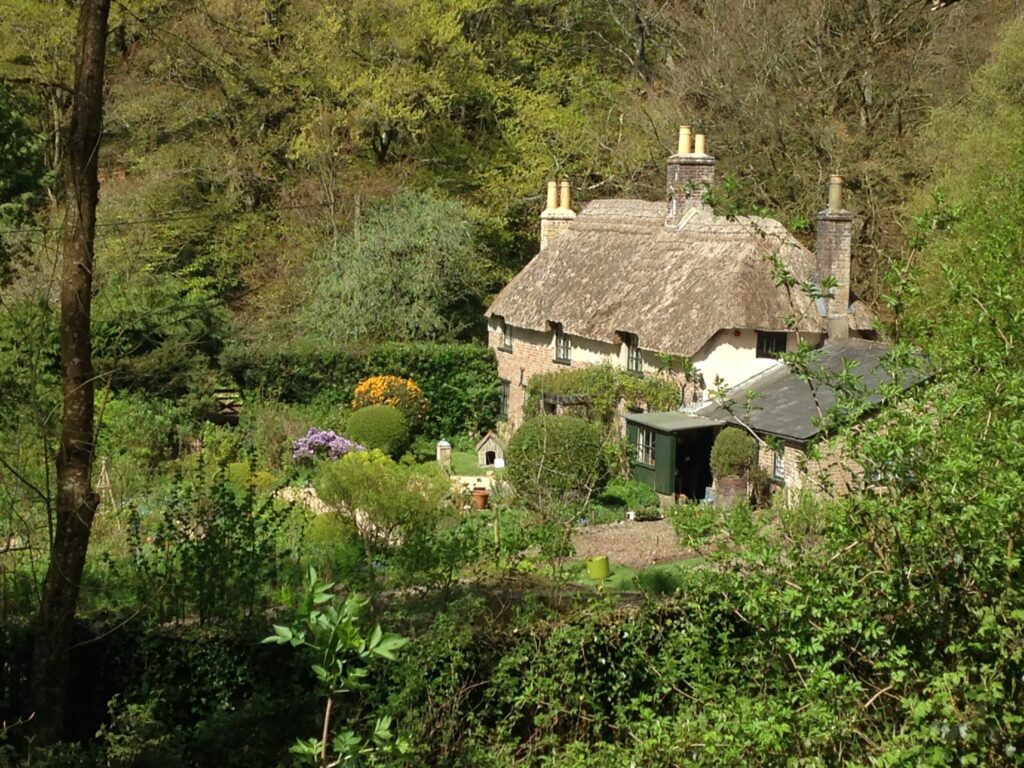
Hardy started writing poems in his teens and continued right up until his death. When he decided to support himself and his wife as a writer, he realised he’d have to write novels as well. The son of a builder, he never went to university, unlike other writers of the time. Instead, he was apprenticed to an architect where he was successful but found the work tedious. He taught himself how to write a novel through extensive reading and trial and error. Fortunately, his friend and mentor, Horace Moule, who had been to Cambridge, then introduced him to publishers in London.
Although I first read Hardy’s novels as a teenager and have reread them frequently over the years, I’d never gotten around to reading more than a handful of his poems until this dreadful year. Maybe I want to escape to the fields and forests of his 19th century Wessex. Perhaps what draws me is something in Hardy himself. From the Poetry Foundation: “In the words of biographer Claire Tomalin, the poems illuminate ‘the contradictions always present in Hardy, between the vulnerable, doomstruck man and the serene inhabitant of the natural world.’ ”
In poem after poem, Hardy’s language is simply astonishing. He weaves together the rural Dorset speech of his youth with that of the professional and educated classes in which he began moving to create a distinctive diction of his own: forthright but rich. In one of his most famous poems, he nods to Matthew Arnold’s “Dover Beach” not just in the title but in the theme. Written in December of 1900, “The Darkling Thrush” is about the end of things: the day, the year, the century, and the age of faith. It begins:
I leant upon a coppice gate,
When Frost was spectre-gray,
And Winter’s dregs made desolate
The weakening eye of day.
The tangled bine-stems scored the sky
Like strings of broken lyres,
And all mankind that haunted nigh
Had sought their household fires
Sometimes he enlivens even gloomy poems by playing with words. Notice the pun on “ash” in the first stanza of “Neutral Tones” and the anagram of “over” and “rove” in the second.
We stood by a pond that winter day,
And the sun was white, as though chidden of God,
And a few leaves lay on the starving sod;
—They had fallen from an ash, and were gray.Your eyes on me were as eyes that rove
Over tedious riddles of years ago;
And some words played between us to and fro
On which lost the more by our love.
I’m reading Claire Tomalin’s biography of Hardy as well as the Collected Poems. While certain incidents and people in his life can be associated with some of poems and a few characters in his novels, that background is not essential. Hardy leaves just enough ambiguity for the reader to bring in their own experiences and emotions. In “When I set out for Lyonnesse” we don’t need to know what “bechanced” him there to remember perhaps a moment that changed everything for us. Here’s the final stanza.
When I came back from Lyonnesse
With magic in my eyes,
All marked with mute surmise
My radiance rare and fathomless,
When I came back from Lyonnesse
With magic in my eyes!
One bit of biographical information is helpful. When Hardy’s first wife Emma died in November 1912, they had been estranged for years. But after she died he began to remember their early love and realise what he had lost. As Tomalin says, “This is the moment when Thomas Hardy became a great poet.” The power of these elegies is stunning, exploding with emotions barely held in check by the various verse forms he uses. Here’s the first stanza of “The Voice”.
Woman much missed, how you call to me, call to me,
Saying that now you are not as you were
When you had changed from the one who was all to me,
But as at first, when our day was fair.
Although of a lower class, his father and other family members were musicians and Hardy himself played the fiddle for dances starting from a young age. His musical experience shows in the rhythms he brings to his poetry, even as his architectural background influences the careful poetic forms he constructs.
Almost the first thing that stands out in these collected poems are the many different forms he uses. In “Beeny Cliff”, another poem for Emma, he uses tercets, three lines with the same end rhyme in each stanza, creating an unsettling feeling that leaves us vibrating between two forms we’re more accustomed to (a couplet and a quatrain) just as he shivers between past and present, ghost and girl.
“At Castle Boterel” he remembers being at that same spot in the past with a woman who now appears to him as a phantom. The form Hardy comes up with by playing with line lengths adds drama and—again—emotion to this poem. The final stanza perhaps references Poe.
I look and see it there, shrinking, shrinking,
I look back at it amid the rain
For the very last time; for my sand is sinking,
And I shall traverse old love’s domain
Never again.
Gloomy and grieving as some of these poems are, we have, as Tomalin says, the solace Hardy finds in nature. There’s hope at the end of “The Darkling Thrush.”
So little cause for carolings
Of such ecstatic sound
Was written on terrestrial things
Afar or nigh around,
That I could think there trembled through
His happy good-night air
Some blessed Hope, whereof he knew,
And I was unaware.
Do you have a favorite Thomas Hardy poem?
Photo by B. Morrison