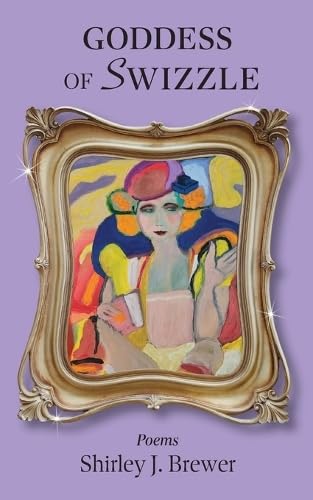
Goddess of Swizzle, by Shirley Brewer

The title perfectly describes this new collection of poems from my friend Shirley Brewer who is indeed a goddess and a master mixologist. A graduate of a bartending school in Baltimore, she serves up concoctions that are bold and funny and tender and unexpected. She sings:

Let all the brazen Hallelujahs multiply

like leaves.

She invites us into her memories, summoning the food and drink that nurture us, coaxing us to smile or startle, her past echoing ours. She writes of the night Bobby Kennedy was killed, memorable already as her 21st birthday (and my senior prom night). Into what kind of adulthood were we graduating? “In the hotel chaos, Ethel / offers her husband comfort. / I’m with you, she whispers.” Shirley offers us the comfort of recognition.

Some of the poems revive scenes from her youth in Rochester while other celebrate the half-weird, half-stodgy city of Baltimore. Yet behind the fine, careless toss of her feather boa lies the abiding pain of loss. Her solace is to feed us on these playful poems served with food and drink.

She gives us a sense of those who are gone, such as a beloved dance teacher and a friend with whom she made pies of Concord grapes picked at the Finger Lakes. She memorialises her sister “fighting for one more/one more breath.” She brings to life a favorite fast-food tradition with her late brother on Opening Day and shows us her parents, including their favorite libations. In “Dear Dad” she says:

Because of you, I imagine the world

as a succulent maraschino cherry

ripe with possibilities.

At the same time, her unbounded imagination delights us: Cher and Emily Dickinson chat over blackcurrant tea in a Hampden café? A poet bringing goats into the Baltimore Museum of Art to view the Cezannes and Matisses? An alligator cruising the aisles of Walmart? Why not?

She celebrates childhood trips to Wegman’s, dancing to Chubby Checker, and Baltimore’s squeegee boys. She finds hilarity and abiding affection in a poem about trying on clothes with her mother in department store changing rooms. And how can you resist a poem that begins:

My grandfather talked to his scarecrow

in the fields near Dundee.

He called it Joseph

Another section includes ekphrastic poems. My favorite is “Purple Robe, Silver Swan” in which she “pledge[s] allegiance” to a Matisse painting, filling us with its sumptuous colors, before a surprising turn that harkens back to the beginning. She begins a remarkable flight of imagination with “I share a villa with Vincent/in the south of France.”

These poems capture Shirley’s ebullience and compassion, as well as her delight in the sensory world. Full of color, tastes and aromas, she truly gives us “a feast for here and now.” Whether it’s “parakeet blues, a taste of lime” or twists of lemon that come to life in a drink, these poems nourish us. Fun, surprising, warm: we are always in on the joke, every poem an invitation—often studded with spangles.

I have always loved Lucinda Matlock in Spoon River Anthology by Edgar Lee Masters which ends:

What is this I hear of sorrow and weariness,

Anger, discontent and drooping hopes?

Degenerate sons and daughters,

Life is too strong for you —

It takes life to love Life.

Shirley’s zest for life comes through in each of these poems. A bright light in a dark time, they make me, like her poet-friend, believe in love. As Sue Ellen Thompson says, “This collection is an antidote to the world’s miseries.”

What poems have you read that lift your spirit and tickle your funny bone?

Disclosure of Material Connection: I received a copy of this book free from the author. I was not required to write a positive review. The opinions I have expressed are my own.
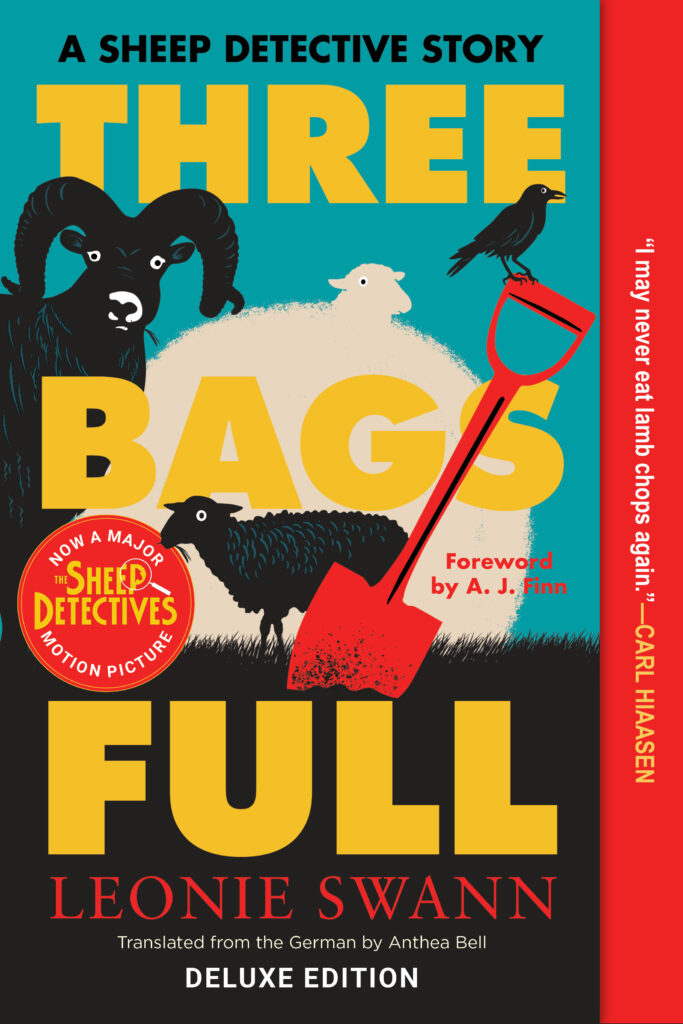
Three Bags Full, by Leonie Swann

A flock of sheep gather around their shepherd who is lying on the ground with a spade stuck in his body. They’ve never seen anything like this in their meadow near the Irish village of Glennkill. They’re very fond of George and worry about what will happen to them now. Who will read books to them and explain the difficult words? So they decide to find his killer.

I wasn’t sure what to expect from this unusual story but found it not only clever but remarkably consistent in the way the ovine protagonists are presented. They know only what a sheep might be expected to know, at least one with a shepherd like George. For example, they think the priest Father Will is named God because of the way he talks about himself.

They can’t interview suspects, since they can’t talk to people directly, so they must watch and listen and make inferences from what they gather. “You shouldn’t believe what you don’t understand. You should understand what you believe.”

Sometimes this can cause confusion, such as when they misinterpret what’s happening, but I found that just another layer of the puzzle. Mostly their opinions of the humans around them are both simple and profound. “Maple thought optimistically that human beings, on their good days, weren’t much dimmer than sheep. Or at least, not much dimmer than dim sheep.”

I also liked that the pacing is a little slow in the beginning. The story takes its time to settle in and let us get to know the various sheep and humans. I loved how the flock continues to follow George’s routine after his death and their sense of what makes for a good life.

The plot itself is satisfyingly twisty, but the real joy is in the characters. We joke about sheep being followers, but each of these remarkable animals has a strongly individual personality. My favorites include Miss Maple, who is said to be the smartest sheep in Glennkill, and Mopple the Whale, who provides comic relief and surprising support; his hunger is as reliable as his memory. And the ram Othello, who knows the most about the outside world because he was once confined in the Dublin Zoo; he knows what it is to be alone.

Reading and books are a slight thread through the book. After all, much that the sheep have learned about the world and about humans comes from the books that George has read to them. “Cordelia was thinking how human beings can invent words, how they can line up their invented words side by side on paper. It was magic.”

A movie based on the book is due to come out in May 2026, but I recommend reading the book first to experience the wit and charm of the story told entirely through the sheep’s point of view.

What is the most unusual mystery you’ve read?

Until It’s Over, by Dorothy Van Soest

When retired social worker Sylvia Jensen refuses to be silenced by a politician with dark secrets, her investigation takes her deep into the past, to the secret springs of guilt, regret, fear and trauma. The story opens with a protest in the state capitol rotunda against a mining company’s plan to open a uranium mine on Indian land.

Readers of Van Soest’s earlier three novels featuring Sylvia know her courage and willingness to fight for her clients’ rights and well-being, as well as for the betterment of all. Now in her eighties, Sylvia attends the protest with her young journalist friend J.B. to support Peter Minter, the frail Ojibwe elder who had been arrested at the mining company’s office.

Peter immediately turns the microphone over to the leading candidate for the Senate, Anthony Jordane, a White man who smoothly promises to protect Indian rights. Then Sylvia, who’s been growing increasingly agitated, lunges toward Jordane screaming that he is a liar before collapsing to the ground unconscious.

This is J.B.’s story as much as it is Sylvia’s. A victim of the U.S.’s unjust and inhumane policies towards the Native Americans whose land they stole, J.B. was forcibly removed from his family as a baby and given to a middle-class White family. Then at age seven he was again forcibly removed from the only family he remembered and returned to his birth family. Eventually he ran away and took refuge with his foster grandparents.

Now he is an investigative journalist with the New York Times who has worked with Sylvia before on some of her cases and also knew her as a social worker who actually cared about what was best for him. However, his unresolved issues about his past, his ethnicity, and his identity make it hard for him to decide the right course of action while Sylvia is sidelined in the hospital.

Per his training, he must first investigate the truth of Sylvia’s claims about Jordane, which means going to the small rural town where she and Jordane grew up and attended high school together. There he must pry open the lid of silence the townspeople have slammed down over the events of that fateful year, the one that made Sylvia leave town swearing never to return.

What I admired most in the story is the subtle way Van Soest weaves the theme of silence versus speaking truth to power through the actions each of the major and minor characters. Sylvia and J.B’s stories were especially moving as the main characters, but I also found myself caring deeply about the minor characters.

This exciting tale, full of compassion and psychological insight, gives voice to the victims of injustice. It speaks to today’s headlines and reminded me of The Great Gatsby where Fitzgerald characterizes the Buchanans as “careless people.” That is of course what we’re seeing today, so I’m grateful to Van Soest for demonstrating how we all, including writers and artists, can resist injustice.

What stories of resistance have inspired you?

Disclosure of Material Connection: I received a copy of this book free from the author. I was not required to write a positive review. The opinions I have expressed are my own.
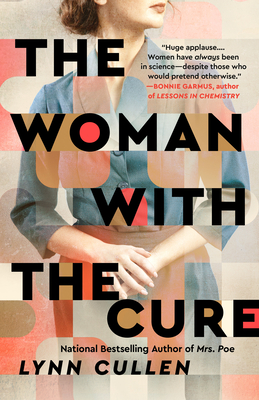
The Woman with the Cure, by Lynn Cullen

Meet Dr. Dorothy Horstmann who worked tirelessly and in the face of persistent gender discrimination to stop the polio pandemic. Now mostly forgotten, polio epidemics between 1948 and 1955 paralyzed or killed hundreds of thousands of people, mostly children, around the world. President Franklin Roosevelt is the patient with whom most people are familiar.


Cullen brings this time period to life with searing portraits of wards filled with children in iron lungs and scientists competing against each other to be the first to find a cure. Dorothy doesn’t care about fame; fighting polio is her only concern. She freely shares what she learns with the two leading competitors—Jonas Salk and Albert Sabin—as well as with others working to end the scourge.


I love that biographers and historical fiction writers are bringing to light women whose essential contributions have been downplayed and forgotten while only the “great men” are credited and remembered. It’s worth noting that polio research was one of the first uses of HeLa cells which I first learned about in Rebecca Skloot’s The Immortal Life of Henrietta Lacks. How much we owe to Ms. Lacks! Check out the book if you’re ever looking for an example of how one person can—even unwittingly—change the world.


Rejected for a residency because of her gender, Dorothy applies again as D. M. Horstmann and is accepted. The first to suspect that polio travels from the gut to the blood, she is refused support needed to investigate and conduct trials. She finally gets funding years later after a male scientist proposes the same thing; meanwhile thousands of children continued to be paralyzed or died each year. Nominated for a Nobel Prize for her work, she is passed over for two men.


With no time for bitterness, Dorothy pushes forward. The first woman to become a full professor at the Yale School of Medicine, she travels around the world to participate in polio conferences and to study polio outbreaks, thus contributing valuable data. She is also instrumental in the Russian study that validated Albert Sabin’s successful polio vaccine, enabling it to be approved.


Cullen takes us behind the scenes as scientists race the clock and each other. I felt Dorothy’s despair at setbacks and her thrills at successes. The delays caused by infighting I found frustrating, thinking of the children around the world left to suffer while male scientists kept their secrets. One of the holdups was danger of human trials with children.


We learn that the first round of Salk’s initial vaccine (which was greeted with cheers of relief) left 164 people paralyzed and 10 dead, due to one of the suppliers cutting corners, so that their vaccines actually gave people polio. The resulting distrust of vaccines lingers to this day.


I’m old enough to remember those awful years, with terrified parents keeping children apart and swimming pools closed. Some of the children in my school stumped around in their leg braces, while other children never got to attend because schools couldn’t accommodate wheelchairs.


I vividly remember the day at school when we lined up to get our first sugar cube with the vaccine and my mother crying. Since then I’ve been a confirmed advocate of vaccinations and nothing that drug-addled creep currently in charge of the U.S. Department of Health and Human Services—who has made millions of dollars off of anti-vax activities—can say will convince me otherwise.


For me, the most moving scene in the book occurs in Detroit, Michigan in 1953 when Dorothy tours the Henry Ford Hospital’s polio unit with its rows of “groaning and wheezing iron lungs out from which heads stuck.” Dorothy herself had tried out one of them early on so that she’d better understand her patients and had immediately panicked.


On the tour, Dorothy is distracted by a little girl in a wheelchair. “With her physician’s eye, she noted that the muscles of both the child’s legs had atrophied from the hips down and were thus likely to remain permanently paralyzed.” The child is playing a board game with a grown woman in an iron lung, Mrs. Konkle, who cheerfully announces that all the children beat her at the game, even her own children when they come to visit.


The game is Candy Land which we played incessantly when I was little. I never knew that it was invented by a schoolteacher in California while she was in the hospital with polio. Mrs. Konkle had her husband buy it and spent her days cheering up the children in the ward with her by letting them win. Such courage!


Occasionally the ins and outs of such a complex, multifaceted effort became a bit tedious, and perhaps some of the side stories could have been eliminated, but it is worth pushing through to get the full story of the dedication and sacrifice, not only Dorothy’s but that of others as well, which finally brought about a cure. Of course, Dorothy—the daughter of immigrants by the way—didn’t stop there but went on to work on the rubella vaccine still used today to protect children.


Did you ever play Candy Land? Were you aware of its history?