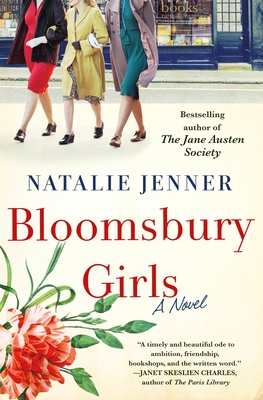
Bloomsbury Girls, by Natalie Jenner

In 1950s London, Bloomsbury Books is a relic of an earlier age. Offering new and rare books, the store has resisted change for a hundred years, and its stodgy general manager, Herbert Dutton, with his 51 unbreakable rules is determined to keep it that way. However, the three women who work there have other ideas.

Vivien staffs the Fiction department and loathes her one-time lover Alec who heads the department. She wants to introduce more female authors while Alec refuses all but the usual classics like Jane Austen and George Eliot. Ambitious and clever, Vivien provides much of the humor in the book. I especially love the way she comes up with witty and daring names for the people and places in the bookshop, like the Tyrant and the Via Dolorosa.

As Mr. Dutton’s secretary, Grace is the unacknowledged angel of the house. She helps Mr. Dutton manage his workload and tries to keep things on an even keel. She’s an anomaly for the time: a wife and mother who decided to take a job to avoid her abusive, unemployed husband. She cannot leave him because she doesn’t make enough to support herself and the children and fears she’d lose custody of them.  

Despite a brilliant career in Cambridge, a member of the first class of women awarded degrees by the university, Evie’s academic plans are crushed when she is passed over for a less accomplished man who takes credit for her work. At the bookstore she is in charge of cataloging the jumbled collection of rare books on the top floor, but she has an ulterior motive for working at Bloomsbury Books.

All tea-making is done by the three women, in obedience to Rule No. 17: ‘Tea shall be served promptly four times a day.’ Each of the four departments is run by a man, and they, of course, cannot be expected to make their own tea. The exception is Ash, head of the Science Department, who makes his own chai. As an immigrant from India, Ash’s presence brings portents of change and adds another dimension of discrimination.

I selected this story when looking for a light but engaging audiobook for a trip. Not only does it check those boxes, but it also features a few of my favorite things: a bookstore, London, one of my favorite actors as narrator—Juliet Stevenson—and the post-WWII time period. It also offers something I look for and rarely find: people, especially women, functioning in the workplace. Yes, raising children and running a household is work, and there are many stories about that, but little is written about the rewards and difficulties of working in an office (literal or figurative).

Jenner’s story abounds with the kind of rivalries and shifting alliances, the kindnesses and restrictions recognisable to anyone who has worked in an office. They keep the plot roiling and force the characters to show what they are made of. Other characters come and go, including real people of the time, such as Peggy Guggenheim, Daphne du Maurier, and Samuel Beckett.

Of course I hate the use of “girls” in the title applied to women, but it is true to the time period. I was a child then, but I see my parents in these characters. Many of those who survived the worldwide depression and WWII treasured security and stability, like Mr. Dutton and his 51 rules. And after the war many women like my mother had to give up jobs they found rewarding and confine their ambitions to home and family. Thus, I found Grace’s journey and her impulsive decision to work at the bookstore particularly touching.

If you’re looking for a cosy read with a bit of a bite, check this one out. You don’t need to have read Jenner’s previous book The Jane Austen Society which includes some of these characters. In writing this book, she was inspired by rereading 84, Charing Cross Road. She describes Bloomsbury Girls as “Mad Men meets You’ve Got Mail” which is pretty accurate. Of note, Jenner once owned an independent bookshop in Oakville, Ontario, where she lives now.

Can you recommend a story set in a bookshop?
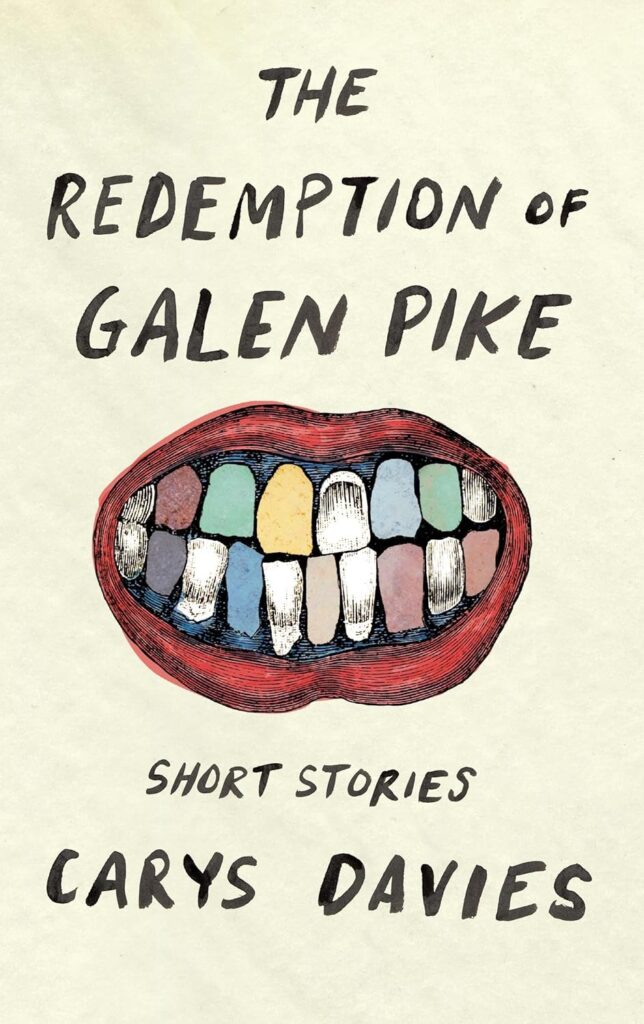
The Redemption of Galen Pike, by Carys Davies

After enjoying her novel Clear, I picked up Davies’s second short story collection. Each of the 17 stories here, most of them very short indeed, is a gem. 

We writers are told to write what we know. The stories here range through time and space: a woman isolated in the outback reluctantly entertaining her rough neighbor, an alderman in a small English town hosting a “bored and miserable and alone” Queen Victoria, a Caribbean immigrant working as a nursemaid in New York.

It may seem risky for a woman from Wales to write stories set in such wildly varied locales—others include Siberia, Africa and Oklahoma—but she pulls it off. Davies brings such a deep knowledge of people and emotions that our shared humanity shines through each story, however distant the place or unusual the plot.

Everything about her made Lenny think of a string pulled tight and about to be plucked, a figure balanced on the crumbling lip of a cliff and ready to jump; a brief electric calm before a storm.

Many of the stories convey a vulnerability or loneliness and consequent attempts to connect, all without naming those emotions but instead building them organically. Evangelina, whose husband disappeared more than a year earlier, is:

. . . the only person who didn’t believe that the emptiness out in the bay, the mist, and the water creeping soundlessly back and forth beneath the moon, in and out over the sands, were the silence of a man who was doing his best to disappear.

Sometimes I shy away from short stories because it can take me a little while to get into a book, and that seems like a lot of effort to go through for something that will soon be over. Not a problem here! I was instantly transported into each story and satisfied when it ended no matter how many or few pages later.

Davies often starts a story with some statement that gives us a person and at the same time raises a question (or three). Here are a few examples:

“His name was Henry Fowler and she hated it when he came.”

“Standing at her shoulder, no longer caring much about his future, Arthur Pruitt began to speak.”

“From the moment I arrived, they loved me.”


These deceptively simple sentences unsettle us because they assume that we know what’s going on; there are no long explanations, no backstory. And they hook us because we want to know more.

Once you’re in the story, what makes it so stunning is the deft way she uses the turn—what Steven James calls the pivot and poets call the volta. In a moment the story changes, and you see everything that came before differently. And that change is both unexpected and inevitable; looking back you can see the little details she has planted along the way, and the assumptions that led you astray.

Sometimes a turn comes  through a change in point of view. Sometimes it’s a reveal of some new information, or an event that calls up a memory shedding new light on what’s happening. It’s less a plot twist than an addition of something that makes everything slide into place—and not the place you expected.

Sadly, the front cover is the ugliest one I’ve ever seen. The back cover is better and says the stories are ”written with prickly wit and punch.” True, and the punch comes from the turn. Some stories have cascading turns where your understanding of what’s happening flips not once, but two, three or more times. Brilliant!

Davies’s use of long sentences, sometimes without commas or other punctuation, captures the swiftness of thought. 

I kept looking at Annie. I knew what she was thinking because I was thinking it too—that we could both of us let go of his hands and feet and leave him there till the tide turned and let him ride back out on it like a Viking and be dragged down by the current; the sea would take him and Bella would never know.

Short stories are notoriously difficult to write. The author has very little real estate in which to place the reader in time and space, introduce characters, and play out a plot. I’m so impressed by the variety and dexterity of Davies’s stories. I’ll be studying them for a long time.

What’s your favorite short story?

North Woods, by Daniel Mason

Daniel Mason’s fifth novel is a shimmering tale of a patch of New England woods and those who pass through it over four centuries. We feel the flow of history as we navigate what is essentially a set of twelve stories keyed to the seasons. They are linked and validated by documents, such as song lyrics, pictures, and almanacs.

Mason brings each story to life with sensitive comprehension of both the people and their place. We begin with a pair of young lovers running away from their Puritan colony.

They had come to the spot in the freshness of June, chased from the village by its people, threading deer path through the forest, the valleys, the fern groves, and the quaking bogs . . . Gone was England, gone the Colony.

What fascinates me is the way Mason writes each section using style, language and social constructs appropriate to its time period. For example, there’s a former British soldier planting an apple orchard during the time of John Chapman, aka Johnny Appleseed, and a spiritualist during the time of the Third Great Awakening. There are murder ballads in the 19th century and psychiatric case notes during the early years of using lobotomies to solve neurological disfunction. What a challenge to set yourself as a writer!

The descriptions of the natural world are stunning as well. Mason has done his research and writes beautifully of the woods and the creatures—and insects—within it. One of his sources, whose wisdom I see throughout the book, is Tom Wessels, whose fabulous book Reading the Forested Landscape was given to me by my son.

I propose a new calendar: not one autumn but twelve, a hundred. The autumn when the birches are yellow but still have their leaves; when the beeches are green but the birch leaves have fallen; when the oaks tint to the color of ripe apricots and the beeches yellow; when the oaks turn a cigar brown and the beeches curl up into crispy copper rolls. And so on: I’ve missed a few. But to call it all just “autumn”!

 As in Jenny Erpenbeck’s novel Visitation, which is centered on a plot of land in Brandenburg and the houses built there, we see a yellow house built, damaged, added to, redecorated, and reconstructed while different inhabitants move through it. As Clara MacGauffin wrote in “The Unhomely House,” there is a peculiar tension when it is the home that is unsafe. “The disturbance is not simply fear. It is closer to a conflict in perception where what should reassure instead unsettles.”

My book club jumped at the chance to read this book; we’re fans of Daniel Mason’s novels such as A Winter Soldier and A Registry of My Passage upon the Earth. However, some thought this book depressing—in the course of four hundred years, every story ends; everyone dies—while others found a lot of it hilarious. There are ghosts here; former inhabitants who sometimes make themselves known, reminding me of Gabrielle Mullarkey’s novel The Ones Who Never Left which she wrote because she wondered if the people who used to live in our houses ever truly leave, an unsettling thought indeed.

Amused by the writerly games and deeply appreciative of the landscape and its history, I did get to a point when I thought the book might be a bit too much. I was overwhelmed by grief at the loss of the birds and the forests, the elm trees and chestnuts.

Then I was reminded of Octavia Butler’s Parable of the Sower thanks to Mason’s story of a post-doctoral fellow studying spring ephemerals, those lovely flowers I’ve tracked in that sliver of time between the coming of the spring sunlight and the canopy blocking it out. “Sometimes, overwhelmed, she retreats into the forests of the past . . . and she has found that the only way to understand the world as something other than a tale of loss is to see it as a tale of change.”

Cold comfort, but I’ll take it.

Have you read a book that has comforted you during this dark time in our history and/or has you thinking about what we leave behind during our brief passage on this earth?


We Begin at the End, by Chris Whitaker

Overwhelmed as we are just now by atrocities and deaths, this novel invites us to take a moment to look at a single death and how it still affects a small town thirty years later. Walk, short for his surname Walker, is the chief of the two-person police force in Cape Haven, California. He’s a cautious, introspective man, still haunted by having testified against his best friend Vincent all those years ago. Now that Vincent is being released from prison, Walk nurtures a dream of restoring their idyllic past.

The other narrator is thirteen-year-old Duchess Day Radley, a self-proclaimed “outlaw” and fierce protector of her little brother Robin and her mother Star, who happens to be Sissy’s older sister. Duchess knows there are plenty of humiliating rumors about her family circulating in the small town, not just about the crime, but also about Star’s addiction and her job waiting tables and singing at a dive bar. Star usually has to bring the children with her and leave them in a booth where Duchess keeps an eye on the men who get loud and handsy after a few drinks and on the bar’s huge and dangerous owner Dickie Darke who might be Star’s protector or her abuser.

A sense of precarity underlies everything in Cape Haven. Houses are falling into the sea. People get beaten or killed. One misunderstanding and everything changes. Even the cadence of the sentences is unsettling at first. The characters struggle keep to keep their footing in an uncertain world. Because Star is a good friend from the old days, Walk watches out for her and the children, but Duchess doesn’t trust him. She doesn’t trust anyone but herself.

Whitaker’s portrait of Duchess is brilliant. She’s not sassy or precocious. She’s angry and smart and fierce and loyal. I knew many thirteen-year-olds when I was teaching in Baltimore’s public schools, and I recognise Duchess. She’s the real thing. So is Walk: someone who is always looking back at the past, someone who wants to do the right thing but isn’t always sure what that is.

While categorised as a thriller, this novel is more a quiet study of grief and danger and pain and tenderness. It unfolds the way real life does, tumultuous at times certainly, but not always. It asks how to go on after the worst happens, how to live with grief, and how to measure what we owe each other.

This book surprised me. Everything about it is so much better than I expected. I kept thinking it couldn’t get better and then it did. Whitaker manages to summon strong emotions without overwriting. He deploys plot pivots that surprised me in the best of ways: by seeming perfect in retrospect. Same with the characters. There is a moral arc here, but not the one I expected. There are no easy answers for these damaged people, for us, or for our damaged world.


Can you recommend a novel that surprised you?

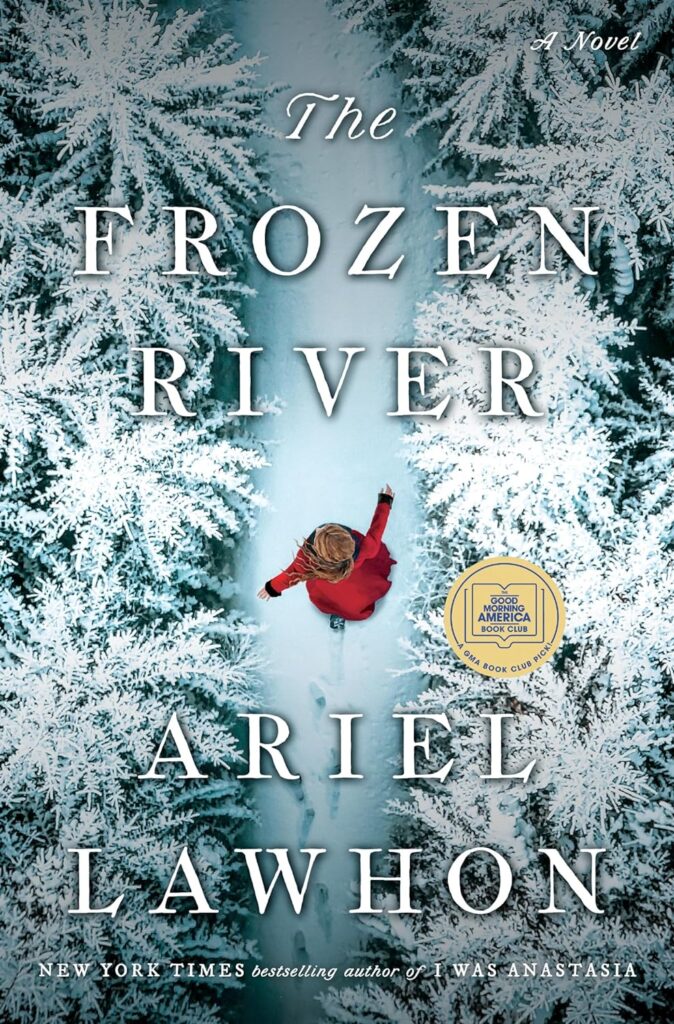
The Frozen River, by Ariel Lawhon

The blizzards that have been pummeling New England recently might hold us up for a while until the plows come through. They might send us scrambling for generators and firewood while waiting for the power to be restored, or putting on snowshoes to go out and assess the damage from fallen trees.

But what if we were in Maine in 1789 when the Kennebec River freezes and stalls activity in our small community? What if the river freezes early and traps a man’s body? Midwife Martha Ballard learns that two men fell through the ice that dark night: Sam Dawin who escaped and Joshua Burgess who didn’t. 

Called to examine the body Martha determines that Burgess was beaten and hanged before being thrown into the river. She’s interrupted by Dr. Page, a recent Harvard graduate and newcomer to town, who calls her an amateur and declares the death an accidental drowning. She later learns that her son Cyrus fought with Burgess shortly before the man’s death. Burgess and Judge North have been accused of raping a local woman, one of many secrets swirling in the village.

We follow Martha’s investigation through her activities as well as through the journal she keeps to record her work as a midwife and community events. Her story is “inspired” by the real Martha Ballard who lived in Hallowell, Maine, delivered over 800 babies, and left a diary covering 30 years of her life. While the author draws on the diary, a nonfiction biography of Ballard, and court transcripts, this story is firmly categorised as historical fiction.

I liked the use of the journal. Even when fictionalised, documents add veracity to a story. Although they sometimes repeated events already dramatised, these sections brought home the physical labor of using ink and quill. I also liked the use of a flashback at the end of each section to fill in information about Martha and her beloved husband Ephraim. These brief forays into the past come just when the information is needed.

The overriding image of the river is powerful; everyone depends on it and is controlled by it. The patriarchal limits on women are powerful as well. Martha’s work makes her an anomaly at a time when women had almost no power and rarely worked in a profession. A woman could not testify in court without her husband accompanying her. Midwives were being supplanted by male doctors who often lacked rudimentary knowledge of sanitation and dismissed women with complaints as lazy or crazy.

Being already well aware of these conditions for women in the 18th century, I found their frequent and unsubtle deployment made the story drag, as did the pace of events now and then. At the same time, I recognise that the slower pace is appropriate to life at the time, when it might take days or weeks to travel between towns, and that there are many readers who might not know about the limitations women suffered then. Similarly, the bullies and corrupt locals seemed exaggerated until I looked around at what is going on here today.

Without giving the ending away, I will say that I appreciated the story’s unusual path to resolution. I also appreciated how the Martha of this story adapts her strategies as needed during the investigation, sometimes backing down, sometimes attacking, sometimes negotiating.

The story also made me think about the body. Not just the dead man, the necessary start to a murder mystery, but also how we inhabit our bodies, whether it’s pushing a quill pen across rough paper or delivering a baby into the world, making love with a husband of 35 years or trying to move quickly through deep snow, riding a horse or dealing with the effects of rape.

Things have changed in the centuries since this story takes place, but not human nature, its insecurity and greedy grasp for power on the one hand and its generous care for everyone in the community on the other. And no matter how much we may think we’ve controlled the natural world since then, it only takes a blizzard to remind us how wrong we are.

What is frozen in your life? What will it take to unfreeze it?