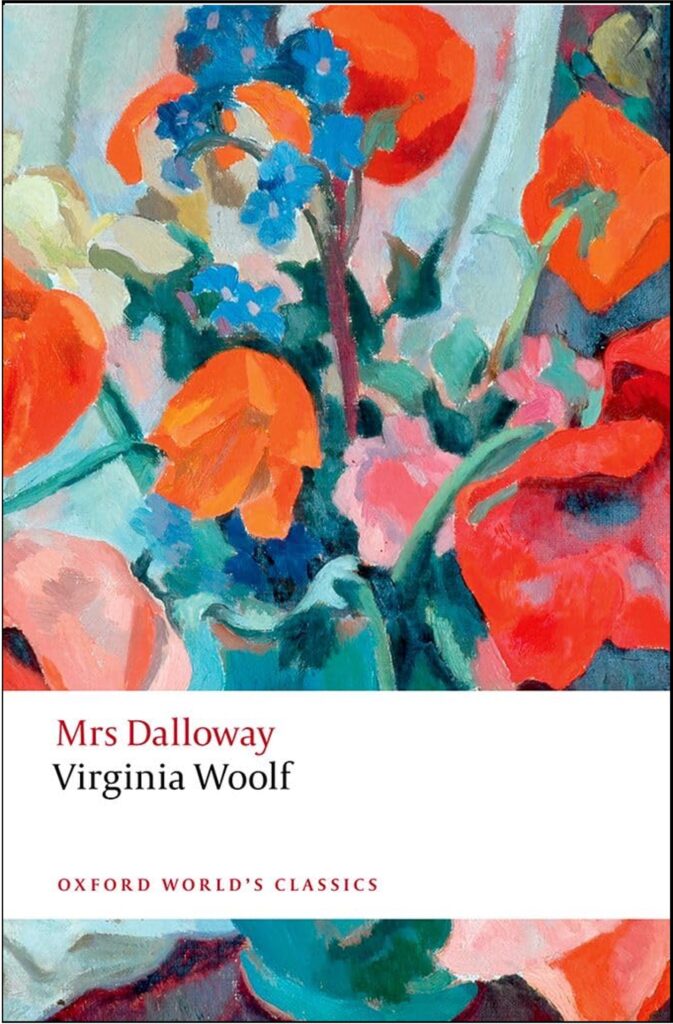
Mrs. Dalloway, by Virginia Woolf

Reading this classic novel now, more than fifty years since I first encountered it as an undergrad, is quite a different experience. Back then I was confused and thrilled by Woolf’s modernist, experimental style that expanded forever my idea of what a novel could be.

Now I see it as a story of midlife, in several senses of the word. The story unfolds as a day in the lives of a handful of people in London going about their ordinary business, and we get thrown right into the middle of things. Clarissa Dalloway is preparing to give a party. Newly returned from India, Peter Walsh sets out to recapture the past by exploring London and visiting Clarissa, his first love. Richard Dalloway is off to lunch with old friend Hugh Whitbread at Lady Bruton’s. Septimus Smith, a damaged veteran of the Great War, and his wife Rezia are walking through the park, on their way to an appointment with a doctor.

Since Clarissa, Peter and others are in their early fifties, we have another sense of midlife. It’s a time of life when we look back nostalgically, but also when we measure ourselves—and others—assessing how we have changed with age, and calculating what we have made of our years. Have we measured up to our early promise?

Time comes up frequently, not just in the characters’ reflections on how they and each other have aged, their memories of the past, and the bustling busy lives of their present; but also in the more linear sense of the clocks sounding the hours of the day. Time in this novel is both infinite and finite.

Another sense of midlife underpins the story: the Bible’s “Media vita in morte sumus”—“In the midst of life we are in death.” Death comes up frequently, whether it’s Septimus thinking of suicide or Clarissa hearing old Mrs Hilbery at the party say “how it is certain we must die.” Clarissa herself has recently been ill which has turned her hair white and left a concern still about her heart.

In my youth the book’s theme that struck me most strongly centered on solitude versus society. Plunging into this novel, we have opportunities to see most of the characters alone—really see them; right into their jumbled, chaotic thoughts, sublime ideas, and snarky digs. We see Peter like his namesake in Kensington Gardens never having fully grown up, and Clarissa awash in memories of a golden childhood and gloriously loving her present life—until she’s brought low by self-doubt or sensing criticism from others.

We also see them with others, whether through intimate conversations or Clarissa’s crowded party. In some instances simply exchanging a look with someone else—a young woman in the park or an elderly woman in a window across the street—becomes a vital communication.

Clarissa believes that her strength is that she knows what other people are feeling. In fact, all the characters think they do, but they are mistaken. Richard is certain that Clarissa will know he loves her without his saying so. Peter thinks he and Clarissa read each other’s minds. The worst offenders are the two doctors to whom Septimus goes for treatment; they burst with confidence that they know what is wrong with him, but their pompous, one-size-fits-all solutions are worse than useless.

There’s a reason why so many books and essays and dissertations have been written about this novel. It is so rich—so full of life. You can look at it through the lens of class or gender; you can hold it up to Woolf’s own life; or consider the fragility of a world that is on the cusp of change—the book came out in 1925, so this year is its centennial.

For me in this reading it is the sense of time that demands my attention. Like these characters I strain to reckon the long years behind me: the golden times that I weave into stories for my grandchildren and the bitter griefs and regrets that I keep to myself. I consider what I will do with the few years that remain, knowing how much I value being alone and how much I enjoy being with others.

We are all born and we all die. That is what we have in common. What comes in between is our own unique story. By slicing one day out of the lives of this small group of people, Woolf gives us a glimpse of the extraordinary richness of the lives humming all around us.

If you’ve read Mrs. Dalloway, what did you think about it? If you’ve reread it, did your opinion change?

Note: My thanks to Tash for her discussion of the novel on her Woolfish! Substack and to all the commenters there as well for expanding my understanding of the novel.
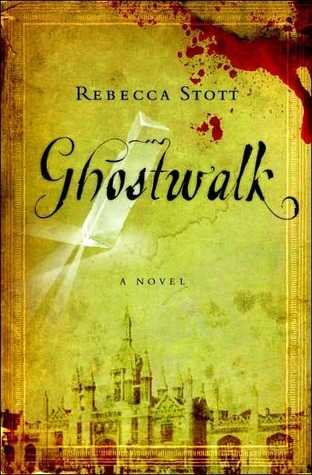
Ghostwalk, by Rebecca Stott

I’ve been on a bit of a Cambridge streak in my reading lately, so here we are again. Stott’s debut novel opens like a mystery: Cambridge historian Elizabeth Vogelsang, whose potentially controversial book on Isaac Newton’s use of alchemy is nearly finished, is found drowned in a river at the end of her garden, clutching a prism. Lydia Brooke, one of her former students, is urged by Elizabeth’s son Cameron to finish the book.

One difficulty is that she has her own work to do. Another is that Cameron is her former lover whom she’s not sure she can resist. However, she does move into Elizabeth’s home, where she feels her mentor around her and where the light—and her computer—begin to play tricks on her.

Most of the book is told in the first person as though it were a letter from Lydia to Cameron, though some chapters of the manuscript are inserted. That manuscript, which is apparently only missing the last chapter, explores Newton’s rise to fame, a series of unsolved seventeenth-century murders, and if there might be a connection between them. Lydia begins to feel that intrigues and conspiracies from Newton’s past are creeping into the present.

Even as Lydia is trying to work out whether her mentor committed suicide or was murdered, Cameron is being menaced by an animal rights group over his work as a neuroscientist that involves experiments on animals. There’s also a fortune teller whom Elizabeth had apparently befriended—perhaps my favorite character—and an odd young woman named Will who seems to have some knowledge of the various forces threatening Cameron and Lydia.

The breadth of Stott’s research is stunning. We learn a lot about Newton’s life and work. She brings the seventeenth century to life, especially in the manuscript chapters. There’s a lot interesting information from that time period about glassmaking, the plague, optics, and of course alchemy.

This is such an intelligent book. And the dark yet lyrical atmosphere is perfect for an October read. However, I struggled to finish it. Much as I loved individual elements, the story as a whole felt murky. The parallel plots of the past and the present never quite came together, perhaps because the seventeenth-century conspiracies fascinated me while those in the present-day seemed irrelevant.

I’m also not a big fan of second-person point of view. Since she’s writing to him, Lydia refers to Cameron as “you,” which is fine occasionally. However, when she’s recounting dialogue, telling him what he’s said, she must use “you said” as the dialogue tag. This throws me out of the story because of course he knows what he’s said, but Stott is forced by her point of view choice into these clumsy conversations.

Still, there’s much to admire here. I learned a lot about Isaac Newton and alchemy. I reveled in gloomy back stairs in Cambridge colleges and a sun-filled studio set in an orchard. And I’m always curious about the ways the past bleeds into the present. Here’s an excerpt from the first chapter:

Lily went to prison because the seventeenth century was missing from her court records, from her story. Her time line needed to be longer, much longer, and there were many sidelines and tracks, twistings and turnings and yes, it was a labyrinth, a skein of silk that began to weave itself in 1665, 339 years ago.

I’ve been thinking about labyrinths this summer. Ariadne giving Theseus the thread so that he could find his way back out of the labyrinth, away from the black void of the flesh–eating Minotaur. Unravellings have to start somewhere. Now that I see, for the first time, how connected everything is, I know that the threads between Isaac Newton and us were all attached, like the ground elder under Kit’s soil.

Most of all, I admire Stott’s ambition. Ghostwalk is an enormously complicated story, thoroughly researched and well written. Most of all, it is intelligent and exercises our own little grey cells.

What do you look for in historical fiction? 

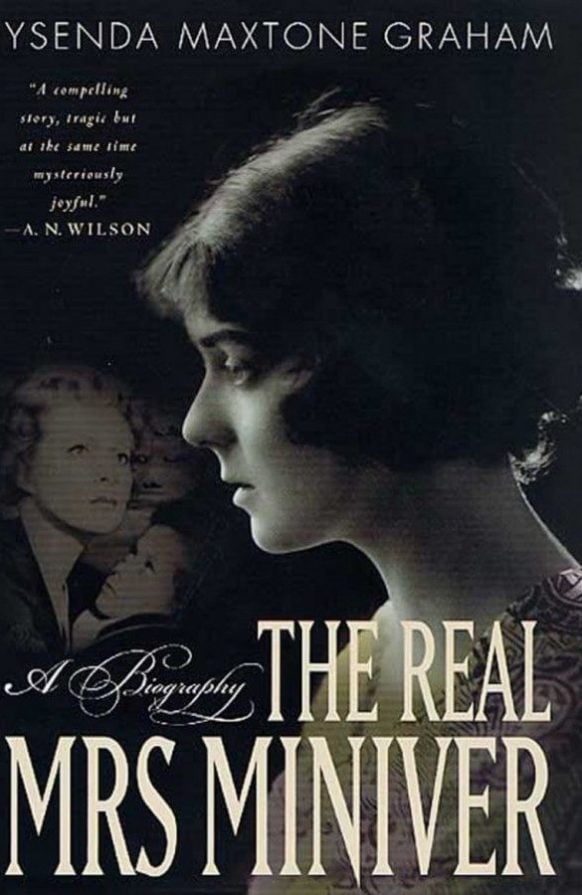
The Real Mrs. Miniver, by Ysenda Maxtone Graham

The Real Mrs. Miniver, by Ysenda Maxtone Graham

We’ve seen the movie, of course, and thought it a sentimental film about a woman who is practically perfect in every way keeping her family together and holding the home front together during the Blitz—the bombing of London during WWII. The book the film is based on, a collection of columns from the London Times, was something else altogether: an idealised portrait of an ordinary upper middle class woman’s life in pre-WWII England.

Those columns were written by Joyce Maxtone Graham (née Anstruther) using the name Jan Struther, and she modeled the family on her own husband and three children. However, as we learn from this biography by her granddaughter, the loving Miniver family was a far cry from Joyce’s own. Her marriage to Tony Maxtone Graham, initially fun-loving and amusing, had dried up as he’d been taken hostage by golf, leaving Joyce to her articles and poems many of which were published in Punch among other periodicals.

Joyce had been a tomboy as a child, loathing the ceremonial tea parties and dance lessons, preferring to run and shoot with the boys. She and Tony initially shared a comic view of the world. I loved the way they shared the silly things they noticed during their days: pebbles, as she called them, like children turning out their pockets at the end of the day. As they drew further apart, Joyce fell deeply in love with Dolf Placzek, a penniless Jewish refugee from Austria gifted with intelligence and a strong appreciation for the arts.

The Mrs. Miniver columns depict a happy, loving marriage that was a far cry from what Joyce’s had become. Yet for many, those columns embodied an England that was being destroyed by the war and a reminder of what they were fighting for. Mrs. Miniver’s upper middle class life was comfortable, with a London house and a weekend cottage in Kent, a son at Eton, and servants to do the chores. The columns contain the small things she notices during the day, some pleasurable, some not—like the pebbles she and Tony used to exchange. While Mrs. Miniver could be critical of her social circle, she was alive to its charms.

Joyce—now Jan all the time—was shocked by the surprising success of the book and the reading tours and talks that followed. She came to be haunted by Mrs. Miniver. Many fans assumed they were the same person. She struggled to finding a firm place to stand.

Of all emotions, she perhaps felt the emotion of missing most acutely. At a party, she missed solitude. Abroad, she missed home. Cut off from her children, she longed to be with them again. When she was, she longed again for solitude. The raggle-tangle gypsy in her head beckoned her to escape.

Why read biographies? In my twenties I read lots of biographies of women writers and artists, looking for inspiration during a time when women were second-class citizens when it came to the arts. I was also looking for ideas for how to write while wrangling two babies and an ex who refused to contribute. Just keeping the heat on and some kind of food on the table was a miracle. Forget about finishing a story and sending it out.

These days I still look for inspiration from brave women and men as I struggle with how to live a moral life in an increasingly compromised and chaotic world. I’m especially drawn to women living during dark times. I’m also interested in the wide range of life choices people make. One thing that is so fascinating in this book is the contrast between the life of Mrs. Miniver—a model for womanhood at the time—and that of the woman who created her.


Sometimes with a biography, it is enough to see myself in a reckless tomboy unwilling to knuckle under to social norms or an almost accidental writer. Now if only I can catch the zeitgeist the way Jan Struthers did! Perhaps it’s better I don’t. Her story is yet another cautionary tale of how too much success and celebrity can wreck a person.

It’s been difficult lately to find books that hold my interest. My reading record is full of DNFs. This one, though, fascinated me and kept my attention right through to the end. Jan reinvented herself several times over, which I find wonderful. And she changed the course of history, inadvertently perhaps and not alone, but for sure. What kind of world would we be living in today if the U.S. had refused to join the Allies fighting Hitler and Mussolini in Europe and Africa?

I take courage from her story and the stories she wrote about the ordinary people of Britain as we fight today’s fascism.

Have you read a biography that inspired you?

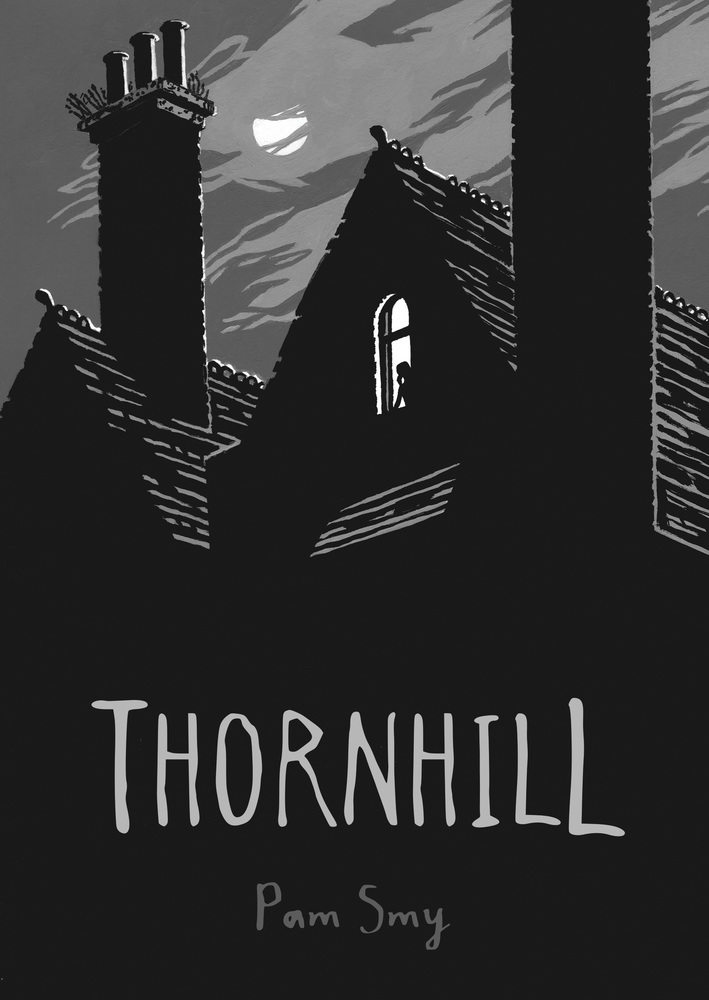
Thornhill, by Pam Smy

This unusual Young Adult (YA) novel is perfect end-of-October reading: stark, a little sad and a lot spooky. Part graphic novel and part journal, it’s a stunning portrayal of what many people experience, especially those on the tender, unpredictable cusp of adolescence.

Lonely Ella has just moved to town, her modern-day story told in striking black-and-white graphics, the only words being those occasionally written on items in the scene. We see an upstairs room, packing boxes, a window—and through that window a strange gothic ruin of a house buried in an overgrown garden.

The Thornhill Institute for Children, a boarding school for abandoned and orphaned children, closed in 1982. Mary is one of the last to leave, and it is her journal that runs parallel to the silent pictures depicting Ella’s life. Mary writes of terrible goings-on at Thornhill, especially the bullying directed at her. She takes refuge in her attic room, locking the door against the nightly bangings of her chief persecutor. There she makes puppets and dolls—creating her own friends—and reading.

Ella’s mother has apparently died, and her busy father seems to have little time for her. Sometimes we see through a crow’s eyes; is it the crow or Ella who first sees a shadow in an attic window of the dilapidated Thornhill? Ella finds a way into the property and begins exploring.

The book made me consider what we see and what we don’t see. The adults at Thornhill don’t see Mary’s suffering, nor does Ella’s father see her loneliness and her grief for the loss of her mother. Mary’s diary reveals her uncertainty about whether to trust what she sees, such as overtures of friendship from her persecutor. It also shows her hiding from view in her room, more and more as the story continues.

We readers see only Mary’s words and the pictures of Ella’s life. I found this distancing  effective because it made me create their stories myself. That happens with the best traditional novels, of course, but I felt newly challenged here. I was reminded of what writer/teacher/agent Donald Maass has said about creating emotion in our stories. Just describing the emotion doesn’t make the reader feel it. Instead, we have to set up a situation that invites the reader to remember feeling that emotion themselves; their own memories then supply the emotional heft.

I certainly found that to be true here. I was flooded with memories of that awkward, in-between time. Mostly I remember glorious days, enchanted moments, etc. but I was reminded that there were some bullying and loneliness; there was the need for a friend.

Another part of my thinking about what we see and how we see it was remembering a show of Andrew Wyeth’s paintings at the National Gallery entitled “Looking Out, Looking In.” His paintings of windows and doors made up the exhibition and sent me down a path considering point of view in a way that had nothing to do with first or third person but everything to do with where we are standing, whether we are inside or outside.

In Thornhill, we have windows and doors, walls and secret gardens, mysteries and ghosts. It’s a quick read, but the story may stay with you a long time.

What are some of your favorite spooky reads for October?